Home Advice Employment types & entitlements
Casual, part time or full time
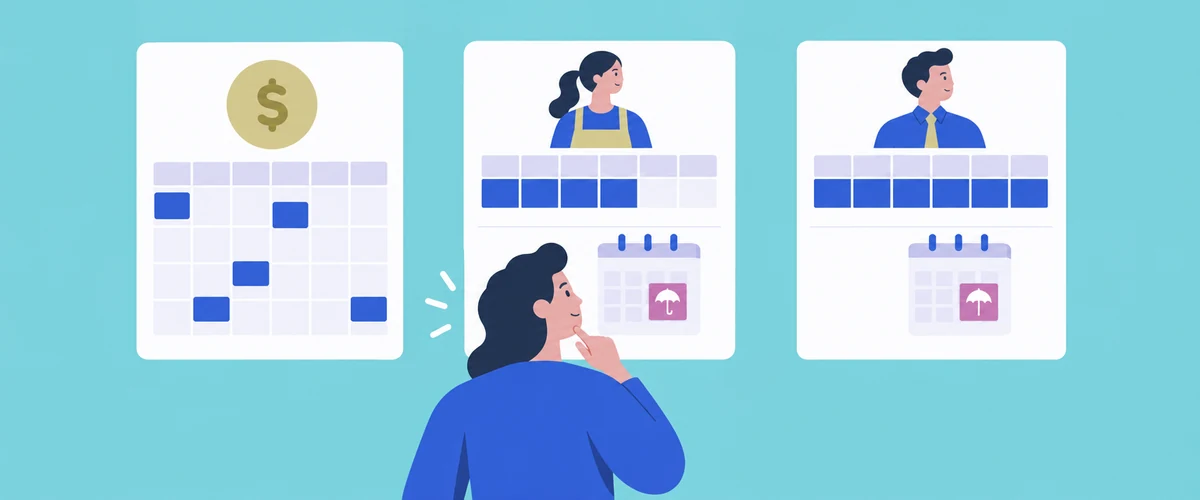
The difference between casual, part-time and full-time work comes down to two separate questions. The first is whether your employer has made a firm commitment to ongoing work. The second is how many hours you work each week.
Full-time and part-time employees both have that commitment, which is why they're often called permanent staff. They get paid leave, notice if the job ends and, after a year, redundancy pay if their role is made redundant. The only real difference between them is hours. Casual employees don't have a firm advance commitment to ongoing work, and they're paid a higher hourly rate, usually through a 25% casual loading, in place of paid leave, notice and redundancy pay. The table below sets out the minimum entitlements side by side. After it, you'll find what each arrangement means day to day, how to weigh the casual loading against paid leave, and what to ask before you accept an offer.
The main differences at a glance
These are the minimums under the National Employment Standards (NES). An award, enterprise agreement or employment contract can give you more, but not less.
| Full time | Part time | Casual | |
|---|---|---|---|
| Firm commitment to ongoing work | Yes | Yes | No |
| Hours | An average of 38 ordinary hours a week | Fewer than 38 hours, usually regular each week | Varies, and can be any number of hours |
| Pay rate | Base rate | Base rate | Base rate plus a casual loading (25% under many awards) or a specific casual rate |
| Annual leave | 4 weeks a year, paid | 4 weeks a year, paid, based on your ordinary hours | None |
| Sick and carer's leave | 10 days a year, paid | 10 days a year pro rata, paid | 2 days unpaid carer's leave per occasion |
| Compassionate leave | 2 days per occasion, paid | 2 days per occasion, paid | 2 days per occasion, unpaid |
| Family and domestic violence leave | 10 days a year, paid | 10 days a year, paid (not pro rata) | 10 days a year, paid |
| Public holiday you don't work | Paid if it falls on a day you normally work | Paid if it falls on a day you normally work | Not paid |
| Notice if your employer ends the job | 1 to 4 weeks, depending on service | 1 to 4 weeks, depending on service | None under the NES |
| Redundancy pay | 4 to 16 weeks after 1 year of service (most small businesses are exempt) | Same as full time | None |
| Request flexible work or take unpaid parental leave | After 12 months of service | After 12 months of service | After 12 months of regular and systematic work, if that's expected to continue |
| Superannuation | 12% of qualifying earnings | 12% of qualifying earnings | 12% of qualifying earnings |
Long service leave is set by state and territory laws, and in some states and territories long-serving casuals can qualify too. The long service leave guide sets out the rules where you work.
Part time describes your hours, casual describes the arrangement
It's easy to assume a casual job is one with a few hours and a part-time job is one with a few more, but the labels measure different things. Full time and part time are about how many hours you work. Casual is about whether the employer has committed to keep offering you work. A casual employee can work close to full-time hours, and a permanent part-time employee might work only a couple of shifts a week.
The overlap is large in practice. In August 2025, the Australian Bureau of Statistics found that 47% of employees working part time in their main job had no paid leave entitlements, which usually indicates casual employment. So if you describe yourself as "working part time", it's worth checking which of the two you actually are.
Under the Fair Work Act, whether you're casual depends on the real nature of the working relationship, not only on what the contract says. A regular roster doesn't automatically make you permanent. The casual employment rights guide explains the full definition and what changed in August 2024.
What full-time work involves
A full-time employee works an average of 38 ordinary hours a week, although the exact hours can be set by an award, an agreement or your contract. Your employer can also ask you to work reasonable additional hours.
In return for that commitment, you build up paid annual leave and sick and carer's leave from your first day, and you're paid for public holidays that fall on days you'd normally work. If your employer ends your employment, you're entitled to notice, or pay in place of it, based on how long you've worked there.
What part-time work involves
A part-time employee works fewer than 38 hours a week, usually on a regular pattern. You get the same minimum entitlements as a full-time employee, calculated in proportion to your hours. If you work 20 hours a week, for example, four weeks of annual leave comes to 80 hours a year. Family and domestic violence leave is the exception: every employee, including casuals, gets the full 10 days, whatever their hours.
Many awards also set rules about how part-time hours are agreed. The General Retail Industry Award, for example, requires the employer and employee to agree in writing on the hours for each day and the start and finish times. Hours worked beyond that agreed pattern are paid at overtime rates unless you've agreed in writing to change the pattern first. Rules like these vary between awards, so check the one that covers your job using the Pay and Conditions Tool.
What casual work involves
Casual employees are paid either a casual loading or a specific casual rate. Under many awards and the national minimum wage, the loading is 25% on top of the minimum hourly rate. When you compare a casual rate in a job ad with a permanent salary, check whether the quoted figure already includes the loading.
What casuals don't get is most paid leave, notice of termination or redundancy pay, even if they work regularly for years. If you aren't rostered on for a public holiday, you aren't paid for it. Casual employees do still get some NES entitlements, including unpaid carer's and compassionate leave, paid family and domestic violence leave and unpaid community service leave. Your employer must also give you the Casual Employment Information Statement when you start.
Casual work is common. The ABS counted 2.4 million casual employees in August 2025, about 19% of all employees. Most say it suits them: in 2024 to 2025, 73% of casual employees said they preferred casual employment, with flexibility the most common reason and the higher hourly rate the second.
Is the casual loading worth more than paid leave?
On hourly pay alone, the loading usually comes out ahead. Four weeks of annual leave is roughly 8% of a working year, and 10 days of sick and carer's leave is about another 4%. Paid public holidays add a little more, depending on your state and which days you work. A 25% loading on your hourly rate is more than those amounts combined, although the exact comparison depends on your award and how much leave you'd actually use.
The loading doesn't replace everything, though. A permanent employee is still paid when they're sick or on holiday, while a casual has to budget for weeks without income. Permanent staff also get notice if the job ends and, after a year with an employer that isn't a small business, redundancy pay of between 4 and 16 weeks. And a permanent job gives you more certainty about your hours, which can matter as much as the rate when you're planning around rent or regular bills.
So the choice often depends on what you need from the job. If you want to fit work around study, travel or caring responsibilities, the flexibility and extra hourly pay of casual work may suit you. If you need steady income or expect to stay with one employer for several years, the paid leave and notice that come with permanent work may be worth more than the loading.
Questions to ask before you accept an offer
An offer letter or contract should say which type of employment you're being offered. If it isn't clear, these questions can help you find out what the job involves in practice:
- Employment type: is the role full time, part time or casual, and is that stated in writing?
- Award or agreement: which award or enterprise agreement covers the job? This sets your minimum pay, loading and many of the rules about hours.
- Pay rate: for a casual role, does the hourly rate include the casual loading?
- Hours: for a part-time role, what are the agreed hours, and how are extra hours paid?
- Rosters: how far ahead are shifts set, and how often do they change?
- Probation: is there a probation period, and how long does it last? The probation periods guide explains what that means for your rights.
Changing from one type to another
You and your employer can agree to change your employment type at any time. If you move from full time to part time, you keep the annual leave and sick leave you've already built up. If you move from full time to casual, your employer needs to deal with entitlements such as unused annual leave.
Casual employees also have a legal pathway to permanent work. After 6 months with the employer, or 12 months at a small business, you can give written notice that you believe you no longer meet the casual definition, and your employer can only refuse on limited grounds. The casual employment rights guide covers eligibility, the 21-day response and the grounds for refusal.
An employer can't dismiss a permanent employee, or threaten to, so they can rehire that person as a casual to do the same work. Knowingly making a false statement to persuade a permanent employee to move to casual work for the same job is also prohibited. If you think your employment type is wrong, the Fair Work Infoline on 13 13 94 can talk through your situation.
Article sources
- Fair Work Ombudsman, National Employment Standards
- Australian Bureau of Statistics
- Fair Work Ombudsman, full-time employee
- Fair Work Ombudsman, part-time employee
- Fair Work Ombudsman, Pay and Conditions Tool
- Fair Work Ombudsman, Casual employees
- Federal Register of Legislation
- Fair Work Ombudsman, hours of work
- Fair Work Ombudsman, annual leave
- Fair Work Ombudsman, paid sick and carers leave
- Fair Work Ombudsman, compassionate and bereavement leave
- Fair Work Ombudsman, flexible working arrangements
- Fair Work Ombudsman, not working on public holidays
- Fair Work Ombudsman, dismissal
- Fair Work Ombudsman, redundancy pay and entitlements
- Fair Work Ombudsman, casual employment information statement
- Fair Work Ombudsman, minimum wages
- Fair Work Commission, MA000004
- Australian Taxation Office, work out if you have to pay super
- Fair Work Ombudsman, tax and superannuation
- Fair Work Ombudsman, becoming a permanent employee
Related articles

Casual employment rights in Australia
Casual employment law changed in August 2024. What casual employees get under the National Employment Standards, the pathway to a permanent role, and whether you can be let go without notice.

Behavioural interview questions and how to answer them
How to answer behavioural interview questions using STAR, with common questions, what they test, an example answer and tips for follow-up questions.

Communication skills at work
Communication skills are the abilities you use to understand what other people need at work and to get your own information across to them.