Foreign Exchange Dealer
Foreign exchange dealers buy and sell currencies for banks, investment firms and corporate treasuries, either on a client's instruction or to take a position for the firm's own book.
- Median salary
- $137,900
3.8%vs last year, before tax
- People employed
- 1,400
0.0%vs last year
- Projected growth
- +12.5%
to 2035
- AI exposure*
- High
- automation risk
- Average hours
- 46/wk
+6h vs all jobs
- Shortage status
- Not in shortage
national
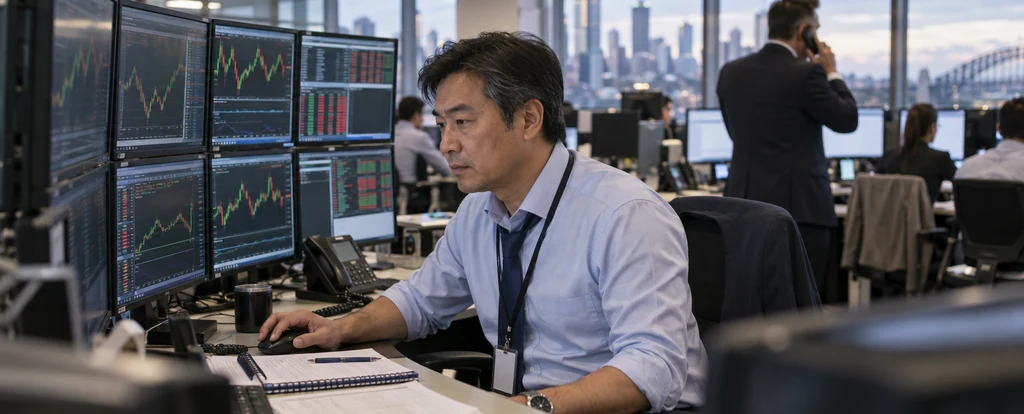
Foreign exchange dealers work on trading floors or corporate treasury desks, dealing spot, forward and derivative currency trades for a bank, investment firm or company. Rates move on economic data, interest rate decisions and geopolitical news, so a dealer watches those releases closely and prices them into the quotes they give. The role differs from a financial analyst's in that a dealer commits the firm's money to a live position rather than modelling a trade for someone else to approve.
How much do foreign exchange dealers earn?
The median full-time salary for a foreign exchange dealer is $137,900 per annum, before tax, up $28,500 since 2018.
A large share of a dealer's pay is usually a bonus tied to the desk's profit and the individual's own book, so total earnings can swing a long way from one year to the next. Base salary depends on the size of the desk, the products you cover and whether you sit on a bank's trading floor or in a corporate treasury, with treasury roles generally paying less. A move to a proprietary trading firm changes the structure again, since pay is often tied directly to the profit you generate.
What does a foreign exchange dealer do day to day?
The list below is what fills most weeks; the exact mix shifts with seniority and whatever stage the current work is at.
- Quoting two-way prices in currency pairs and adjusting them as the market moves
- Executing spot, forward and options trades for clients or for the desk's own book
- Watching economic data releases and central bank announcements for a rate move before the rest of the market prices it in
- Managing open positions and hedging exposure so losses stay inside the limits the firm sets
- Reconciling completed trades with the back office and briefing clients or risk teams on market conditions
What skills do foreign exchange dealers need?
Employers look for financial analysis and modelling, risk and internal controls, data analysis, backed by Bloomberg Terminal fluency and strong stakeholder management.
Specialist skills
- Financial analysis and modelling
- Risk and internal controls
- Data analysis
- Regulatory compliance
Software and tools
- Bloomberg Terminal
- Reuters Eikon
- FX trading platforms (Refinitiv, Interactive Brokers)
- Excel
- Risk management software (RiskMetrics, Kondor+)
General skills
- Stakeholder management
- Attention to detail
- Problem solving
Is the job growing?
About 1,400 people work as foreign exchange dealers in Australia, and employment is projected to grow 12.5% over the decade to 2035. That's healthy, above-average growth, and the role should stay in solid demand.
How do you become a foreign exchange dealer?
Here's the path most foreign exchange dealers take, step by step.
- 1Start with a degree in commerce, economics or finance
A bachelor degree is the usual entry point: the most common qualification in the role is a Bachelor degree, held by about 52% of the workforce. Postgraduate study is usually taken later, once you know which market you want to specialise in.
- 2Enter through a graduate or analyst program
Banks and trading firms recruit graduates onto dealing desks, though many dealers start in middle or back office roles such as trade support or settlements and move across from there. These entry roles are paid and teach you the trade lifecycle a dealer needs.
- 3Meet ASIC's training standards and be accredited by your employer
Firms operating under an Australian financial services licence must make sure staff meet ASIC's training standards, which usually means completing a recognised compliance course such as RG 146 in your first months. Your employer also sets position limits and product accreditation, and these differ from one firm to the next.
- 4Choose a specialisation and build a track record
Dealers tend to settle into a segment such as major currency pairs, emerging market currencies or corporate hedging. Some add the CFA charter, which is common on the buy side but not required to deal.
Ready to apply as a foreign exchange dealer?
Whether you're working toward becoming a foreign exchange dealer or already are one and want a hand with the next step (sharpening your resume for ATS screening, tightening your cover letter, or knowing what you'll actually be asked at interview), here are examples grounded in this specific role, not generic templates.
What jobs can a foreign exchange dealer move to?
None of the roles foreign exchange dealers typically move into pay more than the role itself. Futures Dealer is the closest match. If a bigger salary is the goal, moving up into a senior or principal position within the role is usually the faster route than moving sideways.
| Move to | Typical pay change | Overlap | Retraining |
|---|---|---|---|
| Futures Dealer Currency trading judgement and hedging skills carry into futures markets, with a short course covering contract specifications and clearing. | +$0 | 50% | short course |
| Derivatives Trader Both roles price risk in fast markets, so a foreign exchange dealer moves into derivatives with little further training. | +$0 | 78% | minimal |
| Equities Trader Order execution and trading discipline carry over to equities, with a short course covering equity market rules and settlement. | +$0 | 59% | short course |
| Investment Banker Deal pricing and currency risk skills transfer to corporate advisory, though entering investment banking usually requires further formal study. | −$3,600 | 43% | reskill |
| Risk Analyst Dealing desk knowledge of market and counterparty risk suits risk analysis, needing little beyond the existing degree. | −$21,400 | 100% | minimal |
Moves are chosen from Jobs and Skills Australia's Data on Occupation Mobility, which follows income tax records between 2011-12 and 2020-21, together with entry requirements and skill overlap. A known move is one people were seen making in that data. Pay change compares median full-time pay for the two roles.
Who works as a foreign exchange dealer?
The typical foreign exchange dealer is 38 years old; 81% are men, 83% work full-time, and full-timers average 46 hours a week.
- 38
- Median age
- 19%
- Female share
- 83%
- Full-time
- +6h
- vs all-jobs avg
What's it like being a foreign exchange dealer?
The desk day starts before the local market opens and then follows the currency market around the clock, so early starts and overseas sessions are part of the rhythm. Minutes can carry a lot of money, and how your positions performed is visible to the rest of the desk by the end of the day. It suits people who stay composed through a losing run, follow macroeconomics closely and are comfortable being measured on profit and loss.
What people like
- Your decisions show up immediately. A trade either works or it doesn't within minutes, so there is no long wait to find out whether your read on the market was right.
- The market is a moving puzzle. Interest rate decisions, commodity prices and political events all feed into currency rates, which rewards following the wider economy rather than just the screens.
- Small desk, direct feedback. Trading desks are small teams, and senior dealers are usually sitting close enough to explain why they took a position.
- A clear scoreboard. Profit and loss is calculated daily, so there is little ambiguity about how you are going.
What people find hard
- Losses are visible to the whole desk. Position limits mean a bad run gets noticed quickly by risk, by management and by the people sitting next to you.
- Early starts and long days. Dealers are at their desks before the market opens, and the day often stretches into the European session.
- Relentless screen time. Much of the day is spent watching rates, and quiet markets can mean hours of monitoring with little to do.
- Little room to improvise. Trading limits, compliance rules and product accreditation leave less discretion than outsiders assume, and breaching a limit is a serious matter.
Based on our synthesis of professional-body surveys and public accounts of the role, not first-person verified reviews.
Which industries employ foreign exchange dealers?
Financial and Insurance Services employs the largest share of foreign exchange dealers.
Top employing industries
- 1Financial and Insurance Services
Ranked by employment share; the source doesn't publish an exact percentage per industry.
| Bachelor degree | 51.6% | |
|---|---|---|
| Postgraduate | 21.4% | |
| Year 12 or below | 13.5% | |
| Diploma / Advanced Diploma | 6% | |
| Certificate III/IV | 4.1% |
Will AI replace foreign exchange dealers?
Currency dealing has been heavily automated at the routine end: electronic platforms stream prices, matching engines fill small orders and algorithmic execution handles most standard flow. A dealer's day now centres on the trades the machines handle less well, such as large or illiquid orders, and on judgement calls about how to position the book. That is why the role carries a high exposure rating overall, even though the desk still needs people on it.
Share of typical working time by exposure level
- Quoting prices and watching live ratesPricing engines and auto-quoters stream two-way prices for the major pairs, so a dealer mainly steps in on larger or less liquid orders.30%high
- Executing routine client ordersElectronic platforms match, confirm and settle most standard flow without a dealer touching it, which has cut the number of small trades that reach the desk.25%high
- Managing positions and hedging exposureRisk systems flag limit breaches and suggest hedges, but the call to hold, cut or hedge a position is still the dealer's.25%moderate
- Briefing clients and internal risk teamsExplaining why the book is positioned a certain way, and reading what a corporate client's underlying currency exposure really is, depends on conversations that are hard to automate.20%moderate
Common questions about becoming a foreign exchange dealer
Straight answers to the questions people ask most.
How much do foreign exchange dealers earn?
Foreign exchange dealers earn a median of $137,900 per year before tax. A large part of that is usually a bonus tied to the desk's profit and the individual dealer's book, so total pay varies widely from year to year and between firms.
How do you become a foreign exchange dealer?
Most dealers start with a commerce, economics or finance degree and enter through a graduate program at a bank or trading firm, often after time in trade support or settlements. Employers then put you through ASIC's training standards, usually a course such as RG 146, before you deal under your own limits.
Are foreign exchange dealers in demand?
Foreign exchange dealers are currently not in shortage, and employment is projected to grow 12.5% over the decade to 2035. It is a small occupation, with about 1,400 people working in it, so hiring tends to happen through graduate intakes and internal moves rather than advertised vacancies.
Could AI replace foreign exchange dealers?
Electronic pricing and algorithmic execution already handle most routine quotes and small client orders, which is why this role carries a high automation rating. What stays with the dealer is deciding how to position the book, pricing larger or less liquid trades and explaining a position to a client or a risk committee.
What can foreign exchange dealers move into?
Derivatives trading draws on the same pricing and risk skills, and both roles sit in fast markets, so the move needs little further training and pay is about the same. Risk analysis uses the same market and counterparty knowledge with minimal retraining, and pays $21,400 less by comparison.
What are the hours like?
Full-time dealers average 46 hours a week, and the day starts before the local market opens so the desk is ready for the overseas sessions. Shift work is common on desks that cover London or New York hours.
Related roles
Not sure this is you? Take the career quiz and get a ranked shortlist of roles that fit how you like to work.