Home Advice Workplace wellbeing
Raising a formal grievance
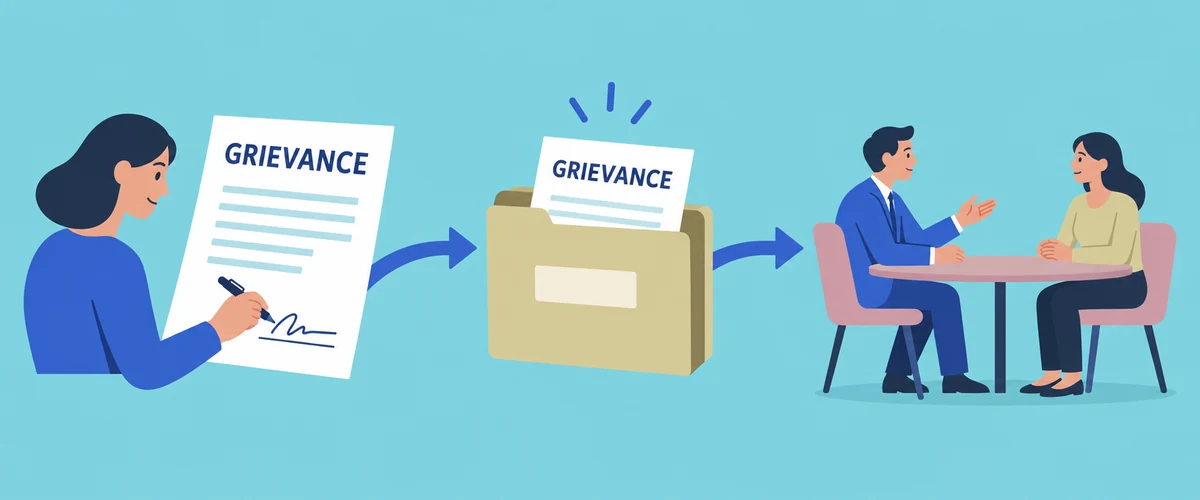
A formal grievance is a complaint you put to your employer in writing and ask it to deal with through a set process. Most workplaces have that process in a grievance or complaints policy. If a modern award or enterprise agreement covers you, it will also contain a dispute resolution clause with its own steps, and that clause can matter more than the policy if things aren't resolved.
In practice, raising a grievance usually means finding the procedure that applies, writing down what has happened and what you'd like done about it, meeting to discuss it, and then escalating if the answer doesn't fix the problem. The law also protects you from being treated worse because you made a complaint about your employment. Below you'll find each of those steps and a written grievance you can adapt. If your concern is bullying, [what happens when you report workplace bullying](/advice/workplace-bullying) covers the Fair Work Commission's stop-bullying process in more detail.
What makes a grievance formal
Many workplace problems are sorted out in a conversation, an approach covered in resolving conflict at work, and the Fair Work Ombudsman's guidance on fixing a workplace problem suggests talking first and putting your concerns in writing if that hasn't worked.
A grievance becomes formal when you put it in writing and ask for it to be handled under a procedure. That changes a few things. There's a record of what you raised and when, the employer is expected to respond according to its own process, and if the matter later goes to the Fair Work Commission or a court, you can show what you asked for and what happened next.
You don't have to try an informal conversation first if that isn't realistic, for example when the problem involves your manager and there's nobody else suitable to speak to. Check your policy for an alternative contact, such as a more senior manager or HR.
Find the procedure that applies to you
Start with two documents: your employer's grievance or complaints policy, and the award or agreement that covers you, if there is one.
The internal policy is usually on the intranet, in an employee handbook or available from HR. It should say who to send a grievance to, what happens after that and roughly how long each step takes.
The dispute resolution clause is required by law. Every modern award must include a term for settling disputes about matters arising under the award and in relation to the National Employment Standards, and an enterprise agreement must include a similar term before the Commission can approve it. You can find your award through the Fair Work Ombudsman's award finder, and search for your enterprise agreement on the Fair Work Commission's website.
Many modern awards use a clause with the same steps. The Clerks award, for example, says the parties must first try to resolve the dispute through discussion with the relevant supervisor, then with more senior management, and only after those steps may a party refer it to the Commission.
It helps to know which kind of problem you have, because the two procedures don't always cover the same ground:
- A problem about your entitlements, such as pay, penalty rates, rosters, leave or anything else in your award, agreement or the National Employment Standards, can be raised under the dispute resolution clause as well as any internal policy.
- A problem about how you're being treated, such as a manager's behaviour, a conflict with a colleague or the way a decision was made, may only be covered by the internal policy, unless it also involves something your award or agreement deals with.
Some issues have their own legal processes as well, including bullying, discrimination, sexual harassment and health and safety concerns. These are covered in the last section.
Before you write it down
The Fair Work Ombudsman suggests gathering anything that shows why there's an issue, such as your contract or letter of offer, pay slips, rosters or timesheets, and the relevant parts of your award or agreement. For a complaint about someone's behaviour, the useful records are dates, what was said or done, who was there, and any emails or messages.
It's also worth deciding what outcome you want before you write. An employer can respond more usefully to "please back-pay the Saturday penalty rates for March to June" or "I'd like to stop reporting to this supervisor while the complaint is looked at" than to a general request to fix things. You may not get exactly what you ask for, but a clear request gives the conversation a starting point.
If you're unsure whether something is an entitlement, the Fair Work Ombudsman's Infoline on 13 13 94 can help you check before you raise it.
What to put in a written grievance
A grievance doesn't need legal language. It should be clear enough that someone who wasn't there can understand what happened and what you're asking for. Most include:
- That it's a formal grievance, and the policy or award clause you're raising it under, if you know it
- What happened, in date order, with names, places and any witnesses
- What you've already done, such as a conversation with your manager, and what came of it
- What you'd like to happen to resolve it
- Any documents you're attaching
- A request to meet, and whether you'd like to bring a support person
Keep it factual. Describing what someone said and did, and how it affected your work, gives the employer something concrete to look into, whereas guesses about someone's motives are easy to dispute.
Send it to the person your policy names, keep a copy, and consider sending it by email so the date is recorded. When you do meet and agree on something, the Fair Work Ombudsman suggests following up with an email summarising what was discussed, what was agreed and what happens next.
A grievance you can adapt
Replace the bracketed parts with your own details and remove any lines that don't apply.
A grievance you can adapt
Subject: Formal grievance, [your full name]
Dear [name of manager or HR contact],
I'm writing to raise a formal grievance under [the grievance policy, or clause number and name of your award or agreement].
My concern is that [a one or two sentence summary of the problem].
What has happened:
- On [date], [what happened, who was involved and who else was present].
- On [date], [what happened next].
I raised this with [name] on [date]. [What was said or agreed, and what has happened since.]
To resolve this, I'm asking for [the outcome you want].
I'd like to meet to discuss this grievance, and I'd like to bring [a support person, or my union representative] to that meeting. I've attached [list of documents].
Please confirm you've received this and let me know what the next step will be and when I can expect to hear from you.
Kind regards,
[Your name]
[Your job title]
Bringing a support person to meetings
Whether you're entitled to bring someone depends on which procedure you're using.
If you're raising a dispute under a modern award's dispute resolution clause, the standard wording lets a party appoint a person, organisation or association to support or represent them in any discussion or process under the clause. An enterprise agreement's dispute term must allow employees to be represented. That person could be a union representative, a trusted colleague or someone else you choose, subject to what your award or agreement says.
Outside those clauses, there isn't a general legal right to a support person at a grievance meeting, although many workplace policies allow one and it's reasonable to ask. The rule that an employer shouldn't unreasonably refuse a support person comes from unfair dismissal law and applies to discussions relating to dismissal. In that context, the Commission describes a support person as someone who assists rather than someone who argues your case for you.
While a dispute is being worked through under an award clause, work continues as normal and you still need to follow reasonable directions to do work that's safe and appropriate for you. That obligation is subject to work health and safety laws, so it doesn't require you to keep doing work you reasonably believe is unsafe.
If you're treated worse for complaining
Under the Fair Work Act, an employee has a workplace right to make a complaint or inquiry in relation to their employment. It's unlawful for an employer to take adverse action against you because you have or have used that right, and the Fair Work Ombudsman's page on protections at work gives asking your employer about your pay rate as an example. Starting or taking part in a dispute settlement procedure under an award or agreement is a workplace right too.
Adverse action includes dismissal, demotion, cutting your shifts or hours, changing your job to your disadvantage, treating you differently from others, and threatening any of these. It has to be taken because of the complaint to be unlawful, so an employer can still manage your performance or make a genuine redundancy for legitimate reasons. Whether a particular complaint is protected, and whether it was the actual reason for what happened, can both be contested, which is one reason to keep copies of your grievance and a note of what followed.
If you think it has happened to you, the Fair Work Commission's general protections pages explain the two types of application:
- If you're still employed, you can apply up to 6 years after the adverse action. The Commission can help both sides talk only if everyone agrees to take part. It doesn't investigate or decide who is right, and you can go straight to the Federal Court or the Federal Circuit and Family Court instead.
- If you've been dismissed, the deadline is 21 days after the dismissal takes effect, and the Commission extends it only in exceptional circumstances.
Getting legal or union advice before you apply is sensible, because either application starts a legal process.
If the grievance isn't resolved
Your first option is usually the next step in the procedure itself, such as asking for the matter to go to a more senior manager or a different decision-maker. If the employer hasn't responded in the time its policy sets out, a short written follow-up asking when you can expect an answer keeps the record clear.
Beyond the workplace, where you go depends on the kind of problem:
- Disputes under an award or agreement. If the dispute resolution clause allows it and you've completed the earlier steps, you can apply to the Commission using Form F10. You'll need to attach a copy of the clause and explain the steps you've already taken. The Commission might hold a mediation or conciliation or make a recommendation, and it can only make a binding decision if the parties have agreed it can arbitrate.
- Unpaid wages or entitlements. The Fair Work Ombudsman can help with problems about minimum pay and entitlements under the Fair Work Act, awards and enterprise agreements. It's impartial, so it doesn't represent either side.
- Bullying. You may be able to apply to the Commission for an order to stop bullying while you're still employed. What happens when you report workplace bullying explains what that order can and can't do.
- Health and safety issues. Work health and safety laws set out their own issue resolution process. Under the model laws, which apply everywhere except Victoria, any party can ask the regulator to send an inspector to help once reasonable efforts to resolve the issue haven't worked. In Victoria, check with WorkSafe Victoria.
- Discrimination or sexual harassment. These have separate processes through the Fair Work Commission and human rights or anti-discrimination bodies, each with their own rules about timing and which body you can use. Workplace discrimination sets out the routes and their time limits.
A union, a community legal centre or a workplace lawyer can help you work out which of these fits. Most employees in Australia are covered by the national Fair Work system described here, but some state and local government employees are covered by their state's industrial relations system instead, so check which applies to you before you apply anywhere.
Article sources
- Fair Work Ombudsman's guidance on fixing a workplace problem
- Federal Register of Legislation, modern award must include a term for settling disputes
- Fair Work Commission, enterprise agreement must include a similar term
- Fair Work Commission's website
- Fair Work Commission, discussions relating to dismissal
- Fair Work Ombudsman's page on protections at work
- Fair Work Commission's general protections pages
- Fair Work Commission, Form F10
- Safe Work Australia, send an inspector to help
- Fair Work Ombudsman, other workplace relations help
- Federal Register of Legislation, document 1
- Fair Work Commission, resolve dispute your workplace
- Fair Work Commission, MA000002
- Fair Work Commission, general protections 1
- Fair Work Commission, apply
- Fair Work Commission, who can apply stop bullying
- Safe Work Australia, model whs laws
- Fair Work Commission, sexual harassment
Related articles

Resolving conflict at work
Most conflict at work is ordinary. Two people want different things, see the same problem differently, or have let a small irritation build up over a few weeks.

What happens when you report workplace bullying
What a Fair Work Commission stop-bullying order can and can't do, who can apply, how long the process usually takes, and where a general protections claim fits.

Workplace discrimination
How workplace discrimination works in Australia, the federal, Fair Work and state complaint options, their time limits and where to get help.