Notice period when resigning
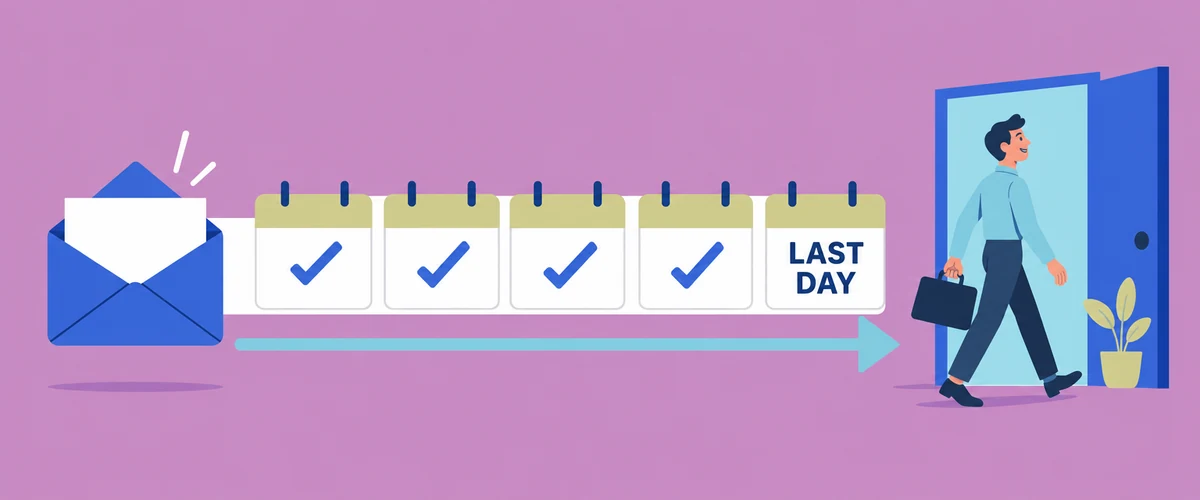
A notice period is the time between telling your employer you're resigning and your last day of work. There's no single length that applies to everyone. Yours comes from your award, enterprise agreement or employment contract, and under most awards it depends on how long you've worked for that employer, somewhere between one and four weeks.
The sections below explain where to find your notice period, how the common award scale works, what changes if you're casual or on a contract, and what happens if you or your employer want your notice to end sooner.
How a notice period works
Your notice period starts the day after you tell your employer you're resigning and ends on your last day of employment. The Fair Work Ombudsman's resignation guidance says you can give notice verbally or in writing, although writing is best practice because it records the date your notice started and the day you intend to finish.
You're still an employee for the whole of the notice period, on the same pay and conditions as before. Your employer also can't choose to accept or reject a resignation. What they can do is talk with you about whether you work the notice out or finish earlier, which is covered further down.
If you're still deciding how to word the resignation itself, the resignation letter guide and template covers that side of it.
Where your notice period comes from
Three documents can set how much notice you need to give, and more than one may apply to you.
- Your enterprise agreement, if your workplace has one. It can set its own notice rules.
- Your award, if you're covered by one. Awards base employee notice on your continuous service with that employer.
- Your employment contract. A contract can ask for more notice than your award or agreement, but it can't set less than the legal minimum those instruments provide.
If you're not sure which award covers you, the Fair Work Ombudsman's Notice and Redundancy Calculator asks a few questions about your job and tells you the minimum notice that applies. It's also a quick way to check a figure in your contract against the award.
The National Employment Standards set out notice periods too, but those minimums apply when an employer ends someone's employment. They're not the source of the notice you give when you resign, even though many awards use the same scale.
How much notice most awards require
Many awards use a standard clause that ties employee notice to length of service. The General Retail Industry Award (clause 37.1) is a typical example.
| Continuous service with your employer when you give notice | Notice you need to give |
|---|---|
| 1 year or less | 1 week |
| More than 1 year, up to 3 years | 2 weeks |
| More than 3 years, up to 5 years | 3 weeks |
| More than 5 years | 4 weeks |
Service is counted on the day you give notice. It includes authorised unpaid leave, such as unpaid parental leave, but not unauthorised absences. Time you spent working as a casual before becoming permanent usually doesn't count.
When an employer ends someone's employment, a worker over 45 with at least two years' service gets an extra week's notice. That extra week doesn't apply the other way, so your age doesn't add to the notice you give when you resign.
For example, if you've worked in a shop for four years under that award and tell your manager on a Monday, you'd need to give three weeks' notice. It starts on the Tuesday, so your last day would be the Monday three weeks later.
If you're casual, award-free or on a fixed-term contract
Casual employees don't have to give notice when they resign. Letting your employer know your last shift is still good practice, and it can make a difference if you'd like them to give you a reference later. The guide to casual employment rights covers what else is different for casuals.
If no award or enterprise agreement covers you, there's no minimum notice you're legally required to give, but your contract may set one. If the contract doesn't mention notice, or you don't have a written contract, you might still need to give what's called reasonable notice. That usually depends on things like your role and how long you've been there, and it's a situation where getting advice on your contract can help.
The standard award clause doesn't apply to people employed for a set period, task or season. If that describes your job and you want to leave before the end date, check what your contract says about finishing early.
Being on probation doesn't remove the need to give notice. Your award's notice period still applies, so check your contract as well in case it sets a longer period. The article on probation periods explains how probation interacts with your other rights.
Can you give more notice than the minimum?
You can, and some people do so their employer has longer to find a replacement or so the handover fits a project. It's worth knowing how extra notice is treated, though.
If your employer decides they don't need you for the whole period, they can agree with you on an earlier finishing date or end your employment early. According to the Fair Work Ombudsman's guidance on resignation notice, you'd still be entitled to at least your minimum notice period, either worked or paid. But you aren't necessarily paid for the extra weeks you offered beyond that minimum.
Say your award requires two weeks and you give four. If your employer finds a replacement after one week and ends your employment, you'd be paid for the week you worked plus at least two weeks' pay in lieu of notice, not the full three weeks that were left. If you're relying on pay for every week you offer, plan on the basis that only the minimum is guaranteed.
If your employer wants you to finish early
When your employer would rather you didn't work your notice, there are two usual routes. You can both agree on an earlier last day, or your employer can end your employment and pay out your notice instead of having you work it.
Payment in lieu of notice has to cover what you would have earned if you'd worked the notice period. The Fair Work Ombudsman's dismissal page lists what that includes: loadings, allowances, penalty rates, overtime, bonuses and other separately identifiable amounts. Once the notice is paid out, your employment ends and you stop accruing leave.
Your employer can't end your notice early without either your agreement or paying at least the minimum notice that applies to you. If that happens, or you're unsure whether an agreed early finish was fair, the Fair Work Ombudsman can help you work out what you're owed.
If you need to leave before your notice ends
Plans change, and sometimes a new job wants you to start sooner than your notice allows. The first step is to ask your employer whether they'll agree to a shorter notice period. Some employers will agree, particularly if the handover is in hand, and it's worth getting that agreement in writing.
If you leave without giving the notice your award requires, and your employer hasn't agreed to less, most awards allow a deduction from your final pay. The limits are specific:
- The deduction can't be more than one week's wages.
- It only applies if you're 18 or over.
- It can't be made if your employer agreed to the shorter notice.
- It must not be unreasonable in the circumstances.
- It can only come from wages owed under the award, such as ordinary hours, penalties, allowances and overtime. It can't come from unused annual leave, other National Employment Standards payments or over-award pay.
So if you're paid above the award rate and leave two weeks short, the most your employer could withhold under that clause is one week's wages at the award rate. An enterprise agreement can have its own rule instead. If you're award and agreement free, the award clause doesn't apply, and the Fair Work Ombudsman's deductions page explains the limited situations in which an employer can take money from your pay.
Taking leave during your notice
You can take paid annual leave during your notice period if your employer agrees to it. Sick or carer's leave works the same way it does at any other time: tell your employer as soon as you can and provide evidence, such as a medical certificate, if they ask for it. Our guide to resigning due to health or stress covers using sick leave during your notice in more detail.
Public holidays that fall during your notice count as part of it. They don't push your last day back.
Working out your own date
To settle on a last day, find which award, agreement or contract covers you, count your continuous service as at the day you'll give notice, and check the notice period that applies. Start counting from the following day. If your contract asks for more than the award, give the contract's period.
The date matters beyond the handover, because it also sets when your final pay is due. Under most awards that's within seven days of your last day, and it includes any unused annual leave. If you've been with your employer for many years, the long service leave rules for your state explain whether any of that leave is paid out when you resign.
These rules come from the national workplace relations system under the Fair Work Act. Some workers are covered by a state system instead. That includes state public sector employees in New South Wales, Queensland, South Australia, Tasmania and Western Australia, and people who work for sole traders or partnerships in Western Australia. If that's you, check with your state's industrial relations body or your HR team.
This article is general information, not legal advice. If your contract has unusual notice terms, or you think a deduction from your final pay was wrong, the Fair Work Infoline on 13 13 94 can help.
Article sources
- Fair Work Ombudsman's resignation guidance
- Fair Work Ombudsman, Notice and Redundancy Calculator
- Fair Work Commission, General Retail Industry Award
- Fair Work Ombudsman's guidance on resignation notice
- Fair Work Ombudsman's dismissal page
- Fair Work Ombudsman, most awards allow a deduction
- Fair Work Ombudsman's deductions page
- Fair Work Ombudsman, final pay
- Fair Work Ombudsman, probation
- Fair Work Ombudsman, fair work system
- wa.gov.au, which system of employment law applies
Related articles

How to resign without burning bridges
Resigning well mostly comes down to the conversation and the few weeks that follow it. The letter matters, but it's short and it goes into a file.

How to write a resignation email (with examples)
A resignation email does the same job as a resignation letter: it says you're resigning and gives your last day.

How to write a resignation letter that leaves on good terms
A resignation letter template you can copy, five more for the situations that are harder to word, and what the last day you write down does to your final pay. No email address required.