HomeCoursesBuilding and constructionCertificate III
Certificate III · national qualification
Certificate III in Concreting
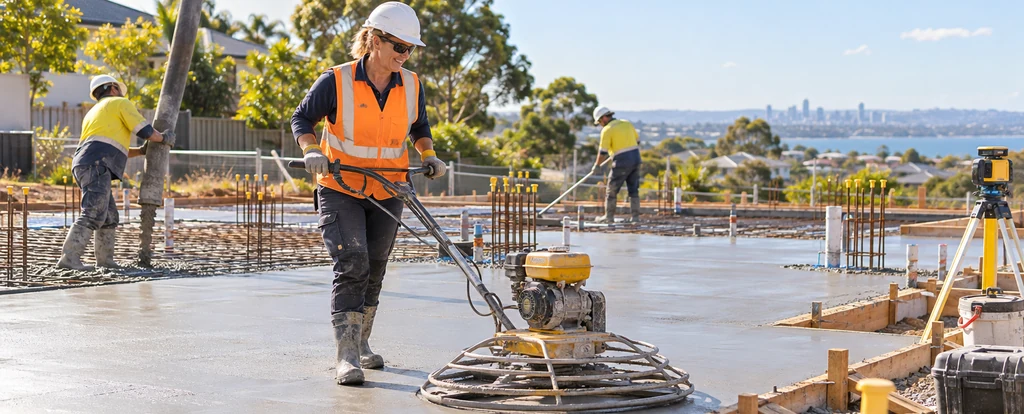
This qualification trains you to work as a concreter on residential and commercial projects, from setting out a job and building the formwork through to placing, finishing and curing the concrete.
- How long it takes
- 1 to 2 years
- typical for this level
- What it costs
- From $11,858
- Full fee at GOTAFE
- How you can study
- On campus
- Main job
- Concreter
- $114,900 median pay, In demand
- Taught by
- 11 providers
- Every state and territory
Is this course right for you?
What the Certificate III in Concreting asks of you, and what you might want to check first.
It helps to have
- an interest in building and construction work
- a careful approach to safety on site
- good communication skills for working in a team
- willingness to work outdoors in all weather
Before you start
There are no entry requirements for this qualification.
Where this course can take you
Jobs this qualification is a recognised route into, and the study that can follow it.
Jobs you can do with it
Concreter
Concreters prepare, pour and finish concrete for jobs ranging from house slabs and driveways to roads, bridges and commercial floors.
What else you need
Most people study it through an apprenticeship or traineeship arranged with an employer, and a white card is needed before starting. Check the provider.
Median pay$114,900
In demand
If you study further
Diploma of Building and Construction (Building)
Leads to work as a, median pay $195,100.
Bachelor of Construction Management
Pay is the median for everyone in the job, and “In demand” means the job is on the national shortage list.
What it costs
Paying the full fee
$11,858
across the TAFEs listed below. Private providers set their own fees.
| TAFE | State | Full fee |
|---|---|---|
| GOTAFE | VIC | $11,858 |
GOTAFEVIC
- Full fee
- $11,858
Fees as each TAFE shows them on its website, read 20 September 2026. Private providers set their own fees.
Where you can study this course
There are 11 places you can study this course. When you compare them, check they teach it the way you want to study, how far you'd be from a campus, what it will cost you and what past students say about the teaching and support. They're listed by how often people search for them, and none of them pays to be here or to move up.
What students like
- Teachers are supportive and ready to help
- Staff are helpful and friendly
- Course content is practical and industry relevant
What to weigh up
- Enrolment and admin can be slow
- Some find front desk staff less helpful
- Website for TAFE SA (opens in a new tab)

TAFE SA
26 campuses, SA
4.4from 1,339 Google reviews
What students like
- Lecturers are nice and helpful
What to weigh up
- Enrolment and admin can be slow
- Course information can be unclear
- Course page for gotafe (opens in a new tab)

gotafe
Wangaratta - Docker Street, VIC
4.3from 72 Google reviews
- How you study
- On campus
- Course page for North Metropolitan TAFE (opens in a new tab)
North Metropolitan TAFE
Balga, WA
4.1from 903 Google reviews
What students like
- Lecturers are helpful and knowledgeable
- Courses provide strong practical skills
- Website for TasTAFE (opens in a new tab)
TasTAFE
12 campuses, TAS
4.3from 167 Google reviews
- Website for Major Training Group (opens in a new tab)
Major Training Group
- Website for National Skills Pty Ltd (opens in a new tab)

National Skills Pty Ltd
National Skills Pty Ltd, QLD
5.0from 374 Google reviews
What students like
- Staff are friendly and easy to deal with
- Staff respond quickly and communicate clearly
- Website for PM Squared (opens in a new tab)

PM Squared
PM Squared, QLD
4.9from 132 Google reviews
What students like
- Trainers are friendly and helpful throughout the course

What you’ll learn
22 units: 17 that everyone takes and 5 you choose.
- Setting out and levelling
- Building and stripping formwork
- Placing and tying reinforcement
- Placing and finishing concrete
- Curing concrete
- Reading plans and specifications
See all 17 core units
Core units
Everyone completes these. Select a unit to see what it covers.
Loading the details for CPCCCA3002…
Loading the details for CPCCCA3002…
Questions to ask before you enrol
Providers run this course differently, so the answers change from one to the next.
- When is the next intake, and how many are there each year?
- What is the total cost, including materials, checks and any placement costs?
- Can I study part time or online, and how does that change the length?
- Do the units count towards a higher qualification if I go on to study further?
Questions people ask
Who is this qualification for?
This qualification trains you to work as a concreter on residential and commercial projects. You will learn on real or closely simulated sites, covering setting out, formwork, placing, finishing and curing concrete, plus general construction skills. The usual jobs it leads to are concreter and concrete tilt panel fabricator.
Do I need experience or other qualifications first?
There are no entry requirements for this qualification, but individual providers can set their own conditions. Check with the provider you choose.
Is a licence, registration or check required to work in this area?
Licensing, legislative, regulatory or certification requirements apply to concreting in some states and territories. Also, anyone carrying out construction work must complete the general construction induction training program (White Card).