Aboriginal and Torres Strait Islander Education Worker
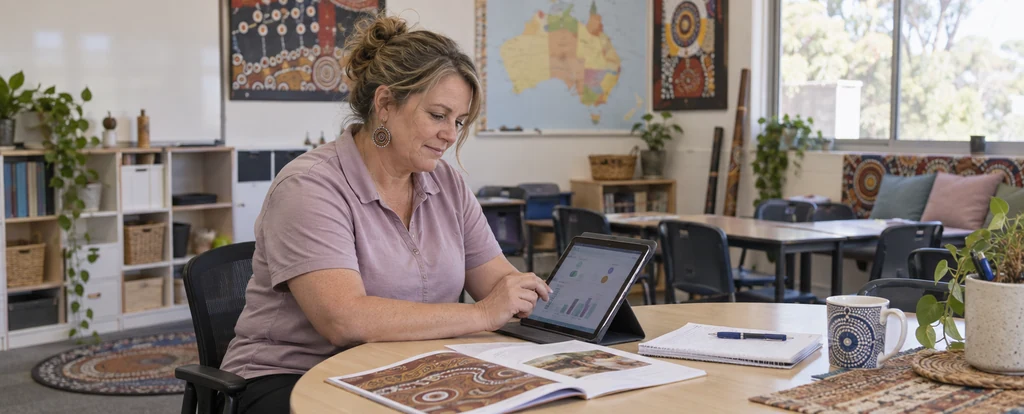
Aboriginal and Torres Strait Islander education workers help Indigenous students stay engaged at school, combining classroom support with cultural guidance and a link between families and school staff.
- Median salary*
- $54,600
3.6%vs last year, before tax
- People employed
- 2,200
0.0%vs last year
- Projected growth
- +9.7%
to 2035
- AI exposure*
- Low
- automation risk
- Average hours
- 38/wk
−2h vs all jobs
- Shortage status
- Not in shortage
national
Most Aboriginal and Torres Strait Islander education workers are based in primary and secondary schools, working alongside teachers, teacher aides and wellbeing staff. The role overlaps with a teacher aide's, but the cultural and family liaison side is what makes it distinct: explaining a student's situation to staff, running cultural activities and keeping families in the loop. Schools commonly fill these positions with people from the local community, and some are advertised as identified roles.
How much do aboriginal and torres strait islander education workers earn?
The median full-time salary for an aboriginal and torres strait islander education worker is $54,600 per annum, before tax, up $11,700 since 2018.
Pay depends mostly on the education support classification in the award or enterprise agreement covering your school, so government, Catholic and independent schools can pay differently for similar work. Part-time and term-time-only appointments are common, which lowers annual earnings even when the hourly rate is close to that of other support roles in the same school.
What does an aboriginal and torres strait islander education worker do day to day?
The list below is what fills most weeks; the exact mix shifts with seniority and whatever stage the current work is at.
- Sitting with students in class to keep them on task and re-explain instructions
- Checking attendance and following up with families when a student has been away
- Running cultural activities and helping teachers bring local language and history into lessons
- Talking with teachers and wellbeing staff about what a student needs and what is happening at home
- Recording attendance, notes and student progress in school systems such as Sentral or Compass
What skills do aboriginal and torres strait islander education workers need?
Employers look for teaching and instruction, pastoral care and wellbeing, community engagement, backed by Sentral fluency and strong written communication.
Specialist skills
- Teaching and instruction
- Pastoral care and wellbeing
- Community engagement
- Student assessment and reporting
- Casework and client support
Software and tools
- Sentral
- Compass
- SEQTA
- Microsoft Office
- Google Workspace
General skills
- Written communication
- Empathy and interpersonal care
Is the job growing?
About 2,200 people work as aboriginal and torres strait islander education workers in Australia, and employment is projected to grow 9.7% over the decade to 2035. That's modest growth: demand is steady rather than booming.
How do you become an aboriginal and torres strait islander education worker?
Here's the path most aboriginal and torres strait islander education workers take, step by step.
- 1Finish Year 12 or a Certificate III in Education Support
There is no single entry requirement, and the Certificate III in Education Support is the qualification most schools recognise. It usually takes six months to a year and can be completed while you are already working in a school.
- 2Get your working with children clearance
Every state and territory requires one before you can work in a school, under names such as a Working with Children Check or a blue card. Schools may also ask for a police check and a first aid certificate.
- 3Apply for work in a school or community program
Positions are advertised by government, Catholic and independent school sectors, and by Aboriginal education units and community organisations. Casual relief and part-time roles are a common way in, and the work is paid from the start.
- 4Study further if you want to specialise or teach
A Certificate IV or diploma in education support or community services opens up coordinator roles, and a teaching degree is the route for anyone who wants their own classroom.
Ready to apply as an aboriginal and torres strait islander education worker?
Whether you're working toward becoming an aboriginal and torres strait islander education worker or already are one and want a hand with the next step (sharpening your resume for ATS screening, tightening your cover letter, or knowing what you'll actually be asked at interview), here are examples grounded in this specific role, not generic templates.
What jobs can an aboriginal and torres strait islander education worker move to?
Moving into Youth Worker typically comes with the biggest pay rise, worth $41,300 a year more on average.
| Move to | Typical pay change | Overlap | Retraining |
|---|---|---|---|
| Youth Worker Their experience supporting young Indigenous people and families applies to youth work, with a short course.Known move | +$41,300 | 50% | short course |
| Aboriginal and Torres Strait Islander Health Worker Their cultural knowledge and community connections transfer to supporting Indigenous health, with additional health training.Known move | +$21,300 | 28% | reskill |
| Community Development Officer Their community engagement and cultural liaison skills suit planning community programs, with further study.Known move | +$20,400 | 14% | reskill |
| Teacher Aide Their cultural knowledge and student support skills carry directly into assisting in classrooms.Known move | +$15,200 | 50% | short course |
Moves are chosen from Jobs and Skills Australia's Data on Occupation Mobility, which follows income tax records between 2011-12 and 2020-21, together with entry requirements and skill overlap. A known move is one people were seen making in that data. Pay change compares median full-time pay for the two roles.
Who works as an aboriginal and torres strait islander education worker?
The typical aboriginal and torres strait islander education worker is 40 years old; 75% are women, 45% work full-time, and full-timers average 38 hours a week.
- 40
- Median age
- 75%
- Female share
- 45%
- Full-time
- −2h
- vs all-jobs avg
What's it like being an aboriginal and torres strait islander education worker?
The work follows the school year, so the rhythm is set by terms, exam blocks and holidays rather than by a standard office calendar. Days are spent moving between classrooms and quiet one-to-one conversations, which suits someone who likes being around young people and is comfortable talking to a 12-year-old and to their grandmother on the same morning. The pressures are real, because some students carry heavy things with them into the classroom and you are often the first person staff turn to when something cultural comes up.
What people like
- A student who was slipping comes back. Attendance and engagement move slowly, so the change shows up over a term or a year rather than a week, which makes it easy to see when it holds.
- Families ask for you by name. Once trust is built, parents and carers ring the school asking for you, which is what makes the liaison part of the job work.
- The cultural side is yours to lead. Running language sessions or NAIDOC activities gives you room to shape what the school teaches about culture, rather than watching it be handled badly.
- Schools that treat the role as part of teaching. Where a school gives the position real standing and time, you can do the job properly instead of fitting it around lunch duty.
What people find hard
- You can be the only one. In smaller schools there may be no other Indigenous staff member, so the cultural questions and the difficult conversations land on you.
- Cultural work gets squeezed. Assemblies, exams and reporting weeks push cultural programs to the side, and you may have to argue for that time again each year.
- Some weeks are heavy. Students bring what is happening at home to school with them, and you are often the person who hears it first.
- Term-time contracts. Part-time and term-time appointments are common, and the annual figure reflects the weeks actually worked rather than a full year.
Based on our synthesis of professional-body surveys and public accounts of the role, not first-person verified reviews.
Which industries employ aboriginal and torres strait islander education workers?
Education and Training employs the largest share of aboriginal and torres strait islander education workers.
Top employing industries
- 1Education and Training
Ranked by employment share; the source doesn't publish an exact percentage per industry.
| Year 12 or below | 39.7% | |
|---|---|---|
| Certificate III/IV | 29.8% | |
| Diploma / Advanced Diploma | 11% | |
| Bachelor degree | 8.2% | |
| Postgraduate | 5.1% |
Will AI replace aboriginal and torres strait islander education workers?
This is a low-exposure job. The heart of it is trust and cultural knowledge held by a person the students and their families know, which software cannot hold. The school systems already in use, such as Sentral and Compass, handle attendance records and reporting, so what changes is the paperwork rather than the conversations around it.
Share of typical working time by exposure level
- Classroom support and tutoringSitting beside a student and re-explaining a task depends on reading how they are going that morning, which is not something a program can pick up.30%low
- Cultural programs and language sessionsRunning a language or NAIDOC activity draws on local knowledge and often on Elders, though AI tools can help draft the worksheet that goes with it.30%low
- Attendance follow-up and family contactSoftware flags who is away and can draft a message, but the call home is a conversation about what is actually going on.20%moderate
- Records and reporting in school systemsSentral, Compass and SEQTA now generate attendance summaries and progress reports, which takes away much of the typing and checking.20%high
Common questions about becoming an aboriginal and torres strait islander education worker
Straight answers to the questions people ask most.
How much do Aboriginal and Torres Strait Islander education workers earn?
The median for full-time workers in this role is $54,600 per year before tax. What moves that figure most is the agreement covering your school, the sector it belongs to, and whether you work full time, part time or term-time only.
How do I become an Aboriginal and Torres Strait Islander education worker?
Most people enter with Year 12 or a Certificate III in Education Support, then apply for advertised positions in a school, an Aboriginal education unit or a community program. A working with children clearance is required everywhere, although the name of the check and the application process differ by state.
Are Aboriginal and Torres Strait Islander education workers in demand?
Employment is projected to grow 9.7% over the decade to 2035, and these workers are currently not in shortage. Openings tend to follow where school systems fund Indigenous education programs, so the picture varies between states and school sectors.
Will AI or automation replace this role?
Unlikely. The core of the job is trust and cultural knowledge held by a person students and families know, and school systems like Sentral and Compass already look after the records side without touching that. Automation removes some typing from attendance and reporting, but the conversation that follows an absence is still yours.
What can I move into from this role?
Moving into teacher aide work carries 50% of your skills across, and teacher aides earn $15,200 more. Youth work is also reachable with a short course and pays $41,300 more. Community development work and Aboriginal and Torres Strait Islander health work need more retraining and pay $20,400 more and $21,300 more respectively.
Do I have to be Aboriginal or Torres Strait Islander to do this job?
Many positions are identified roles, advertised only for Aboriginal and Torres Strait Islander applicants under equal opportunity provisions, because the work relies on cultural knowledge and community trust. Others sit inside general education support teams, and the advertisement will say which it is.
Related roles
- Teacher Aide
- Community Development Officer
- Aboriginal and Torres Strait Islander Health Worker
- Youth Worker
- Teacher Aide
- Middle School Teacher
Not sure this is you? Take the career quiz and get a ranked shortlist of roles that fit how you like to work.