Court Reporter
Court reporters turn what is said in a courtroom into an accurate written record that judges, lawyers and appeal courts rely on.
- Median salary*
- $83,200
4.0%vs last year, before tax
- People employed
- 1,400
0.0%vs last year
- Projected growth
- −3.5%
to 2035
- AI exposure*
- Moderate
- automation risk
- Average hours
- 39/wk
−1h vs all jobs
- Shortage status
- Not in shortage
national
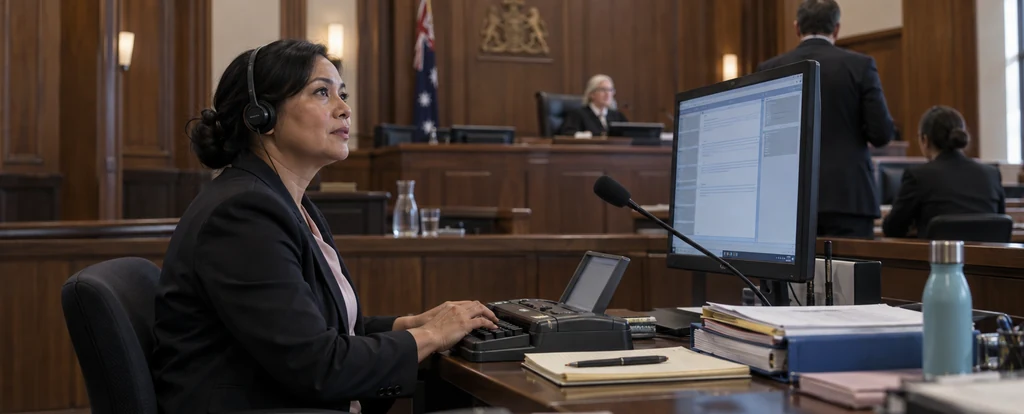
Court reporters work in courtrooms, tribunals and the transcription firms that supply them, turning spoken evidence and argument into written transcripts. In most Australian courts the proceedings are audio recorded, so the reporter's job is to produce, check and certify the written record from that audio rather than type in the room. It is close to general transcription work, but the standard is higher: transcripts are used in judgments, appeals and inquiries, so names, citations and legal terms have to be exact.
How much do court reporters earn?
The median full-time salary for a court reporter is $83,200 per annum, before tax, up $17,400 since 2018.
Pay depends heavily on who employs you. State and territory courts and tribunals pay according to public sector enterprise agreements with regular increases, while contract transcription work is usually paid by the page or the audio minute, so your income moves with your typing speed and the volume of work available. Experienced reporters who certify transcripts for appeal courts, coronial matters and inquiries tend to sit at the higher end.
What does a court reporter do day to day?
The list below is what fills most weeks; the exact mix shifts with seniority and whatever stage the current work is at.
- Monitoring proceedings in court and logging speakers, exhibits and rulings
- Producing transcripts from the court's audio recording using transcription software
- Checking names, legal terms and citations against court files and legislation
- Formatting transcripts to the court's required layout and certifying them as accurate
- Supplying transcripts to judges, lawyers and parties, and managing requests for copies
What skills do court reporters need?
Employers look for legal research, litigation and dispute support, backed by Express Scribe fluency and strong attention to detail.
Specialist skills
- Legal research
- Litigation and dispute support
Software and tools
- Express Scribe
- FTW Transcriber
- Dragon NaturallySpeaking
- Microsoft Word
General skills
- Attention to detail
- Written communication
- Time and deadline management
- Digital literacy
- Stakeholder management
Is the job growing?
About 1,400 people work as court reporters in Australia, and employment is projected to decline 3.5% over the decade to 2035. That's a real decline, worth weighing carefully before training into the role.
How do you become a court reporter?
Here's the path most court reporters take, step by step.
- 1Finish Year 12 with strong English
There is no single prerequisite degree. Among people working as court reporters, Bachelor degree is the most common qualification, held by about 30% of them, while others came into the job without a degree and learned the work on the bench.
- 2Build typing accuracy and legal vocabulary
A diploma of legal services or a business and legal administration qualification covers the terminology and document conventions you will meet daily, and steady typing practice builds the speed you need. Training in machine shorthand or voice writing is worth considering if you want to work in the courts and firms that still use it.
- 3Apply to courts, tribunals or transcription firms
Most entry is through a state or territory courts administration, the contractors that transcribe for the courts, or firms serving tribunals and inquiries. Employers usually test your accuracy and speed, then train you on their software and their standards for certified transcripts.
- 4Learn the certification and formatting rules
Each court has its own layout, abbreviations and certificate wording, and getting these right is what separates a court transcript from an ordinary transcription job. Larger courts train reporters in house, while smaller ones rely on a senior reporter to show you the conventions.
- 5Specialise once you have the basics
Experienced reporters move into appeal and inquiry transcripts, coronial work or broadcast captioning, where the terminology, turnaround times and accuracy standards differ again.
Ready to apply as a court reporter?
Whether you're working toward becoming a court reporter or already are one and want a hand with the next step (sharpening your resume for ATS screening, tightening your cover letter, or knowing what you'll actually be asked at interview), here are examples grounded in this specific role, not generic templates.
What jobs can a court reporter move to?
Moving into Judge's Associate typically comes with the biggest pay rise, worth $2,600 a year more on average.
| Move to | Typical pay change | Overlap | Retraining |
|---|---|---|---|
| Judge's Associate Court reporters bring courtroom knowledge and legal terminology, but becoming a judge's associate generally requires a law degree. | +$2,600 | 71% | requalify |
| Legal Executive Court reporters bring legal terminology and document expertise, and can move into legal executive roles with further legal practice study. | +$2,600 | 38% | reskill |
Moves are chosen from Jobs and Skills Australia's Data on Occupation Mobility, which follows income tax records between 2011-12 and 2020-21, together with entry requirements and skill overlap. A known move is one people were seen making in that data. Pay change compares median full-time pay for the two roles.
Who works as a court reporter?
The typical court reporter is 49 years old; 80% are women, 42% work full-time, and full-timers average 39 hours a week.
- 49
- Median age
- 80%
- Female share
- 42%
- Full-time
- −1h
- vs all-jobs avg
What's it like being a court reporter?
Court reporting is quiet, concentrated work with a hard deadline attached. Days are shaped by the court list: proceedings finish, audio lands, and a transcript is due before an appeal or a judgment moves forward. It suits people who like getting details exactly right and are content working alone for long stretches.
What people like
- The record matters, and you can see it. Your transcript becomes part of the case file and is quoted in judgments and appeals, so the work has a visible purpose without you having to argue anyone's side.
- Discrete jobs with clear finish lines. Each transcript is a bounded task with a deadline, so progress is easy to measure and the work does not follow you home the way a legal practice often does.
- Legal knowledge that compounds. Court procedure, terminology and the way evidence is structured become familiar over time, which makes the next transcript faster and less demanding to produce.
- Flexible, often home-based work. A lot of transcription is done from audio files at a keyboard, which suits people who want to work from home or set their own hours around other commitments.
What people find hard
- Sustained close listening. Hours of focused attention on indistinct audio, overlapping voices and unfamiliar accents is tiring, and it is hard to sustain for a full day without proper breaks.
- Deadlines set by the court. Appeal and sentencing timelines drive the schedule, so a late listing turns into a late night with very little room to negotiate.
- Contract rather than permanent work. Much of the work sits with private transcription firms that take on reporters casually or project by project, so income can vary between contracts.
- Sound quality you cannot control. You depend on how well the court's microphones captured the room, and a poor recording with crosstalk can double the time a transcript takes.
Based on our synthesis of professional-body surveys and public accounts of the role, not first-person verified reviews.
Which industries employ court reporters?
Administrative and Support Services employs the largest share of court reporters, followed by Public Administration and Safety.
Top employing industries
- 1Administrative and Support Services
- 2Public Administration and Safety
- 3Information Media and Telecommunications
Ranked by employment share; the source doesn't publish an exact percentage per industry.
| Bachelor degree | 30% | |
|---|---|---|
| Year 12 or below | 27.6% | |
| Diploma / Advanced Diploma | 14.3% | |
| Postgraduate | 10.6% | |
| Certificate III/IV | 9% |
Will AI replace court reporters?
AI reaches this job moderately. Speech recognition now turns courtroom audio into a usable first draft, which is where a lot of the typing used to sit, but court transcripts have to be checked word by word against the recording and verified for legal terms, names and citations before anyone certifies them. The role has moved towards correcting machine output and quality control rather than producing every word from scratch.
Share of typical working time by exposure level
- Producing first-pass transcripts from audio recordingsSpeech recognition handles most of the initial conversion, though it struggles with crosstalk, heavy accents and a muffled microphone.35%high
- Monitoring proceedings and logging speakers, exhibits and rulingsFollowing a live hearing and keeping track of who said what still needs a person in the room, even where the court runs its own audio system.25%low
- Checking and correcting transcripts against the recordingSoftware can flag likely errors, but deciding whether a name, citation or legal term is right takes a reader who understands the case.25%moderate
- Certifying, formatting and releasing transcripts to the courtThe certificate and each court's formatting and abbreviation rules carry legal weight, so they stay with a person.15%low
Common questions about becoming a court reporter
Straight answers to the questions people ask most.
How much do court reporters earn in Australia?
Court reporters earn a median of $83,200 per year before tax. Pay in the public court system follows state and territory enterprise agreements, while contract transcription work is usually paid by the page or the audio minute, so what you take home depends on how much work you can turn around.
How do you become a court reporter?
Most people enter through a transcription firm that supplies the courts, or through a state or territory courts administration, and learn the formatting and certification rules on the job. Strong typing accuracy, legal vocabulary and a qualification such as a diploma of legal services help you get a first interview. Shorthand or voice writing training is useful in the courts and firms that still use it.
Are court reporters in demand in Australia?
Court reporters are currently not in shortage, and employment is projected to decline 3.5% over the decade to 2035. The occupation is small and much of the work is contracted by courts rather than employed directly, so openings appear when firms win new transcription contracts or when reporters leave. It is worth checking vacancies with your state or territory courts administration as well as with transcription firms.
Will AI replace court reporters?
Speech recognition now produces a usable first draft of most courtroom audio, which has taken over much of the typing. What it does not do is verify a transcript word by word, sort out overlapping speakers and poor audio, or certify that the finished record is accurate, and those steps are what the courts pay for. The role is shifting towards editing and quality control rather than transcription from scratch.
What can court reporters move into?
A legal executive role builds on the same legal terminology and document skills, pays about $2,600 more and usually calls for further study in legal practice. Court officers already know court procedures, so some move across into reporting, though the recording and transcription side of the job needs training first. Both moves keep you close to the courtroom without starting again from scratch.
Related roles
Not sure this is you? Take the career quiz and get a ranked shortlist of roles that fit how you like to work.