Lighting Technician
Lighting technicians rig, focus and operate the lighting that shapes a stage, a set or a live event.
- Median salary*
- $70,200
3.8%vs last year, before tax
- People employed
- 920
2.2%vs last year
- Projected growth
- +8.3%
to 2035
- AI exposure*
- Moderate
- automation risk
- Average hours
- 45/wk
+5h vs all jobs
- Shortage status
- Not in shortage
national
Lighting technicians work in theatres, concert venues, television studios and on film sets, usually as part of a casual or freelance crew hired production by production. The job sits between the lighting designer's plan and the light itself: you hang and focus the fixtures, patch and program them, then run the cues during the show. Most work comes through production companies and venues rather than advertised vacancies, so a few steady contacts carry a career a long way.
How much do lighting technicians earn?
The median full-time salary for a lighting technician is $70,200 per annum, before tax, up $14,600 since 2018.
Pay depends heavily on how you are engaged, because casual and freelance technicians are usually paid hourly or by the day, so earnings move with how much work you take on and whether you travel. Larger venues and touring productions covered by enterprise agreements tend to pay above the award, and night work, load-ins and public holidays attract penalty rates. The sector matters as well, with corporate events and broadcast often paying more reliably than small theatre.
What does a lighting technician do day to day?
The list below is what fills most weeks; the exact mix shifts with seniority and whatever stage the current work is at.
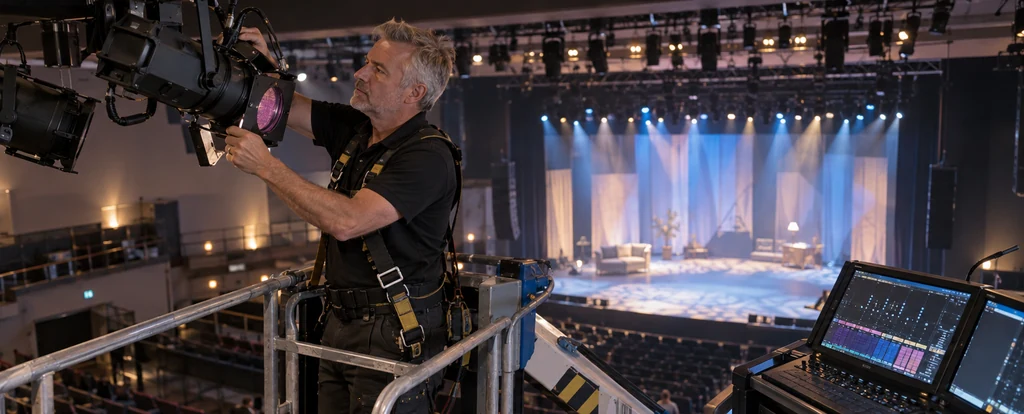
- Rigging and focusing fixtures at height from a ladder or boom lift, then addressing and patching them back to the console
- Building cue stacks on a console such as GrandMA3 or ETC Eos and running the show live, where a cue landing late is visible to everyone
- Maintaining and repairing fixtures, cables and dimmers between shows, including fault-finding when a light drops out mid-run
- Reading lighting plans and paperwork in Vectorworks Spotlight, then adjusting for rigging points, power or a plot that will not fit the venue
- Working through focus and tech rehearsals, taking notes from the designer and director and re-cueing as the running order changes
What skills do lighting technicians need?
Employers look for plant and equipment operation, worksite safety management, creative software production, backed by GrandMA3 fluency and strong problem solving.
Specialist skills
- Plant and equipment operation
- Worksite safety management
- Creative software production
Software and tools
- GrandMA3
- ETC Eos
- Vectorworks Spotlight
- QLab
General skills
- Problem solving
- Attention to detail
- Written communication
- Time and deadline management
Is the job growing?
About 920 people work as lighting technicians in Australia, and employment is projected to grow 8.3% over the decade to 2035. That's modest growth: demand is steady rather than booming.
How do you become a lighting technician?
Here's the path most lighting technicians take, step by step.
- 1Finish Year 12 or a pre-vocational course
No degree is required to get started: of the people working as lighting technicians, 28% list Year 12 or below as their highest qualification. A school certificate or equivalent is enough to begin applying for casual crew work.
- 2Study live production and technical services
A Certificate III in live production and technical services (CUA30425) at TAFE covers rigging, safe power, patching and console basics over about a year, while a diploma adds design and programming depth. Most people study while already picking up casual crew shifts.
- 3Get on a crew and get known
Many lighting technicians start as stagehands or bump-in crew with staging, audio-visual and equipment hire companies, because that is where you learn the gear and where the next job comes from. The work is casual and paid, and a reliable crew member gets called back.
- 4Add the licences and qualifications employers ask for
That means a White Card for construction sites, working at heights and elevated work platform training, test and tag, and a high risk work licence if you are rigging. Requirements differ by state and by venue, so check what the companies you want to work for ask for.
- 5Specialise on a console and a sector
Pick a console such as GrandMA3 or ETC Eos and get fluent enough to program a show alone, then aim for a regular place with a venue, a production company or a tour. Hours and pay usually settle once you are on a roster rather than waiting on single-day calls.
Ready to apply as a lighting technician?
Whether you're working toward becoming a lighting technician or already are one and want a hand with the next step (sharpening your resume for ATS screening, tightening your cover letter, or knowing what you'll actually be asked at interview), here are examples grounded in this specific role, not generic templates.
What jobs can a lighting technician move to?
Moving into Technical Director typically comes with the biggest pay rise, worth $44,200 a year more on average.
| Move to | Typical pay change | Overlap | Retraining |
|---|---|---|---|
| Technical Director A lighting technician brings technical production experience, advancing to technical director with further study in production leadership and planning. | +$44,200 | 29% | reskill |
| Sound Engineer A lighting technician brings live show timing and equipment control, moving into sound engineering with training in audio systems.Known move | +$25,700 | 23% | reskill |
| Pyrotechnician A lighting technician brings electrical control and safety awareness, moving into pyrotechnics with minimal extra training in firing systems. | +$13,000 | 71% | minimal |
| Stage Manager A lighting technician brings cueing and production floor knowledge, stepping into stage management with retraining in scheduling and rehearsal practice.Known move | +$1,600 | 17% | reskill |
Moves are chosen from Jobs and Skills Australia's Data on Occupation Mobility, which follows income tax records between 2011-12 and 2020-21, together with entry requirements and skill overlap. A known move is one people were seen making in that data. Pay change compares median full-time pay for the two roles.
Who works as a lighting technician?
The typical lighting technician is 34 years old; 83% are men, 55% work full-time, and full-timers average 45 hours a week.
- 34
- Median age
- 17%
- Female share
- 55%
- Full-time
- +5h
- vs all-jobs avg
What's it like being a lighting technician?
The rhythm of the job is load-in, focus, show, bump out, and it repeats with a different venue or a different act each week. Full-time lighting technicians average 45 hours a week and most of those hours fall in the evening or on weekends, because that is when audiences are free. It suits someone who likes solving a physical problem quickly, keeps their head when a cue is coming up, and does not mind that the work is invisible when it goes well.
What people like
- Cues landing exactly on time. The audience should never notice the lighting change, and that is the measure of a good night's work.
- Every venue is a different problem. A 900-seat theatre, a festival stage and a television studio each bring their own rigging points, power supply and load-in window, so the planning changes every time.
- Hands-on and technical in the same shift. You might spend the morning pulling cable and the afternoon building cue stacks on a console.
- The crew on a long run. Touring and theatre seasons build a tight team, so the same people turn up at the next venue and the work gets faster.
What people find hard
- Nights, weekends and early load-ins. Shows happen when audiences are free, and a get-in can start at 6am for a performance that finishes after 11pm.
- Freelance income arrives unevenly. Casual and contract work thins out in the quieter weeks of the year, and invoices can take a month or more to be paid.
- You light someone else's design. The look belongs to the designer and the director, and notes can change late in tech week after the rig is already in the air.
- The physical load. Truss, cable and moving lights are heavy, and much of the work happens at height or in a hot venue.
Based on our synthesis of professional-body surveys and public accounts of the role, not first-person verified reviews.
Which industries employ lighting technicians?
Arts and Recreation Services employs the largest share of lighting technicians, followed by Information Media and Telecommunications.
Top employing industries
- 1Arts and Recreation Services
- 2Information Media and Telecommunications
- 3Public Administration and Safety
Ranked by employment share; the source doesn't publish an exact percentage per industry.
| Year 12 or below | 27.7% | |
|---|---|---|
| Bachelor degree | 23.3% | |
| Diploma / Advanced Diploma | 21.1% | |
| Certificate III/IV | 20.3% | |
| Postgraduate | 4.6% |
Will AI replace lighting technicians?
Lighting technicians sit at a moderate level of exposure. The paperwork and plotting side of the job has moved heavily onto software, with Vectorworks Spotlight, offline console editors and timecode-driven cue lists doing work that was once done by hand. What has not moved is the physical side: hanging and focusing fixtures, tracing a fault at 2am and reading a live room are still done by a person on site.
Share of typical working time by exposure level
- Rigging and focusing fixturesHanging, addressing and focusing dozens of lights to a plot is physical work at height, and no system does it for you.30%low
- Programming and running cuesTimecode and cue-stack automation can run a repeatable show, but live events still need someone watching the stage and taking manual cues.30%moderate
- Maintenance and fault-findingWhen a fixture drops out mid-show, someone has to trace the cable or swap the unit before the next cue.25%low
- Lighting plots and documentationVectorworks Spotlight and console file exports generate plans, patch sheets and rigging documentation that used to be drawn by hand.15%high
Moves least exposed to AI
These career moves from lighting technician work are rated low for AI exposure:
- Stage Manager
Some skill overlap (17%), reskill to get there, and a low automation-risk profile.
- Technical Director
Some skill overlap (29%), reskill to get there, and a low automation-risk profile.
- Pyrotechnician
High skill overlap (71%), little retraining to get there, and a low automation-risk profile.
Common questions about becoming a lighting technician
Straight answers to the questions people ask most.
How much do lighting technicians earn?
$70,200 per annum, before tax, as a median for full-time lighting technicians. Casual and freelance work is usually paid hourly or by the day, so yearly earnings depend on how much you take on, and larger venues and touring productions under enterprise agreements often pay above the award.
How do you become a lighting technician?
Start with casual crew work for a staging or audio-visual company, then build the technical side at TAFE with a certificate or diploma in live production. Console skills matter more than any single qualification, and most employers want working at heights and elevated work platform training in place before you go up a ladder.
Are lighting technicians in demand?
Lighting technicians are currently not in shortage. Employment is projected to grow 8.3% over the decade to 2035, and because the occupation is small, with about 920 people, most opportunities come through crew networks and repeat bookings rather than advertised roles.
Will AI replace lighting technicians?
Not entirely, because the work sits at a moderate level of exposure. Software now handles much of the plotting, patch sheets and cue documentation, and timecode can run a repeatable show on its own, but rigging, focusing and recovering from a fault mid-show still need someone on site.
What can a lighting technician move into?
A move into sound engineering draws on the same live show timing and equipment control, and pays $25,700 more. Stage management uses the same cueing and production-floor knowledge, while technical director roles build on production experience and usually need further study in planning and leadership. Pyrotechnics is closer than it looks, since firing systems depend on the same electrical control and safety awareness and the extra training is minimal.
Do lighting technicians work full time?
About 55% of lighting technicians work full time, with the rest on casual, part-time or freelance arrangements. Casual crew work is normal at the start, and it usually takes a few years of reliable jobs before a venue or production company puts you on a regular roster.
Related roles
Not sure this is you? Take the career quiz and get a ranked shortlist of roles that fit how you like to work.