Meteorologist
Meteorologists study the atmosphere and forecast its behaviour, and their warnings help communities, aviation and agriculture prepare for hazardous weather.
- Median salary*
- $104,000
4.2%vs last year, before tax
- People employed
- 710
1.4%vs last year
- Projected growth
- +24.7%
to 2035
- AI exposure*
- Moderate
- automation risk
- Average hours
- 39/wk
−1h vs all jobs
- Shortage status
- Not in shortage
national
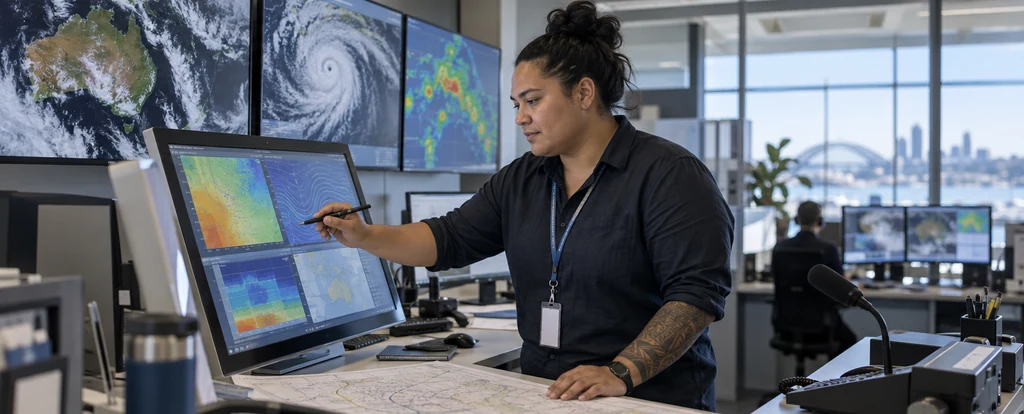
Most meteorologists work for the Bureau of Meteorology or in defence, aviation, research and consulting, where forecasting runs to a 24-hour roster so warnings are always staffed. The role sits between science and public service: reading observational data, running and questioning model output, then explaining what it means to pilots, farmers, emergency services or the public. It is often confused with climatology, which studies patterns over decades rather than tomorrow's weather.
How much do meteorologists earn?
The median full-time salary for a meteorologist is $104,000 per annum, before tax, up $21,900 since 2018.
Pay follows the employer more than the job title, since government and defence roles sit on defined classifications and shift rosters while research and consulting pay varies with the project and the client. Forecasters on overnight and weekend rosters usually receive penalty rates or rostered days off in return. A postgraduate qualification and experience in a specialty such as tropical cyclone or fire weather tends to move you up the scale.
What does a meteorologist do day to day?
The list below is what fills most weeks; the exact mix shifts with seniority and whatever stage the current work is at.
- Reading observations from weather stations, radar, satellites and balloons, and checking them for gaps or errors
- Running numerical weather prediction models and interrogating their output before trusting it
- Writing forecasts for public, aviation, marine and agricultural users
- Issuing severe weather warnings and briefing emergency services as a system develops
- Verifying how earlier forecasts performed and feeding that back into methods
What skills do meteorologists need?
Employers look for data analysis, statistical modelling, programming and software development, backed by Python fluency and strong written communication.
Specialist skills
- Data analysis
- Statistical modelling
- Programming and software development
- Machine learning
Software and tools
- Python
- R
- MATLAB
- ArcGIS Pro
- GRIB decoding tools
General skills
- Written communication
- Problem solving
- Presenting and data storytelling
- Time and deadline management
Is the job growing?
About 710 people work as meteorologists in Australia, and employment is projected to grow 24.7% over the decade to 2035. That's very strong growth. Few roles in Australia are expanding this fast, and it points to solid demand for years to come.
How do you become a meteorologist?
Here's the path most meteorologists take, step by step.
- 1Start with a science degree
A Bachelor of Science with a major in atmospheric science, meteorology or physics is the usual beginning, and the maths and physics units matter more than the name of the degree. Several Australian universities offer an atmospheric science or meteorology major.
- 2Add a postgraduate qualification
Around 69% of people working as meteorologists hold a Postgraduate qualification, typically honours or a masters with a research component. Employers look for that depth because the modelling work builds on it.
- 3Apply for a graduate or cadet program
The Bureau of Meteorology runs a graduate program that rotates new meteorologists through forecasting, research and operations, and it is paid from the start. Defence, CSIRO and private consultancies also take graduates, though in smaller numbers.
- 4Complete operational forecasting training
New forecasters train under experienced staff before taking their own shifts, learning to write warnings and brief users during severe weather. This is where the roster work begins.
- 5Choose a specialty
After a few years, meteorologists often move into aviation, tropical cyclones, fire weather or climate services, or into research and model development. That choice shapes both the roster you work and how your pay progresses.
Ready to apply as a meteorologist?
Whether you're working toward becoming a meteorologist or already are one and want a hand with the next step (sharpening your resume for ATS screening, tightening your cover letter, or knowing what you'll actually be asked at interview), here are examples grounded in this specific role, not generic templates.
What jobs can a meteorologist move to?
Moving into Data Scientist typically comes with the biggest pay rise, worth $20,800 a year more on average.
| Move to | Typical pay change | Overlap | Retraining |
|---|---|---|---|
| Data Scientist Meteorologists bring numerical weather modelling and analysis of large observational records, with programming and quantitative skills carrying across well. | +$20,800 | 69% | minimal |
| Mathematician Meteorologists bring applied mathematical modelling of fluids to mathematics, where quantitative and computational skills carry across. | +$7,800 | 82% | minimal |
| Statistician Meteorologists bring modelling of atmospheric observations to the statistician role, where quantitative analysis and computing skills carry across directly. | +$2,600 | 82% | minimal |
| Environmental Scientist Meteorologists bring atmospheric science and climate analysis to environmental monitoring, though retraining in environmental science is required.Known move | −$2,400 | 17% | requalify |
| Physicist Meteorologists bring atmospheric physics, fluid dynamics and mathematical modelling to physics, where the same physical foundations apply. | −$7,900 | 74% | minimal |
Moves are chosen from Jobs and Skills Australia's Data on Occupation Mobility, which follows income tax records between 2011-12 and 2020-21, together with entry requirements and skill overlap. A known move is one people were seen making in that data. Pay change compares median full-time pay for the two roles.
Who works as a meteorologist?
The typical meteorologist is 42 years old; 67% are men, 77% work full-time, and full-timers average 39 hours a week.
- 42
- Median age
- 33%
- Female share
- 77%
- Full-time
- −1h
- vs all-jobs avg
What's it like being a meteorologist?
The job runs on the weather and the roster, so a forecaster might work a quiet overnight shift and then hand over to a colleague as a cyclone forms offshore. Deadlines are absolute: a warning has to go out before the event, not after it. It suits someone who enjoys the puzzle of a messy atmosphere and is comfortable being the person who makes the call.
What people like
- Your work is used the same day. A forecast or warning goes out and people act on it, which is a short line between the science and its consequences.
- The methods keep changing. Numerical models, satellite data and machine learning post-processing are all developing quickly, so there is always something new to test and learn.
- Shift work suits some routines. Forecasting runs around the clock, which brings rostered days off, penalty rates and quieter stretches that some people use for study or side projects.
- Specialist knowledge is valued. Aviation, marine, fire weather and tropical cyclone forecasting each have their own users who come to rely on your judgement about their conditions.
What people find hard
- Nights, weekends and public holidays. Weather does not keep office hours, so most operational forecasters work a rotating roster that includes overnight and holiday shifts.
- Public criticism when a forecast misses. A forecast that does not come off attracts attention, even when the model guidance was uncertain or the event sat on a knife edge.
- Long quiet stretches. Most shifts are routine, filled with checking observational data and model output rather than dramatic weather.
- Slow research cycles. In research and model development roles, a study can take years before it changes what forecasters actually do on shift.
Based on our synthesis of professional-body surveys and public accounts of the role, not first-person verified reviews.
Which industries employ meteorologists?
Professional, Scientific and Technical Services employs the largest share of meteorologists, followed by Education and Training.
Top employing industries
- 1Professional, Scientific and Technical Services
- 2Education and Training
- 3Public Administration and Safety
Ranked by employment share; the source doesn't publish an exact percentage per industry.
| Postgraduate | 68.9% | |
|---|---|---|
| Bachelor degree | 26.2% | |
| Diploma / Advanced Diploma | 2% | |
| Year 12 or below | 1.2% | |
| Certificate III/IV | 0% |
Will AI replace meteorologists?
Automation reaches a long way into meteorology, because numerical weather prediction has been computer-driven for decades and machine learning now handles parts of post-processing and short-range nowcasting. The judgement that remains is interpretive: weighing conflicting guidance, deciding what it means for one region or user, and issuing warnings that carry public consequences.
Share of typical working time by exposure level
- Interpreting model output and writing the forecastSoftware can produce a baseline forecast from the models; the forecaster weighs competing guidance and writes the words that tell a farmer, pilot or marine user what it means.30%moderate
- Running numerical weather prediction modelsEnsembles run automatically and machine learning corrects their output, but someone still configures the runs, notices when the guidance disagrees with itself and decides which scenario to favour.25%moderate
- Quality-controlling observations and verifying forecastsAutomated checks flag suspect readings from radar, satellites and stations, and verification scores are calculated by software, so most of this work happens without a person.25%high
- Issuing severe weather warnings and briefing emergency servicesWarning thresholds, live briefings and questions from an emergency controller at 2am need a person on shift, and accountability for the warning sits with that forecaster.20%low
Common questions about becoming a meteorologist
Straight answers to the questions people ask most.
How much do meteorologists earn?
Meteorologists earn a median of $104,000 per annum before tax. That covers full-time workers, and individual pay then depends on your employer, your classification and how much shift work your roster includes.
How do you become a meteorologist?
The usual route is a science degree with a major in atmospheric science or physics, then honours or a masters, then a graduate or cadet program with the Bureau of Meteorology or another forecasting employer. Around 69% of people working as meteorologists hold a Postgraduate qualification, and that research training is what most employers look for.
Are meteorologists in demand?
Meteorologists are currently not in shortage, and employment is projected to grow 24.7% over the decade to 2035. The occupation is small, so the number of new positions in any year is limited, and graduate intakes with the main employers are the realistic entry point.
Will AI replace meteorologists?
AI already does much of the calculation, since numerical models and machine learning post-processing generate forecast guidance faster than any person could. What it does not do is decide whether to issue a warning, explain uncertainty to a pilot or a farmer, or carry responsibility for the call, which is why exposure in this role is moderate rather than high.
What other jobs can meteorologists move into?
The analytical side of the job transfers well: statistician is a close fit at 82% skills overlap and pays $2,600 more, while data science pays $20,800 more with 69% overlap. Mathematics and physics roles also draw on the same modelling background, and moving into environmental science usually means requalifying.
How is meteorology different from climatology?
Meteorologists forecast what the atmosphere will do over hours to weeks, while climatologists study patterns over decades. The two share training in atmospheric science and some people move between them, but the daily work and the audiences are different.
Related roles
Not sure this is you? Take the career quiz and get a ranked shortlist of roles that fit how you like to work.