Agricultural Mechanic
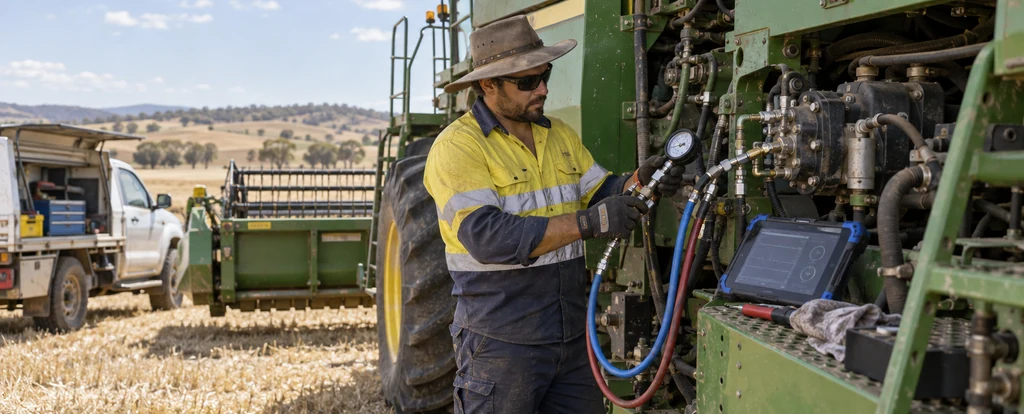
Agricultural mechanics keep the tractors, headers and sprayers on a farm working, diagnosing and repairing faults in the workshop and out in the paddock.
- Median salary*
- $75,400
4.1%vs last year, before tax
- People employed
- 1,200
0.0%vs last year
- Projected growth*
- +2%
to 2035
- AI exposure*
- Low
- automation risk
- Average hours*
- 42/wk
+2h vs all jobs
- Shortage status*
- In shortage (regional)
national
The work happens wherever farm machinery is: brand dealership workshops in country towns, independent repair businesses, farm sheds and paddocks, with a fair bit of driving between jobs. It sits closest to diesel mechanic work, but the machines are built for fieldwork rather than road transport, with hydraulics, electronics and guidance systems that set them apart. Many agricultural mechanics work for a dealership, so they specialise in one or two makes of machine and rely on the manufacturer's diagnostic software.
How much do agricultural mechanics earn?
The median full-time salary for an agricultural mechanic is $75,400 per annum, before tax, up $15,800 since 2018.
Pay depends heavily on who you work for, because a brand dealership, an independent repair business, a farm contracting company and a local council all set their own rates within the award for vehicle repair work. The extras usually come from field service, on-call rosters and the long hours through harvest. Specialising in a particular make or in precision guidance systems changes what a workshop is willing to pay.
What does an agricultural mechanic do day to day?
The list below is what fills most weeks; the exact mix shifts with seniority and whatever stage the current work is at.
- Diagnosing mechanical, hydraulic and electrical faults in tractors, headers, sprayers and other farm machinery
- Repairing or replacing engines, transmissions, hydraulic pumps, hoses and driveline components
- Carrying out scheduled servicing and pre-season checks so equipment is ready before sowing or harvest starts
- Testing machinery in the paddock and adjusting settings such as drum speed or guidance calibration for local conditions
- Recording parts and labour, ordering components from suppliers and explaining to the customer what a repair involves
What skills do agricultural mechanics need?
Employers look for installation and maintenance, hand and power tool work, plant and equipment operation, backed by John Deere Service ADVISOR fluency and strong problem solving.
Specialist skills
- Installation and maintenance
- Hand and power tool work
- Plant and equipment operation
- Field inspection and testing
Software and tools
- John Deere Service ADVISOR
- CLAAS Diagnostic Tool
- Bosch ESI[tronic]
- Topcon agriculture guidance systems
- Hydraulic flow and pressure testers
General skills
- Problem solving
- Attention to detail
- Safety and compliance awareness
Is the job growing?
About 1,200 people work as agricultural mechanics in Australia, and employment is projected to grow 2% over the decade to 2035. That's modest growth: demand is steady rather than booming.
How do you become an agricultural mechanic?
Here's the path most agricultural mechanics take, step by step.
- 1Finish Year 10 or Year 12 with maths
Employers look for maths in particular, since the trade involves electrical circuits, hydraulic pressures and measurements. A pre-apprenticeship, or any time spent in a workshop or on a farm, helps you stand out from other applicants.
- 2Start a Certificate III in Agricultural Mechanical Technology
This is the standard trade qualification, usually delivered as a paid apprenticeship over three to four years, with blocks at TAFE or another registered training organisation mixed with full-time work in a workshop.
- 3Find an apprenticeship with a dealership or repair business
Brand dealerships, farm machinery dealers, contractors and large farms all take on apprentices. Applying directly to workshops and rural dealerships often works better than waiting for a position to be advertised.
- 4Build experience across the seasons
Working through a harvest and a sowing season teaches you the failure patterns that matter, and becoming confident with one brand's diagnostic software makes you useful to dealerships that run a large service area.
- 5Add licences and qualifications as you go
A car licence is essential, and a heavy vehicle or forklift licence helps when machinery has to be moved between properties. No trade licence or registration is required to work as a mechanic in Australia, though some employers ask for welding or refrigerant handling qualifications.
Ready to apply as an agricultural mechanic?
Whether you're working toward becoming an agricultural mechanic or already are one and want a hand with the next step (sharpening your resume for ATS screening, tightening your cover letter, or knowing what you'll actually be asked at interview), here are examples grounded in this specific role, not generic templates.
What jobs can an agricultural mechanic move to?
Moving into Auto Electrician typically comes with the biggest pay rise, worth $70,600 a year more on average.
| Move to | Typical pay change | Overlap | Retraining |
|---|---|---|---|
| Auto Electrician Agricultural mechanics bring low-voltage wiring and diagnostic experience to auto electrician work, with formal electrical training required. | +$70,600 | 67% | reskill |
| Motor Mechanic Agricultural mechanics bring engine, transmission and diagnostic skills to light vehicle repair, though car-specific systems need further training. | +$8,900 | 50% | reskill |
| Diesel Mechanic Agricultural mechanics bring heavy diesel, hydraulic and driveline skills to diesel mechanic work on trucks and earthmoving equipment. | +$5,200 | 67% | reskill |
| Marine Mechanic Agricultural mechanics bring diesel engine, cooling and hydraulic skills to marine mechanic work on vessels and marine equipment. | +$0 | 63% | reskill |
Moves are chosen from Jobs and Skills Australia's Data on Occupation Mobility, which follows income tax records between 2011-12 and 2020-21, together with entry requirements and skill overlap. A known move is one people were seen making in that data. Pay change compares median full-time pay for the two roles.
Who works as an agricultural mechanic?
The typical agricultural mechanic is 33 years old; 99% are men, 90% work full-time, and full-timers average 42 hours a week.
- 33
- Median age
- 1%
- Female share
- 90%
- Full-time
- +2h
- vs all-jobs avg
What's it like being an agricultural mechanic?
The job follows the farming calendar. Sowing and harvest bring long days, evening callouts and customers who need a machine back in the paddock by morning, while the quieter months go into servicing, rebuilds and pre-season preparation. It suits someone who likes working with their hands, is comfortable driving long distances to farms and enjoys a fault that isn't obvious.
What people like
- Faults that take real detective work. Modern machinery throws codes that point you in a direction, but finding the actual cause often means tracing wiring, testing hydraulic pressures and ruling out what the software is suggesting.
- Work that changes with the season. A week might hold a gearbox rebuild in the workshop, a field service call to a header and a pre-delivery check on a new tractor, so the job rarely settles into one task.
- Getting a farm moving again. When a machine stops mid-harvest the whole operation waits on it, so a repair that puts it back to work is a visible result you can see before you leave the property.
- Time outdoors and on the road. Field service breaks up workshop time, with drives between properties and a different view from the workshop door.
What people find hard
- Harvest hours. Breakdowns don't keep office hours, and through harvest the days run long, with callouts in the evening or before dawn when a header or tractor has stopped.
- Chaff, dust and weather. Oil, mud and crop residue come with the job, and repairs in the field happen in whatever heat, cold or rain the day brings.
- Waiting on parts. A machine can sit idle for days while a component comes from interstate or overseas, and you're the one explaining the delay to a customer who is losing time.
- Long drives on your own. Service areas can be large, so a single callout might mean several hours of driving for an hour of work at the other end.
Based on our synthesis of professional-body surveys and public accounts of the role, not first-person verified reviews.
Which industries employ agricultural mechanics?
Agriculture, forestry and fishing employs the largest share of agricultural mechanics, followed by Machinery and equipment wholesaling.
Top employing industries
- 1Agriculture, forestry and fishing
- 2Machinery and equipment wholesaling
- 3Repair and maintenance services
- 4Mining
- 5Construction
Ranked by employment share; the source doesn't publish an exact percentage per industry.
| Certificate III/IV | 34% | |
|---|---|---|
| Diploma / Advanced Diploma | 26% | |
| Bachelor degree | 20% | |
| Year 12 or below | 20% |
Will AI replace agricultural mechanics?
This is low-exposure work. Diagnostic platforms such as John Deere Service ADVISOR and CLAAS Diagnostic Tool read fault codes and guide a diagnosis, but the fault still has to be confirmed, and the repair happens with tools in a workshop or a paddock. Pulling a transmission out of a tractor, replacing a hydraulic hose in the field and setting up a header for the crop are physical jobs that automation doesn't reach.
Share of typical working time by exposure level
- Hands-on repair of engines, hydraulics and drivelinesRemoving a failed hydraulic pump, splitting a tractor or rebuilding a gearbox is manual work in a workshop bay, and that share of the week hasn't changed.40%low
- Field service and pre-season checksTravelling to a farm to test a machine under load, adjust settings and check it over before sowing is work that has to happen on site.25%low
- Reading fault codes and diagnostic softwareManufacturer platforms narrow down where a fault is likely to be, which saves time but doesn't confirm the actual cause.20%moderate
- Parts ordering, job records and warranty paperworkParts catalogues, service histories and warranty claims are increasingly handled through dealer systems that fill in much of the detail automatically.15%high
Common questions about becoming an agricultural mechanic
Straight answers to the questions people ask most.
How much does an agricultural mechanic earn?
$75,400 per annum, before tax, for full-time work. What you take home depends on the employer and the region, with dealership rates, field service allowances, on-call rosters and harvest overtime making more difference than the trade average suggests.
How do you become an agricultural mechanic?
The usual route is a Certificate III in Agricultural Mechanical Technology (AUR30420), completed as a paid apprenticeship over three to four years. You need to be taken on by a dealership, repair business or contractor, so most entrants apply directly to workshops in farming areas.
Are agricultural mechanics in demand?
Agricultural mechanics are currently in shortage in regional areas. Employment is projected to grow 2% over the decade to 2035, so the trade stays small and openings tend to appear when someone leaves a workshop or a dealership expands its service area.
Will AI or automation replace agricultural mechanics?
Diagnostic software and telematics are already part of the job, and a dealer can read fault codes from a machine hundreds of kilometres away before you arrive. That changes where a diagnosis starts rather than who fixes the machine, and the physical work of removing, repairing and adjusting components stays with the mechanic.
What can an agricultural mechanic move into?
Diesel mechanic and motor mechanic work are the closest shifts, because engine, hydraulic and driveline skills carry across with extra training on the vehicles involved. Auto electrician and marine mechanic roles suit those willing to take on further study in electrical or marine systems. Some mechanics go out on their own with a mobile service van or open a workshop, and that is often where earnings grow.
How many hours do agricultural mechanics work?
Full-time agricultural mechanics average 42 hours a week, but the spread is wide, with quiet months close to standard hours and harvest weeks well beyond them. Overtime and on-call work are common in dealership service departments.
Related roles
Not sure this is you? Take the career quiz and get a ranked shortlist of roles that fit how you like to work.