Exhaust Fitter
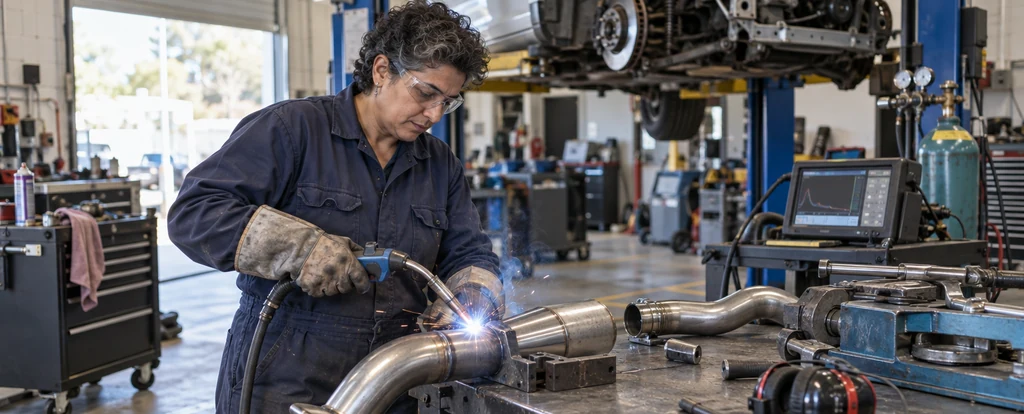
Exhaust fitters install, repair and replace the exhaust systems that carry gases away from a vehicle's engine and keep the noise down.
- Median salary*
- $67,600
4.2%vs last year, before tax
- People employed
- 180
10.0%vs last year
- Projected growth
- +4.6%
to 2035
- AI exposure*
- Low
- automation risk
- Average hours
- 40/wk
matches all-jobs average
- Shortage status
- Not in shortage
national
Exhaust fitters work in automotive workshops, muffler and exhaust shops, and the manufacturing businesses that make exhaust components. Their nearest neighbours are motor mechanics, but the work stays on the exhaust and emissions system rather than the engine and driveline, and much of it is fabrication: cutting, bending and welding pipe to fit a particular vehicle. Some specialise in performance systems, and others in heavy vehicles, plant and fleet work.
How much do exhaust fitters earn?
The median full-time salary for an exhaust fitter is $67,600 per annum, before tax, up $14,200 since 2018.
Where you work shapes pay more than the job title does: custom and performance shops that weld stainless pay above the award rate, while high-volume replacement outlets tend to pay closer to it. Penalty rates, overtime and shift allowances apply in some workplaces, particularly in heavy vehicle and fleet servicing where jobs run outside standard hours.
What does an exhaust fitter do day to day?
The list below is what fills most weeks; the exact mix shifts with seniority and whatever stage the current work is at.
- Removing and replacing worn mufflers, catalytic converters and pipe sections
- Cutting, bending and welding pipe to clear a vehicle's chassis and suspension
- Hanging and aligning a new system so it sits clean and doesn't rattle
- Running an exhaust gas analyser to check emissions and noise levels
- Talking a customer through the options for a repair, a replacement or a performance system
What skills do exhaust fitters need?
Employers look for hand and power tool work, fabrication and finishing, installation and maintenance, backed by MIG welder fluency and strong problem solving.
Specialist skills
- Hand and power tool work
- Fabrication and finishing
- Installation and maintenance
- Plant and equipment operation
Software and tools
- MIG welder
- Pipe bender
- Exhaust gas analyser
- Hand and power tools
General skills
- Problem solving
- Attention to detail
- Safety and compliance awareness
Is the job growing?
About 180 people work as exhaust fitters in Australia, and employment is projected to grow 4.6% over the decade to 2035. That's modest growth: demand is steady rather than booming.
How do you become an exhaust fitter?
Here's the path most exhaust fitters take, step by step.
- 1Finish school or a pre-apprenticeship
Year 12 helps but isn't required, and a certificate II in automotive vocational preparation gives you workshop exposure that makes you a stronger apprentice applicant. About 50% of people in the job list Year 12 or below as their highest qualification, so there is no single gatekeeping credential.
- 2Start an automotive apprenticeship or traineeship
Most people enter through a certificate III in light vehicle mechanical technology (AUR30620) or a related automotive qualification, combining paid work in a workshop with study at TAFE or another registered training organisation. It usually takes three to four years, and you need a driver licence because the job involves road testing vehicles and moving between sites.
- 3Build the fabrication skills
Exhaust work is fabrication as much as mechanics, so MIG welding on mild steel, TIG welding on stainless, pipe bending and cutting are what employers look at. Practise on scrap pipe and learn to work with aluminised and stainless steel, which behave differently from each other.
- 4Learn the emissions and noise rules
Australian Design Rules and state road rules set what a vehicle must keep, and tampering with emissions equipment is an offence in most states. Knowing what you can and can't legally change on a road vehicle is part of advising customers properly.
Ready to apply as an exhaust fitter?
Whether you're working toward becoming an exhaust fitter or already are one and want a hand with the next step (sharpening your resume for ATS screening, tightening your cover letter, or knowing what you'll actually be asked at interview), here are examples grounded in this specific role, not generic templates.
What jobs can an exhaust fitter move to?
Moving into Panel Beater typically comes with the biggest pay rise, worth $28,500 a year more on average.
| Move to | Typical pay change | Overlap | Retraining |
|---|---|---|---|
| Panel Beater Exhaust fitters know vehicle undersides and fitting, but panel beating requires a separate apprenticeship in body repair. | +$28,500 | 67% | requalify |
| Motor Mechanic Exhaust fitters bring vehicle systems and emissions knowledge, but must complete a motor mechanic apprenticeship to service engines and drivetrains.Known move | +$16,700 | 50% | requalify |
| Vehicle Accessories Fitter Exhaust fitters already install and align vehicle components, so vehicle accessories fitting builds on those skills with a short course. | −$2,600 | 53% | short course |
Moves are chosen from Jobs and Skills Australia's Data on Occupation Mobility, which follows income tax records between 2011-12 and 2020-21, together with entry requirements and skill overlap. A known move is one people were seen making in that data. Pay change compares median full-time pay for the two roles.
Who works as an exhaust fitter?
The typical exhaust fitter is 53 years old; 97% are men, 82% work full-time, and full-timers average 40 hours a week.
- 53
- Median age
- 3%
- Female share
- 82%
- Full-time
- +0h
- vs all-jobs avg
What's it like being an exhaust fitter?
The work has a short cycle: a car comes in, the faulty system comes off, a new one is made or fitted, and the customer drives away the same day, which suits people who like finishing what they start. Most workshops run with small teams, so there is little supervision and plenty of noise, fumes and hot metal. The pace is set by the job list, and a seized or rusted bolt can turn a quoted half hour into an afternoon.
What people like
- The fit is obvious when it's right. A system that hangs clear of the body, doesn't rattle and sounds right tells you straight away that the job was done well.
- Custom work uses real skill. Building a stainless system for a performance or four-wheel drive customer means measuring, bending and welding to a shape nobody has drawn for you, and the result is yours.
- Short jobs with a visible result. Many repairs are finished in a morning, so you get the satisfaction of a completed job rather than a project that runs for months.
- Small workshops, little bureaucracy. Most exhaust shops run with a handful of people, so decisions are quick and you usually deal with the owner rather than layers of management.
What people find hard
- Rust and seized fasteners. On older vehicles, bolts and flanges are often rusted solid, so a straightforward replacement turns into cutting, drilling and welding before anything new goes on.
- Quoted times that a snapped bolt blows out. Jobs are often priced per vehicle, and the fiddly extra time rarely gets billed, so the pressure of the quote lands on the person doing the work.
- Noise, fumes and hot metal. You work under raised vehicles with engines running, exhausts still hot and welding sparks close by, so hearing protection and good ventilation matter every day.
- Customers asking for changes you can't legally make. Requests to remove a catalytic converter or fit a straight-through pipe come up often, and most states won't allow it on a vehicle used on the road, so you have to explain why not.
Based on our synthesis of professional-body surveys and public accounts of the role, not first-person verified reviews.
Which industries employ exhaust fitters?
Other Services employs the largest share of exhaust fitters, followed by Manufacturing.
Top employing industries
- 1Other Services
- 2Manufacturing
- 3Administrative and Support Services
Ranked by employment share; the source doesn't publish an exact percentage per industry.
| Year 12 or below | 49.8% | |
|---|---|---|
| Certificate III/IV | 45.4% | |
| Postgraduate | 1.6% | |
| Diploma / Advanced Diploma | 1.6% | |
| Bachelor degree | 0% |
Will AI replace exhaust fitters?
Exhaust fitting has low exposure to AI and automation because the core of the job is physical and one-off: a pipe has to be measured, cut, bent and welded to fit the vehicle in front of you, and the finished system is checked by ear and hand for rattles and leaks. Software does reach the quoting, parts lookup and diagnostic side, which is where most of the change is, but it doesn't do the fabrication or the fitting.
Share of typical working time by exposure level
- Measuring, cutting and bending pipeEvery system is built around a particular chassis and suspension layout, so the bend angles come from the vehicle rather than a drawing.30%low
- Welding exhaust componentsMIG on mild steel and TIG on stainless still need a person under the hoist, especially where a weld has to be gas-tight on a custom system.25%low
- Fitting and aligning systems on the vehicleHangers, flanges and clearance to the body are adjusted by feel and by listening for rattles on a road test.25%low
- Quoting jobs and ordering partsCatalogue software and quoting tools already match a vehicle to the right muffler or converter and price the job, which cuts the time spent on this part of the work.20%high
Common questions about becoming an exhaust fitter
Straight answers to the questions people ask most.
How much do exhaust fitters earn?
The median full-time pay for exhaust fitters is $67,600 per year before tax. That is a median across full-time workers, so it sits in the middle of a range: custom and stainless fabrication work pays more, and high-volume replacement work pays less.
How do you become an exhaust fitter?
Most people come through an automotive apprenticeship, usually a certificate III in light vehicle mechanical technology (AUR30620) or a related qualification, and pick up the exhaust side on the job. A pre-apprenticeship such as a certificate II in automotive vocational preparation (AUR20720) helps you get hired, and welding experience stands out because so much of the work is fabrication.
Are exhaust fitters in demand?
Exhaust fitters are currently not in shortage, and employment is projected to grow 4.6% over the decade to 2035. The occupation is small, with about 180 people working in it, so openings tend to come from retirements and staff turnover rather than from new workshops opening.
Will AI or automation replace exhaust fitters?
The work rates as low exposure to AI and automation, mainly because the fabrication and fitting is physical and different on every vehicle. Quoting software, online parts catalogues and scan tools speed up the paperwork and the diagnosis, but a pipe still has to be measured, cut, bent and welded by hand.
What is the difference between an exhaust fitter and a motor mechanic?
Exhaust fitters specialise in the exhaust and emissions system and the fabrication around it, while motor mechanics diagnose and repair engines, transmissions, brakes and the rest of the vehicle. The two work side by side in some workshops, and the exhaust trade is the narrower of the two.
What career moves are open to an exhaust fitter?
Motor Mechanic is a common move and the median there is $16,700 more, but it needs a full apprenticeship because engine and driveline work is a separate trade. Panel Beater is another route and the median is $28,500 more, though it also requires a separate apprenticeship in body repair. Many experienced people in this trade eventually open their own workshop or go out as mobile operators, and running the business is often where earnings grow.
Related roles
- Motor Mechanic
- Panel Beater
- Vehicle Accessories Fitter
- Motor Mechanic
- Metal Machinist
- Mechanic's Assistant
Not sure this is you? Take the career quiz and get a ranked shortlist of roles that fit how you like to work.