Chocolatier
Chocolatiers turn couverture chocolate into filled, moulded and hand-finished confectionery for shops, cafes and gift markets.
- Median salary*
- $59,800
3.8%vs last year, before tax
- People employed*
- 2,200
0.0%vs last year
- Projected growth*
- +2%
to 2035
- AI exposure*
- Moderate
- automation risk
- Average hours*
- 40/wk
matches all-jobs average
- Shortage status*
- Not in shortage
national
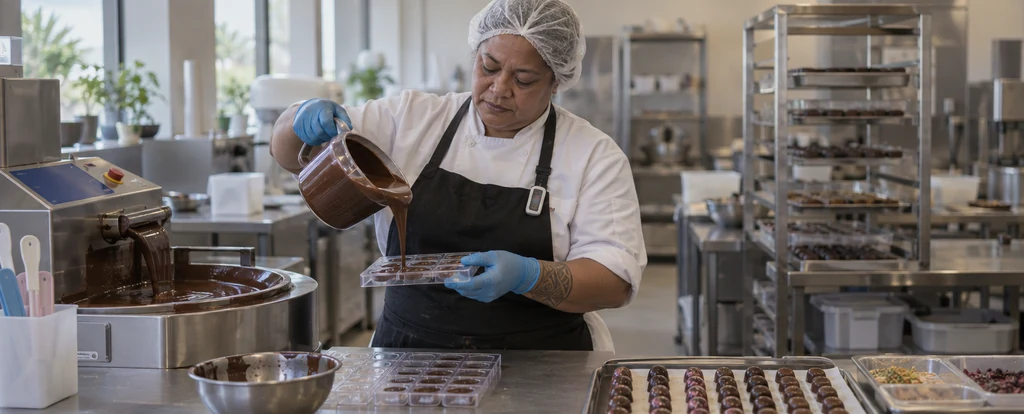
Most chocolatiers work in a small production kitchen attached to a shop, or on the confectionery line of a food manufacturer. What separates the job from pastry chefs and cake decorators is the focus on chocolate itself: tempering, fillings and finish, not baked goods. Teams are usually small, so one person often handles production, packing and counter sales in the same day.
How much do chocolatiers earn?
The median full-time salary for a chocolatier is $59,800 per annum, before tax, up $12,400 since 2018.
Where you work shapes pay more than anything else: a small retail kitchen, a larger manufacturing operation or your own business all sit in different places. Experienced chocolatiers who run production or develop ranges earn more than those starting on packing and moulding, and award coverage differs between food manufacturing and retail settings.
What does a chocolatier do day to day?
The list below is what fills most weeks; the exact mix shifts with seniority and whatever stage the current work is at.
- Tempering couverture on a machine or a marble slab until it sets with a clean snap
- Cooking ganache, praline and caramel fillings and checking their texture as they cool
- Moulding, enrobing and hand-piping chocolates and bonbons
- Building seasonal ranges for Easter and Christmas, when production runs hardest
- Packing, labelling and storing stock to food safety standards, and washing moulds between batches
What skills do chocolatiers need?
Employers look for food preparation and cooking, food safety and hygiene, craft and handmade production, backed by Tempering machine fluency and strong attention to detail.
Specialist skills
- Food preparation and cooking
- Food safety and hygiene
- Craft and handmade production
- Inventory management
- Operations management
Software and tools
- Tempering machine
- Chocolate moulds
- Digital thermometer
- POS systems
- Inventory management software
General skills
- Attention to detail
- Customer service
Is the job growing?
About 2,200 people work as chocolatiers in Australia, and employment is projected to grow 2% over the decade to 2035. That's modest growth: demand is steady rather than booming.
How do you become a chocolatier?
Here's the path most chocolatiers take, step by step.
- 1Start with a food qualification
A Certificate III in Patisserie (SIT31021) or a Certificate III in Food Processing (FBP30121) covers food safety, ingredients and production basics, and both are accepted by chocolate makers hiring for junior roles.
- 2Complete food safety training
A food handler certificate is the minimum before you work with food in most states, and a Food Safety Supervisor course helps if you will be running a kitchen or supervising others.
- 3Learn tempering on the job
Tempering is the skill that sets a chocolatier apart, and the usual way to learn it is alongside an experienced maker. A patisserie apprenticeship is one route in, but many people start as kitchen hands in a chocolate shop or production kitchen and build up from packing and moulding.
- 4Specialise or take on production
After a few years, chocolatiers often narrow their focus, whether that is filled chocolates, bean-to-bar production or pastry, or take charge of a small production kitchen. Some go on to open their own shop, which is usually where earnings grow.
Ready to apply as a chocolatier?
Whether you're working toward becoming a chocolatier or already are one and want a hand with the next step (sharpening your resume for ATS screening, tightening your cover letter, or knowing what you'll actually be asked at interview), here are examples grounded in this specific role, not generic templates.
What jobs can a chocolatier move to?
Moving into Pastry Chef typically comes with the biggest pay rise, worth $13,900 a year more on average.
| Move to | Typical pay change | Overlap | Retraining |
|---|---|---|---|
| Pastry Chef Chocolatiers move into pastry chef roles by completing an apprenticeship, applying their chocolate knowledge to broader pastry production. | +$13,900 | 53% | requalify |
| Baker Chocolatiers can requalify as bakers through an apprenticeship, using their confectionery skills in bread and pastry baking. | +$13,900 | 43% | requalify |
| Coffee Roaster Chocolatiers can become coffee roasters with a short course, transferring their understanding of flavour development and small-batch production. | +$5,200 | 48% | short course |
| Cake Decorator Chocolatiers bring chocolate tempering and moulding skills to cake decoration, needing only a short course to adapt to sugar work. | +$0 | 52% | short course |
Moves are chosen from Jobs and Skills Australia's Data on Occupation Mobility, which follows income tax records between 2011-12 and 2020-21, together with entry requirements and skill overlap. A known move is one people were seen making in that data. Pay change compares median full-time pay for the two roles.
Who works as a chocolatier?
The typical chocolatier is 35 years old; 55% are women, 70% work full-time, and full-timers average 40 hours a week.
- 35
- Median age
- 55%
- Female share
- 70%
- Full-time
- +0h
- vs all-jobs avg
What's it like being a chocolatier?
The work is part craft, part production line: steady, repetitive batches through most of the year, then long days when a seasonal range is due. Kitchens are kept cool and dry because chocolate is fussy about heat and humidity, and much of the day is spent standing. It suits people who like precision and don't mind that the reward arrives at the end of a batch.
What people like
- Tempering that comes good. Getting a batch to set with a mirror gloss and a clean snap is a skill you can see, and it takes practice before it happens every time.
- Room to invent flavours. Small producers test new combinations for seasonal ranges, so the person making the chocolate usually has a say in what goes into it.
- Quieter than a restaurant kitchen. Production runs to its own timetable instead of a dinner service, which suits people who prefer steady work to a rush.
- Customers who taste the difference. In a shop or at a market stall you often hand the product over yourself and hear straight away what people think of it.
What people find hard
- Chocolate punishes small mistakes. A few degrees too warm, or a humid day, and the temper fails, which means reworking the batch rather than saving it.
- The seasonal crunch. Easter and Christmas concentrate production into a few weeks of longer days and repetitive moulding.
- Pay is modest in small shops. Small producers often can't pay much above the food manufacturing or retail award, so the higher rates come with production or management responsibility.
- Cleaning and food safety paperwork. Moulds and equipment are washed constantly between batches, and temperature and hygiene records are part of every day.
Based on our synthesis of professional-body surveys and public accounts of the role, not first-person verified reviews.
Which industries employ chocolatiers?
Chocolate and confectionery manufacturing employs the largest share of chocolatiers, followed by Specialised food retailing.
Top employing industries
- 1Chocolate and confectionery manufacturing
- 2Specialised food retailing
- 3Cafes, restaurants and catering
- 4Tourism and hospitality
Ranked by employment share; the source doesn't publish an exact percentage per industry.
| Certificate III/IV | 34% | |
|---|---|---|
| Diploma / Advanced Diploma | 26% | |
| Bachelor degree | 20% | |
| Year 12 or below | 20% |
Will AI replace chocolatiers?
Chocolate making sits in the middle: machines take on more of the routine production, but the parts customers pay for still depend on a person's eye and palate. Tempering machines, moulding lines and inventory software handle consistency and stock control, while flavour, finish and the look of the product stay hands-on.
Share of typical working time by exposure level
- Hand-finishing and decoratingPiping, dipping and decoration are the visible skill of the trade, and buyers pay for the slightly irregular hand-made finish.30%low
- Tempering and moulding chocolateA tempering machine holds the curve and a casting line speeds up moulding, but you still watch gloss, snap and humidity, and rework any batch that fails.25%moderate
- Stock control, packing and counter salesInventory and point-of-sale software flag what to make next and what to reorder, and online orders are picked and labelled from the same system.25%high
- Making ganache, praline and caramel fillingsRecipe software scales a batch and costs it out, yet texture and flavour balance are adjusted by taste each time a filling is cooked.20%low
Moves least exposed to AI
These career moves from chocolatier work are rated low for AI exposure:
- Cake Decorator
Solid skill overlap (52%), short course to get there, and a low automation-risk profile.
- Pastry Chef
Solid skill overlap (53%), requalify to get there, and a low automation-risk profile.
Common questions about becoming a chocolatier
Straight answers to the questions people ask most.
How much do chocolatiers earn?
Chocolatiers earn a median of $59,800 per year before tax. That covers full-time workers across manufacturing and retail, so individual pay moves with experience, the size of the business and whether you take on production or management duties. Treat it as a guide rather than a starting rate.
How do you become a chocolatier?
Most people start with a Certificate III in Patisserie (SIT31021) or a Certificate III in Food Processing (FBP30121), then learn tempering and moulding on the job in a production kitchen or a chocolate shop. Food safety training is usually required before you handle food. Once you are in, experience with batch production counts for more than a higher qualification.
Are chocolatiers in demand?
Chocolatiers are currently not in shortage, and employment is projected to grow 2% over the decade to 2035 over the decade to 2035. With about 2,200 people in the role nationally, openings tend to come up in individual shops and kitchens rather than in large annual intakes, so local contacts and a good sample box help.
Will AI replace chocolatiers?
Tempering machines, moulding lines and stock software already handle part of the routine work, which is why the role carries moderate exposure rather than low. What stays with people is the judgement customers notice: a clean temper, a balanced ganache and hand-finished decoration.
What else can a chocolatier do?
Chocolatiers often move sideways into cake decorating, which needs only a short course and pays about the same, or into coffee roasting, another short-course move at $5,200 more. Moving to pastry chef or baker usually means requalifying through an apprenticeship and brings $13,900 more. Many experienced chocolatiers instead open their own small production kitchen or shop, which is often where earnings grow.
What are the hours like for a chocolatier?
Full-time chocolatiers average around 40 hours a week, mostly during the day. Retail and market work adds weekend and public holiday shifts on a roster, and small businesses need cover on their busiest trading days.
Related roles
Not sure this is you? Take the career quiz and get a ranked shortlist of roles that fit how you like to work.