Conservator
Conservators treat and care for artworks, artefacts and archival collections so they survive for the long term.
- Median salary*
- $78,000
4.4%vs last year, before tax
- People employed
- 530
6.0%vs last year
- Projected growth
- +24.7%
to 2035
- AI exposure*
- Low
- automation risk
- Average hours
- 41/wk
+1h vs all jobs
- Shortage status
- Not in shortage
national
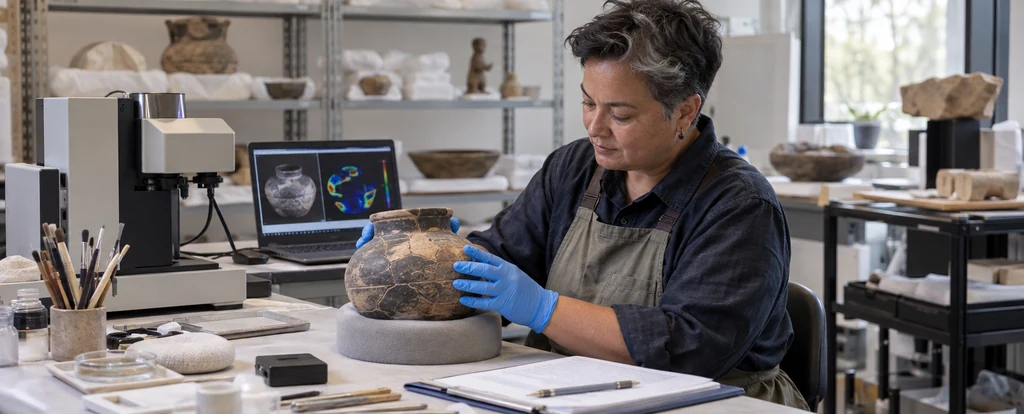
Conservators work in museums, galleries, archives, libraries and heritage sites, and some run their own studios on contract for smaller collections and private owners. The work sits between science and craft: a conservator might analyse a pigment under a microscope in the morning and spend the afternoon consolidating flaking paint on a painting. It differs from curatorial work in that a conservator handles the object itself, rather than deciding what a collection should contain or how it is displayed.
How much do conservators earn?
The median full-time salary for a conservator is $78,000 per annum, before tax, up $16,500 since 2018.
Pay depends heavily on who employs you. Public museums, galleries and archives pay against enterprise agreements or state public service bands, while contract and project work can leave unpaid gaps between funded jobs. Specialisation matters as well, since senior treatment roles in paintings, textiles or objects are few, and income in private practice rises and falls with the work you win.
What does a conservator do day to day?
The list below is what fills most weeks; the exact mix shifts with seniority and whatever stage the current work is at.
- Assessing the condition of objects and identifying how they are deteriorating
- Recording examinations and treatments in a collection management system
- Cleaning, stabilising and repairing objects with treatments that can be reversed later
- Monitoring temperature, humidity, light and pests in storage, display and transit
- Advising on handling, loans, exhibitions and salvage after a flood or fire
What skills do conservators need?
Employers look for craft and handmade production, laboratory analysis, project management, backed by The Museum System (TMS) fluency and strong attention to detail.
Specialist skills
- Craft and handmade production
- Laboratory analysis
- Project management
- Regulatory compliance
Software and tools
- The Museum System (TMS)
- Adobe Photoshop
- ImageJ
- X-ray fluorescence (XRF) spectrometer
- FTIR spectrometer
General skills
- Attention to detail
- Written communication
- Problem solving
Is the job growing?
About 530 people work as conservators in Australia, and employment is projected to grow 24.7% over the decade to 2035. That's very strong growth. Few roles in Australia are expanding this fast, and it points to solid demand for years to come.
How do you become a conservator?
Here's the path most conservators take, step by step.
- 1Complete an undergraduate degree
Conservation training starts with a bachelor degree, often in science, art history, archaeology or fine arts. Chemistry and materials subjects are the ones that carry into conservation study, so they are worth choosing deliberately.
- 2Study conservation at postgraduate level
About 45% of the people working as conservators hold a postgraduate qualification, and specialist training is usually completed there. Only a handful of Australian universities offer conservation programs, so study often means moving city or travelling for placements.
- 3Get supervised bench hours
Courses include placements in museum and gallery labs, and the treatment hours you record there are what employers ask about. Volunteering with a historical society or a small collecting institution is a realistic way to add hours before you finish studying.
- 4Choose a specialisation
Conservators usually settle into a material or a type of work, such as paintings, paper and books, objects, textiles, or preventive conservation. Specialising early makes it easier to find supervision, because senior conservators in your area are the people who will train you.
- 5Join the professional body
The Australian Institute for the Conservation of Cultural Material is the professional body, and its special interest groups, conferences and mentoring matter in a field this small, where many roles are filled through people who already know your work.
Ready to apply as a conservator?
Whether you're working toward becoming a conservator or already are one and want a hand with the next step (sharpening your resume for ATS screening, tightening your cover letter, or knowing what you'll actually be asked at interview), here are examples grounded in this specific role, not generic templates.
What jobs can a conservator move to?
Moving into Archivist typically comes with the biggest pay rise, worth $40,500 a year more on average.
| Move to | Typical pay change | Overlap | Retraining |
|---|---|---|---|
| Archivist A conservator brings hands-on collection care and materials knowledge to archival preservation, with short training in records management. | +$40,500 | 47% | short course |
| Curator A conservator's collection and exhibition knowledge supports curatorial work, but interpretation and exhibition planning require further study. | +$9,400 | 20% | requalify |
Moves are chosen from Jobs and Skills Australia's Data on Occupation Mobility, which follows income tax records between 2011-12 and 2020-21, together with entry requirements and skill overlap. A known move is one people were seen making in that data. Pay change compares median full-time pay for the two roles.
Who works as a conservator?
The typical conservator is 48 years old; 70% are women, 59% work full-time, and full-timers average 41 hours a week.
- 48
- Median age
- 70%
- Female share
- 59%
- Full-time
- +1h
- vs all-jobs avg
What's it like being a conservator?
The work is project-paced rather than deadline-driven, and a single treatment can run for months, so the job suits someone comfortable with slow, careful progress. Days are split between the bench, the gallery floor and the computer, and a good share of the work is preventive: keeping conditions stable so objects never need treatment at all. The field is small and specialised, and much of it happens alongside curators, registrars, scientists and sometimes the communities an object belongs to.
What people like
- Work you can see finish. A treatment can take weeks of small steps, and watching a torn work or a corroded metal object come back together is the payoff.
- Knowledge of materials. Conservators learn how a pigment, textile or timber behaves over decades, and that understanding gets sharper with every object they handle.
- Objects most people never see. A museum lab brings you close to items that sit in storage for years, from colonial furniture and scientific instruments to film and photographic negatives.
- Deciding with other specialists. Treatment plans are usually settled with curators, registrars, scientists and conservators from other materials, which keeps the work from becoming solitary.
What people find hard
- Funding shapes the career. Many positions are project or grant funded, so contracts end when the money does and the next job can be interstate.
- Progress is counted in objects. A single large treatment can absorb months, and there is no way to hurry the drying time of an adhesive or the slow removal of a varnish.
- The paperwork is constant. Condition reports, treatment proposals, loan forms and environmental logs are a large part of the job, and they have to be accurate enough to be read years later.
- Solvents and physical load. Conservators work with solvents, dust, mould and occasionally heavy objects, and much of the job is done standing at a bench.
Based on our synthesis of professional-body surveys and public accounts of the role, not first-person verified reviews.
Which industries employ conservators?
Arts and Recreation Services employs the largest share of conservators, followed by Information Media and Telecommunications.
Top employing industries
- 1Arts and Recreation Services
- 2Information Media and Telecommunications
- 3Public Administration and Safety
Ranked by employment share; the source doesn't publish an exact percentage per industry.
| Postgraduate | 45% | |
|---|---|---|
| Bachelor degree | 33.6% | |
| Diploma / Advanced Diploma | 7.8% | |
| Year 12 or below | 7.6% | |
| Certificate III/IV | 4.7% |
Will AI replace conservators?
Conservators sit at the low end of AI exposure, because the core of the job is hands-on treatment of unique objects. Software already helps with condition photography, spectral analysis and collection records, and that side of the work will keep getting faster. What it does not change is the physical treatment: judging how far to intervene on a deteriorating object and carrying that out by hand.
Share of typical working time by exposure level
- Treating objects by handConsolidating flaking paint, filling a loss in a ceramic or humidifying a rolled document depends on hand skills and on reading the material in front of you.45%low
- Condition examination and analysisXRF and FTIR spectrometers and imaging tools speed up identifying pigments and corrosion products, but working out what the results mean for the object is still a conservator's call.20%moderate
- Documentation and collection recordsTreatment reports, condition surveys and entries in a collection management system such as TMS are text and image work that drafting tools increasingly handle.20%high
- Preventive care and environmental monitoringData loggers and building systems flag temperature and humidity drift automatically, though deciding how to respond in a store or gallery still rests with the conservator.15%moderate
Common questions about becoming a conservator
Straight answers to the questions people ask most.
How much do conservators earn?
Conservators earn a median of $78,000 per annum, before tax. Pay sits within public service bands or enterprise agreements in most museums and collecting institutions, while contract conservators carry the gaps between funded projects.
How do you become a conservator?
The usual route is an undergraduate degree, often in science, art history or fine arts, followed by a postgraduate qualification in conservation and a period of supervised treatment work. Entry is competitive, so placements and volunteer hours in a collecting institution count for a lot.
Are conservators in demand?
Conservators are currently not in shortage. Employment is projected to grow 24.7% over the decade to 2035, and with about 530 people in the field that is a small number of positions in absolute terms, many of them tied to project funding rather than ongoing budgets.
Will AI replace conservators?
AI and automation reach the analysis and record-keeping side of the job more than the bench. Software speeds up condition photography, spectral comparison and documentation, but a treatment plan for a torn canvas or a corroded bronze still depends on hands and judgement about the material.
What else can a conservator do?
Conservators often move into archival preservation, where collection care transfers with a short course and the median pay for archivists is $40,500 more than for conservators. Chemists come the other way with minimal retraining, since 67% of their skills overlap, and curatorial work is a further step that needs study in interpretation and exhibition planning. Many also build a private practice or take contract work for smaller galleries and private owners, which is often where earnings grow.
What is the difference between a conservator and a curator?
A conservator is responsible for the physical care of an object, while a curator decides what a collection should contain and how it is interpreted and displayed. The two work together on exhibitions and acquisitions, but the roles need different training.
Related roles
Not sure this is you? Take the career quiz and get a ranked shortlist of roles that fit how you like to work.