Fisheries Scientist
Fisheries scientists work out how much fishing a stock can take, using field surveys and population models to advise on catch limits and conservation.
- Median salary*
- $101,400
4.3%vs last year, before tax
- People employed
- 160
20.0%vs last year
- Projected growth*
- +4%
to 2035
- AI exposure*
- Moderate
- automation risk
- Average hours*
- 38/wk
−2h vs all jobs
- Shortage status*
- Not in shortage
national
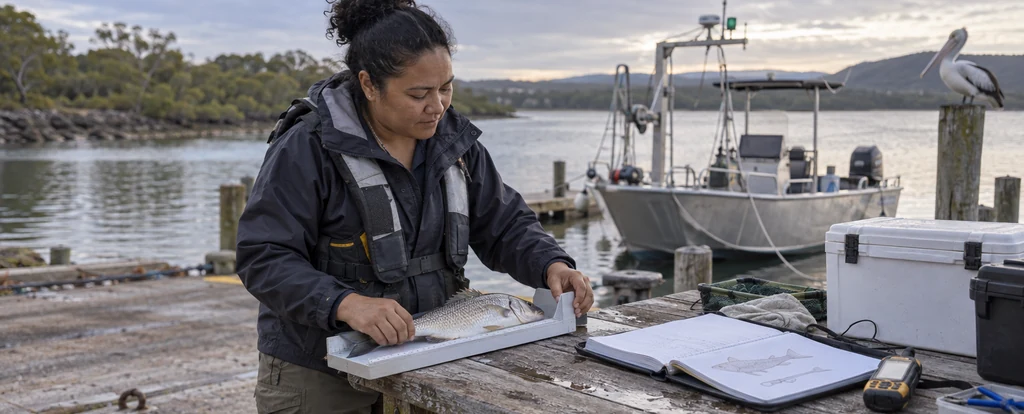
Most fisheries scientists work for state or Commonwealth fisheries agencies, research institutes or environmental consultancies, splitting their time between field sampling, laboratory work and statistical modelling. The job is built around a management question: how many fish can be taken from a stock without pushing it into decline. It sits close to marine biology, but where a marine biologist might study any marine species, a fisheries scientist usually works on fished stocks and the rules that govern them.
How much do fisheries scientists earn?
The median full-time salary for a fisheries scientist is $101,400 per annum, before tax, up $21,400 since 2018.
Most fisheries scientists are paid under public sector classifications, so the agreement covering the agency sets the band and annual increases come through increments and promotion. Consultancies and research institutes set their own scales and may pay differently for people who can run assessments unsupervised. Early roles are often short-term project contracts, and contract length can matter more to total earnings than the rate itself.
What does a fisheries scientist do day to day?
The list below is what fills most weeks; the exact mix shifts with seniority and whatever stage the current work is at.
- Sampling fish at boat ramps, markets and on research charters to record age, length and breeding condition
- Running stock assessments in R or Stock Synthesis to estimate how a population is tracking
- Tagging and tracking fish to map movement between estuaries, reefs and open water
- Writing advice for managers on catch limits, closed seasons and gear restrictions
- Checking logbook and catch data from commercial fishers and reporting on what it shows
What skills do fisheries scientists need?
Employers look for data analysis, statistical modelling, field research and sampling, backed by R fluency and strong written communication.
Specialist skills
- Data analysis
- Statistical modelling
- Field research and sampling
- Laboratory analysis
- Environmental assessment
- Policy analysis and advice
Software and tools
- R
- Python
- ArcGIS
- Stock Synthesis
- Microsoft Excel
General skills
- Written communication
- Problem solving
Is the job growing?
About 160 people work as fisheries scientists in Australia, and employment is projected to grow 4% over the decade to 2035. That's modest growth: demand is steady rather than booming.
How do you become a fisheries scientist?
Here's the path most fisheries scientists take, step by step.
- 1Complete a bachelor degree in marine science, biology or environmental science
Three or four years full time. Choose units in ecology, statistics and population modelling, because stock assessment is quantitative work and employers look for the maths as much as the biology.
- 2Add an honours year or a master's if you want to specialise
A research project gives you a supervisor who knows the agencies and a piece of work to talk about at interview. Postgraduate qualifications are held by a substantial share of the people already in the role.
- 3Get field experience while you study
Volunteer with fish tagging programs, university research projects or your state fisheries agency. Time on boats and at boat ramps separates applicants who otherwise hold the same degree.
- 4Apply for graduate, technical or research assistant roles
State and Commonwealth agencies, research institutes and environmental consultancies are the main employers. Many people enter through a technical officer or research assistant position and move into scientific work as their modelling experience builds.
- 5Learn the assessment tools on the job
R, Python and packages such as Stock Synthesis are mostly learned at work, alongside the agency's own databases. Being able to run an assessment and explain what it means is what turns a technical role into a scientific one.
Ready to apply as a fisheries scientist?
Whether you're working toward becoming a fisheries scientist or already are one and want a hand with the next step (sharpening your resume for ATS screening, tightening your cover letter, or knowing what you'll actually be asked at interview), here are examples grounded in this specific role, not generic templates.
What jobs can a fisheries scientist move to?
Moving into Ecologist typically comes with the biggest pay rise, worth $200 a year more on average.
| Move to | Typical pay change | Overlap | Retraining |
|---|---|---|---|
| Ecologist Fisheries scientists apply habitat and population knowledge to ecological assessment, conservation and environmental monitoring roles. | +$200 | 74% | minimal |
| Environmental Scientist Fisheries scientists use aquatic sampling and impact assessment experience in environmental consulting, with a short course adding regulatory knowledge. | +$200 | 58% | short course |
| Zoologist Fisheries scientists transfer animal population and field survey expertise to zoological research and wildlife management. | −$2,600 | 67% | minimal |
| Biologist Fisheries scientists carry ecological modelling and field survey skills into broader biological research and monitoring work. | −$5,200 | 81% | minimal |
| Marine Biologist Fisheries scientists bring fish population and aquatic ecosystem expertise to marine biology roles studying wild marine species. | −$21,100 | 85% | minimal |
Moves are chosen from Jobs and Skills Australia's Data on Occupation Mobility, which follows income tax records between 2011-12 and 2020-21, together with entry requirements and skill overlap. A known move is one people were seen making in that data. Pay change compares median full-time pay for the two roles.
Who works as a fisheries scientist?
The typical fisheries scientist is 41 years old; 62% are men, 82% work full-time, and full-timers average 38 hours a week.
- 41
- Median age
- 38%
- Female share
- 82%
- Full-time
- −2h
- vs all-jobs avg
What's it like being a fisheries scientist?
The work runs to a rhythm of field seasons and analysis: weeks on boats or at boat ramps collecting samples, then long stretches at a desk cleaning data and fitting models. Assessment cycles set the pressure, because advice has to be finished in time for a management meeting and will be questioned by fishers, conservation groups and sometimes lawyers. It suits people who enjoy quantitative puzzles and can stay measured when the answer is that the data is not yet conclusive.
What people like
- Fieldwork in real places. Sampling runs take you onto estuaries, reefs and open water, and the data you bring back is yours to work with.
- Your advice changes the rules. A stock assessment can end up as a catch limit or a closed season, a direct line from analysis to what happens on the water.
- A small field with wide reach. Because the occupation is small nationally, you get to know the researchers and managers in other state agencies and often work across jurisdictions.
- Fitting a model to imperfect data. Working out why a model behaves unexpectedly, or what patchy sampling means for the result, is the intellectual core of the job.
What people find hard
- Funding cycles shape the work. Many positions are tied to short-term projects, so contract renewals and shifting government priorities decide what gets researched.
- Contested advice. Catch limits affect people's livelihoods, and your assessment may be challenged publicly by commercial fishers, recreational groups or conservation bodies.
- Time away in rough conditions. Field trips mean early starts, seasickness and days lost to weather, and some surveys run in remote areas for weeks at a time.
- Slow policy change. Advice can sit with managers for years before it becomes regulation, which is hard to watch when the data is clear.
Based on our synthesis of professional-body surveys and public accounts of the role, not first-person verified reviews.
Which industries employ fisheries scientists?
Government administration employs the largest share of fisheries scientists, followed by Scientific research services.
Top employing industries
- 1Government administration
- 2Scientific research services
- 3Aquaculture
- 4Fishing
- 5Environmental consulting services
Ranked by employment share; the source doesn't publish an exact percentage per industry.
| Bachelor degree | 52% | |
|---|---|---|
| Postgraduate | 26% | |
| Diploma / Advanced Diploma | 13% | |
| Other | 9% |
Will AI replace fisheries scientists?
The job sits at a moderate level of exposure. Data cleaning, routine catch-data processing and the first draft of reports are increasingly handled by software, and assessment models have automated much of what was once manual calculation. What keeps the role from being more exposed is the field work and the advisory side: someone still has to sample the fish, judge whether a model result is believable, and defend a catch limit in front of people whose livelihoods depend on it.
Share of typical working time by exposure level
- Field sampling and taggingMeasuring, tagging and releasing fish at boat ramps or on research charters still needs a person on deck, though the data entry that follows is automated.30%low
- Cleaning and processing catch dataLogbook, observer and market sampling records are now checked and reformatted by scripted pipelines rather than by hand.25%high
- Running stock assessment modelsPackages like Stock Synthesis handle the fitting, but someone has to set the assumptions and decide whether the output is believable.25%moderate
- Briefing managers on what the assessment meansDraft summaries can be generated from model output, but the recommendation that goes into a management meeting is argued and signed by a person.20%moderate
Moves least exposed to AI
These career moves from fisheries scientist work are rated low for AI exposure:
- Marine Biologist
High skill overlap (85%), little retraining to get there, and a low automation-risk profile.
- Zoologist
High skill overlap (67%), little retraining to get there, and a low automation-risk profile.
Common questions about becoming a fisheries scientist
Straight answers to the questions people ask most.
How much do fisheries scientists earn in Australia?
$101,400 per year before tax, for full-time workers at the median. Most fisheries scientists are paid under public sector classifications, so pay moves through annual increments and promotion rather than negotiation, while consultancies and research institutes set their own bands.
How do you become a fisheries scientist?
Most start with a bachelor degree in marine science, biology or environmental science, then build field and modelling experience. Honours or a master's helps for specialist roles, and entry is often through a graduate, technical officer or research assistant position in a state or Commonwealth agency. Practical experience with R and population modelling tends to matter more at interview than the name of your degree.
Are fisheries scientists in demand in Australia?
Fisheries scientists are currently not in shortage. Employment is projected to grow 4% over the decade to 2035, and because the occupation is small, vacancies appear through government agencies, research institutes and consultancies rather than large graduate intakes.
Will AI replace fisheries scientists?
The analytical side of the job is moderately exposed: catch data cleaning, routine processing and first drafts of reports are increasingly automated. Field sampling, species identification and the judgement behind a management recommendation are not. Fisheries agencies have used assessment software for decades, so the change is in how much preparation is automated rather than in the advice itself.
What else can a fisheries scientist do?
Fisheries scientists move into marine biology, ecology, environmental science and zoology, where the survey and modelling skills carry across with little retraining. Marine biology roles typically pay $21,100 less, and ecology pays $200 more. Environmental consulting usually needs a short course in regulatory and impact assessment work to be competitive.
Do you need a PhD to work as a fisheries scientist?
No. A bachelor degree is the usual entry point, and most people in the role hold one. A master's or PhD becomes common in research institute and senior scientific positions, where you are expected to publish and lead assessments rather than contribute to them.
Related roles
Not sure this is you? Take the career quiz and get a ranked shortlist of roles that fit how you like to work.