Play Therapist
Play therapists use play, art and storytelling to help children express feelings and work through difficulties they can't easily put into words.
- Median salary*
- $83,200
4.0%vs last year, before tax
- People employed*
- 1,500
0.0%vs last year
- Projected growth
- +34%
to 2035
- AI exposure*
- Low
- automation risk
- Average hours*
- 38/wk
−2h vs all jobs
- Shortage status
- Not in shortage
national
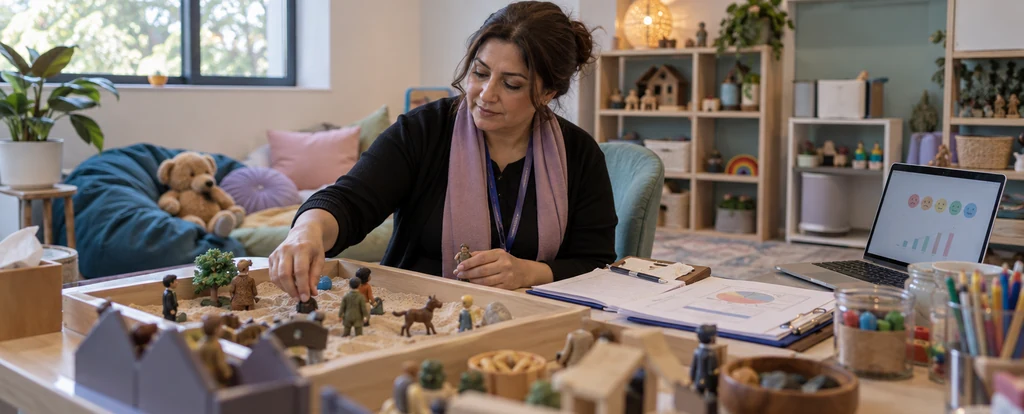
Most play therapists work in clinics, schools, hospitals or community health services, alongside psychologists, occupational therapists, speech pathologists and teachers. What sets the role apart is the medium: instead of talking a problem through, you work with toys, sand, drawing and role play, and read what a child shows you. Play therapy isn't a registered profession in Australia, so practitioners come from several backgrounds and hold a range of qualifications.
How much do play therapists earn?
The median full-time salary for a play therapist is $83,200 per annum, before tax, up $17,300 since 2018.
What you earn depends heavily on your employer: salaried roles in health services and schools usually sit under an award or enterprise agreement, while private practice income depends on your session fee and how full your books are. Because play therapy isn't registered, there's rarely an award classification for the title itself, so you're often paid under a related allied health, teaching or counselling stream. Caseload funding, particularly through the NDIS, also shapes how many sessions a practice can offer in a week.
What does a play therapist do day to day?
The list below is what fills most weeks; the exact mix shifts with seniority and whatever stage the current work is at.
- Observing how a child plays, what they choose and what they avoid, to build a picture of their emotional and developmental needs
- Running individual and small group sessions using toys, sand trays, art materials and role play
- Meeting parents and carers to explain what you're seeing and agree on goals to carry into home life
- Writing session notes and progress reports for referrers, schools and funding bodies
- Setting up and resourcing the therapy room, then cleaning and resetting it between sessions
What skills do play therapists need?
Employers look for patient care and support, clinical assessment and treatment, care planning and coordination, backed by Cliniko fluency and strong empathy and interpersonal care.
Specialist skills
- Patient care and support
- Clinical assessment and treatment
- Care planning and coordination
- Counselling and support work
Software and tools
- Cliniko
- Halaxy
- Power Diary
- Sand tray and art materials
- Strengths and Difficulties Questionnaire (SDQ)
General skills
- Empathy and interpersonal care
- Written communication
- Problem solving
- Attention to detail
Is the job growing?
About 1,500 people work as play therapists in Australia, and employment is projected to grow 34% over the decade to 2035. That's very strong growth. Few roles in Australia are expanding this fast, and it points to solid demand for years to come.
How do you become a play therapist?
Here's the path most play therapists take, step by step.
- 1Start with a degree in a related field
About 52% of people working as play therapists hold a bachelor degree, usually in psychology, social work, occupational therapy, teaching, nursing or counselling. That qualification is the foundation you build the therapy training on.
- 2Get experience working with children
Paid or volunteer work in early childhood education, disability support, schools or child mental health builds the observation skills the job depends on, and most training programs expect some of it before you enrol.
- 3Complete specialist play therapy training
With no single licence for the profession, training comes as certificates, diplomas and postgraduate courses from universities and specialist providers. Professional bodies such as the Australasian Play Therapy Association keep registers of recognised courses, which is where to check that a program will be accepted by employers and referrers.
- 4Join a professional association and arrange supervision
Membership gives you ongoing supervision, continuing professional development and a register that parents, schools and referrers can check. Supervision is also where you work through the difficult cases, so it's worth treating as a regular cost of practising rather than an optional extra.
- 5Keep any underlying registration current
If you come from psychology, occupational therapy or social work, that qualification and any registration stays the basis of your practice, and play therapy training sits on top of it. Teachers and counsellors follow the same pattern within their own profession.
Ready to apply as a play therapist?
Whether you're working toward becoming a play therapist or already are one and want a hand with the next step (sharpening your resume for ATS screening, tightening your cover letter, or knowing what you'll actually be asked at interview), here are examples grounded in this specific role, not generic templates.
What jobs can a play therapist move to?
Moving into Occupational Therapist typically comes with the biggest pay rise, worth $16,300 a year more on average.
| Move to | Typical pay change | Overlap | Retraining |
|---|---|---|---|
| Occupational Therapist Play therapists bring child development and therapeutic play skills, but need occupational therapy qualification and registration to practise.Known move | +$16,300 | 60% | requalify |
| Music Therapist Play therapists share creative and developmental methods, so moving into music therapy needs only music-specific therapeutic training. | −$2,600 | 74% | minimal |
| Art Therapist Play therapists already use creative and developmental approaches, so moving into art therapy needs only modality-specific training. | −$5,200 | 79% | minimal |
Moves are chosen from Jobs and Skills Australia's Data on Occupation Mobility, which follows income tax records between 2011-12 and 2020-21, together with entry requirements and skill overlap. A known move is one people were seen making in that data. Pay change compares median full-time pay for the two roles.
Who works as a play therapist?
The typical play therapist is 42 years old; 88% are women, 55% work full-time, and full-timers average 38 hours a week.
- 42
- Median age
- 88%
- Female share
- 55%
- Full-time
- −2h
- vs all-jobs avg
What's it like being a play therapist?
The week runs on booked sessions, each followed by notes, with a room you set up and reset yourself. The pressure comes from the weight of what children bring into the room and from holding the line between a therapy session and a playdate, because from the outside the work looks like fun. It suits people who are patient with slow, uneven progress and who are as comfortable talking with parents as they are sitting on the floor with a child.
What people like
- Change shows up in the play. A child who couldn't name a feeling in week one might act it out with puppets by week eight, and you're the person who sees that shift happen.
- Hands-on rather than desk-bound. Most of the day is spent on the floor with a child, using sand, paint and toys instead of a screen.
- Parents can change the outcome. Coaching a parent on how to respond at home often does more for a child than the session itself, which makes the family work worth the time.
- Work across several settings. There are roles in community health, hospitals, schools and private practice, so you can move as your interests and circumstances change.
What people find hard
- The stories are heavy. Many referrals involve trauma, abuse, family breakdown or a serious diagnosis, and regular supervision is what keeps the work sustainable over years.
- Progress is slow and uneven. A child can make steady gains for months and then go backwards after a change at home, so the work rewards a long view.
- Reports and funding rules. Paperwork for schools, NDIS plans and referrers takes a real slice of the week, and each funding body wants something slightly different.
- No single professional standard. Because the profession isn't registered, what employers call the role, what they expect of you and what they pay vary a lot between services.
Based on our synthesis of professional-body surveys and public accounts of the role, not first-person verified reviews.
Which industries employ play therapists?
Health Care and Social Assistance employs the largest share of play therapists, followed by Education and Training.
Top employing industries
- 1Health Care and Social Assistance
- 2Education and Training
- 3Public Administration and Safety
- 4Social Assistance Services
Ranked by employment share; the source doesn't publish an exact percentage per industry.
| Bachelor degree | 52% | |
|---|---|---|
| Postgraduate | 26% | |
| Diploma / Advanced Diploma | 13% | |
| Other | 9% |
Will AI replace play therapists?
Play therapy is low exposure overall, because the work is a live relationship with a child: you read tone of voice, body language and what they choose to do with the toys in front of them, and no system does that. What does change is the surrounding administration, where software already handles bookings, reminders and first drafts of reports. The clinical core stays with the therapist.
Share of typical working time by exposure level
- Running play sessions with a childYou watch what a child does with the sand tray or the puppets and decide in the moment where to take the session, which depends on being in the room.50%low
- Assessment and clinical formulationTools such as the Strengths and Difficulties Questionnaire can be scored automatically, but working out what those scores mean for this child and family is the therapist's judgement.25%low
- Session notes and progress reportsDictation and drafting tools cut the time spent writing notes for referrers and funding bodies, though every report is checked and rewritten in clinical language.15%high
- Talking with parents, schools and referrersScheduling software and message templates help with the logistics, but the conversations about what a child needs still happen face to face or on the phone.10%moderate
Common questions about becoming a play therapist
Straight answers to the questions people ask most.
How much do play therapists earn?
Play therapists earn a median of $83,200 per year before tax, though the figure covers a small and varied profession, not one single job. Salaried roles in health services and schools usually follow an award or enterprise agreement, while private practitioners set their own fees and earn according to how full their books are.
How do you become a play therapist?
Most people start with a degree in psychology, social work, occupational therapy, teaching or counselling, then add specialist play therapy training and supervised practice. Play therapy isn't registered in Australia, so there's no single licence, and employers and referrers look instead at your training hours, supervision and association membership.
Are play therapists in demand?
Play therapists are currently not in shortage, and employment is projected to grow 34% over the decade to 2035. The occupation is small, so a rising percentage still translates into a limited number of new positions, and a common way in is through an existing allied health, education or counselling role.
Will AI replace play therapists?
Therapy with children is among the least exposed work to AI, because the job depends on a live relationship, on reading body language and play, and on physical materials. Software already handles bookings, reminders, note drafting and scoring tools such as the Strengths and Difficulties Questionnaire, but it doesn't decide what a child needs or how to respond in the room.
What can play therapists move into?
Art therapy and music therapy are close moves, since you already work through creative media with children and both need only modality-specific training. Occupational therapy is a bigger step, because it requires a new qualification and registration, and it pays $16,300 more. Many experienced practitioners also set up their own practice, which is often where earnings grow as referrals build.
Do you need to be a psychologist to work as a play therapist?
No. Play therapy isn't a registered profession, so people come to it from psychology, social work, occupational therapy, teaching, nursing and counselling. What employers look at is the specialist training and supervised practice you've completed, not the discipline you started in.
Related roles
- Occupational Therapist
- Art Therapist
- Music Therapist
- Early Childhood Educator
- Disability Support Worker
- Aged Care Worker
Not sure this is you? Take the career quiz and get a ranked shortlist of roles that fit how you like to work.