Home Manufacturing & Production
Printer
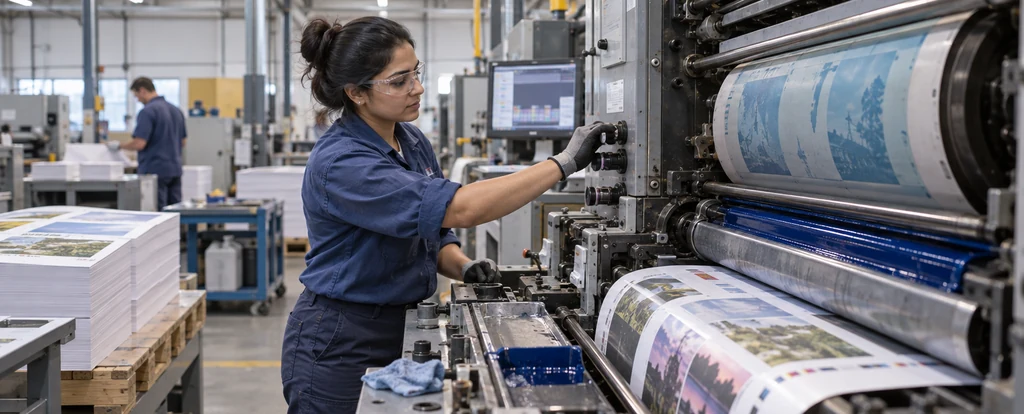
Printers set up and run the presses that turn artwork files into finished books, packaging, labels and commercial print.
- Median salary
- $73,200
4.3%vs last year, before tax
- People employed
- 3,400
0.0%vs last year
- Projected growth
- +5%
to 2035
- AI exposure*
- Moderate
- automation risk
- Average hours
- 41/wk
+1h vs all jobs
- Shortage status
- Not in shortage
national
Printers work in commercial print shops, packaging plants, label printers and in-house print rooms, running offset, digital or flexographic presses. They sit near the end of the process, after a designer and pre-press operator have prepared the artwork, and they are responsible for what actually comes off the machine: colour, registration, stock and finish. In a small shop one printer may handle everything from setup to trimming, while larger plants split press, finishing and despatch between separate crews.
How much do printers earn?
The median full-time salary for a printer is $73,200 per annum, before tax, up $15,400 since 2018.
Most printers are covered by the Graphic Arts, Printing and Publishing Award, so base rates follow the classification of the press you run and the skills you hold. Shift and night loadings, overtime and the size of the plant all move take-home pay, and a lead hand or supervisory role carries a higher classification than an operator's. Small commercial shops and large packaging plants set different expectations, so the figure for one workplace does not necessarily carry across.
What does a printer do day to day?
The list below is what fills most weeks; the exact mix shifts with seniority and whatever stage the current work is at.
- Setting up a run by mounting plates or loading a digital file, then setting ink, stock and registration
- Checking colour against the proof as sheets come off and adjusting ink density through the run
- Spotting faults such as misregistration, ink marks and smudges early, before a bad run wastes stock
- Cleaning and maintaining the press between runs, replacing blankets and rollers and clearing jams
- Handing the run to the finishing team and checking trimmed, folded or bound copies against the job sheet
What skills do printers need?
Employers look for plant and equipment operation, craft and handmade production, operations management, backed by Adobe InDesign fluency and strong attention to detail.
Specialist skills
- Plant and equipment operation
- Craft and handmade production
- Operations management
- Process improvement
Software and tools
- Adobe InDesign
- Adobe Illustrator
- EFI Fiery
- Heidelberg Prinect
- Onyx Thrive
General skills
- Attention to detail
- Time and deadline management
- Problem solving
Is the job growing?
About 3,400 people work as printers in Australia, and employment is projected to grow 5% over the decade to 2035. That's modest growth: demand is steady rather than booming.
How do you become a printer?
Here's the path most printers take, step by step.
- 1Try the work as a printer's assistant
Feeding presses, handling stock and cleaning down machines is paid work you can often start without qualifications, and it shows you quickly whether the noise, shifts and pace of a press room suit you.
- 2Complete a Certificate III in Printing
The printing machinist apprenticeship combines paid employment with study at TAFE or another registered training organisation, usually over three to four years, and it is the qualification most employers look for. Adult apprenticeships are available for people changing trades.
- 3Learn both the digital and offset sides
Shops increasingly run digital and offset presses side by side, so familiarity with pre-press software such as InDesign and Illustrator and a digital front end like Fiery or Onyx widens the jobs you can take.
- 4Specialise or step up
Printers move into packaging and label work, large format signage or finishing, each with its own equipment and manufacturer training, and experienced operators can take on lead hand or production management roles.
Ready to apply as a printer?
Whether you're working toward becoming a printer or already are one and want a hand with the next step (sharpening your resume for ATS screening, tightening your cover letter, or knowing what you'll actually be asked at interview), here are examples grounded in this specific role, not generic templates.
What jobs can a printer move to?
Moving into Production Manager typically comes with the biggest pay rise, worth $46,300 a year more on average.
| Move to | Typical pay change | Overlap | Retraining |
|---|---|---|---|
| Production Manager Years on press give a printer the workflow, scheduling and quality knowledge to supervise production, with management study supporting the step up.Known move | +$46,300 | 30% | reskill |
| Graphic Designer Understanding how artwork behaves on press helps in design work, but creative software and design study are needed to move across.Known move | +$23,000 | 8% | reskill |
| Print Finisher Finishing work sits alongside press operation, so a printer already understands stock, cutting and binding requirements on the finishing line.Known move | −$10,800 | 100% | reskill |
| Pre-press Operator Printer knowledge of impositions, plates and press output transfers into preparing artwork files, with a separate pre-press qualification required.Known move | −$10,800 | 30% | requalify |
| Screen Printer Press setup, ink handling and colour matching carry directly into screen printing, though the screen process itself needs further trade training.Known move | −$13,400 | 78% | reskill |
Moves are chosen from Jobs and Skills Australia's Data on Occupation Mobility, which follows income tax records between 2011-12 and 2020-21, together with entry requirements and skill overlap. A known move is one people were seen making in that data. Pay change compares median full-time pay for the two roles.
Who works as a printer?
The typical printer is 48 years old; 88% are men, 85% work full-time, and full-timers average 41 hours a week.
- 48
- Median age
- 12%
- Female share
- 85%
- Full-time
- +1h
- vs all-jobs avg
What's it like being a printer?
The rhythm of the job follows the print schedule: a burst of setup at the start of each run, then long stretches of monitoring while the press does the work. Printers tend to enjoy the mechanical side and the visible result, which suits people who are patient with machines and precise about colour. The pressure comes from fixed delivery dates and the cost of getting a run wrong, because a fault found late can waste hours of press time and a whole pallet of stock.
What people like
- Finished work you can hold. A run ends with a pallet of printed product, and on packaging or label work you see the job on shelves weeks later.
- The press rewards attention. Colour and registration drift as a run goes on, so noticing a problem early is what separates a careful printer from a wasteful one.
- A trade that moves with you. Press skills carry between commercial shops, packaging plants, label printers and in-house print rooms, and experienced printers are not replaced quickly.
- Working out why a job will not run clean. When something goes wrong the answer is usually mechanical, or in the ink and stock, and tracing it is a large part of the job.
What people find hard
- Shift and night work. Larger plants run presses around the clock, so a printer may work nights or rotate shifts, which loadings compensate for but do not make easy.
- Deadlines that cannot move. A magazine, catalogue or packaging run has a date attached, and if paper arrives late the press hours do not extend to match.
- Long runs are repetitive. A big offset run means hours of watching and pulling sheets every few hundred, checking the same things again and again.
- Standing, noise and ink. The work is done on your feet beside noisy machinery, with ink, solvent and paper dust part of the environment.
Based on our synthesis of professional-body surveys and public accounts of the role, not first-person verified reviews.
Which industries employ printers?
Manufacturing employs the largest share of printers, followed by Information Media and Telecommunications.
Top employing industries
- 1Manufacturing
- 2Information Media and Telecommunications
Ranked by employment share; the source doesn't publish an exact percentage per industry.
| Certificate III/IV | 57.4% | |
|---|---|---|
| Year 12 or below | 24.2% | |
| Diploma / Advanced Diploma | 7.7% | |
| Bachelor degree | 6.5% | |
| Postgraduate | 1.4% |
Will AI replace printers?
Automation has changed pre-press more than the press floor: imposition, plate making and colour profiles are now produced by software such as Heidelberg Prinect or a digital front end like Fiery, so a printer checks a prepared job rather than building it from scratch. On the machine, automated plate changers and closed-loop colour measurement handle part of a run, but loading stock, watching sheets and tracing a fault stay hands-on. That split is why the job is moderately exposed rather than highly exposed.
Share of typical working time by exposure level
- Running the pressAutomated plate changes and colour control do part of the work, but someone still has to watch tension, registration and ink across thousands of sheets.30%moderate
- Pre-press and job setupSoftware generates the imposition, plates and colour profiles for most jobs, so the printer's role is usually to check and adjust a prepared file.25%high
- Maintenance, fault-finding and finishingClearing a jam, replacing a blanket or adjusting a folder is physical work on a particular machine, which is the part automation reaches least.25%low
- Colour matching and quality checksA spectrophotometer measures the sheet and flags drift, while deciding whether a colour will satisfy the client remains the printer's call.20%moderate
Common questions about becoming a printer
Straight answers to the questions people ask most.
How much do printers earn?
Printers earn $73,200 per annum, before tax, and shift loadings can add to that. The figure is a median across the trade, so pay varies with the press you run, the shifts you work and whether the employer is a small commercial shop or a larger plant.
How do you become a printer?
Most printers enter through a printing machinist apprenticeship, which pairs paid work on press with a Certificate III in Printing (ICP31220) at TAFE or another registered training organisation, usually over three to four years. Starting as a printer's assistant or feeder is the other common route, and it lets you try the work before committing to the apprenticeship.
Are printers in demand?
Printers are currently not in shortage. Employment is projected to grow 5% over the decade to 2035, and with a small workforce most openings come from replacing printers who retire or leave rather than from new positions. Ask local printers and packaging plants directly about apprenticeships, because vacancies in a trade this size are often not advertised widely.
Will AI replace printers?
Automation has reshaped pre-press far more than the press floor, with software generating impositions, plates and colour profiles that a printer once prepared by hand. Running the machine, checking stock and diagnosing mechanical faults are much less exposed, which is why the overall effect on the trade is moderate. The practical response is to be comfortable with the digital front end as well as the press itself.
What can a printer move into?
Production management is a common step for experienced printers, and production managers earn $46,300 more than printers because years on press give you the scheduling and quality knowledge the role needs. Moving across to pre-press is closely related, though pre-press operators earn $10,800 less and the work shifts from machinery to artwork files. Some printers eventually open their own small print shop, and that is often where earnings grow.
Do printers work shifts?
In larger plants presses often run a night shift or a 24-hour roster, and shift loadings lift base pay. Smaller commercial shops usually keep to weekday hours, with overtime when a deadline is close.
Related roles
Not sure this is you? Take the career quiz and get a ranked shortlist of roles that fit how you like to work.