Home Manufacturing & Production
Pre-press Operator
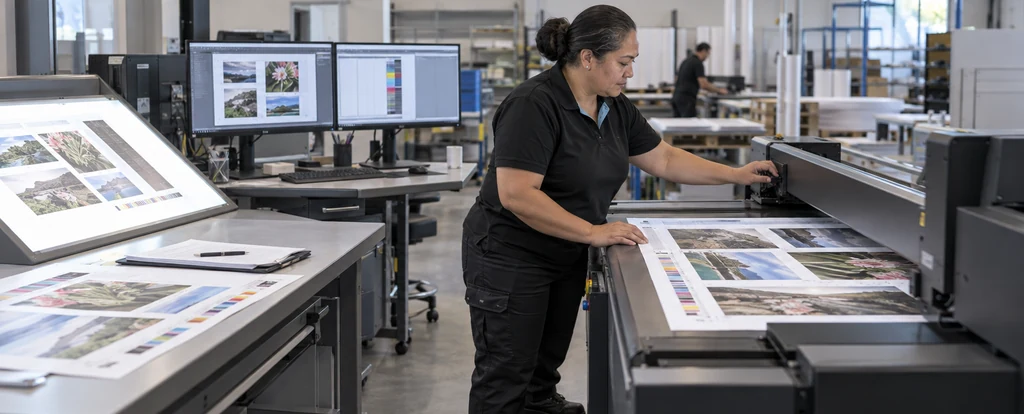
Pre-press operators turn finished artwork into files a printing press can run, checking pages, images and colour before anything goes to print.
- Median salary*
- $62,400
4.0%vs last year, before tax
- People employed
- 1,300
0.0%vs last year
- Projected growth
- +6.5%
to 2035
- AI exposure*
- Moderate
- automation risk
- Average hours
- 40/wk
matches all-jobs average
- Shortage status
- In shortage
national
Pre-press operators sit between the designer and the press, in commercial printers, packaging plants, publishers and in-house print rooms. Where a graphic designer decides how a job looks, the pre-press operator makes sure that design can actually be printed: fonts embedded, images at the right resolution, and colour converted for the press and paper being used. It's a small occupation, with about 1,300 people working in it, and most jobs are in printing firms that also run the presses their files feed.
How much do pre-press operators earn?
The median full-time salary for a pre-press operator is $62,400 per annum, before tax, up $13,000 since 2018.
Rates come from an award or enterprise agreement, and shift penalties for evening and weekend press schedules often add to the base. Experience with colour management, packaging work and digital presses is what lifts pay over time, and what a small commercial printer offers can differ quite a bit from a large packaging plant.
What does a pre-press operator do day to day?
The list below is what fills most weeks; the exact mix shifts with seniority and whatever stage the current work is at.
- Checking incoming files for missing fonts, low-resolution images and colour that won't convert cleanly
- Imposing pages, which means arranging them on a large sheet so they fold and trim in the right order
- Managing colour profiles and printing proofs for a client to sign off before the full run
- Outputting plates for offset presses, or sending files straight to a digital press
- Talking through job specifications with clients, designers and press operators, and fixing problems when a proof comes back wrong
What skills do pre-press operators need?
Employers look for creative software production, operations management, backed by Adobe InDesign fluency and strong attention to detail.
Specialist skills
- Creative software production
- Operations management
Software and tools
- Adobe InDesign
- Adobe Illustrator
- Adobe Photoshop
- Kodak Prinergy
- Enfocus PitStop
General skills
- Attention to detail
- Digital literacy
- Time and deadline management
- Problem solving
- Written communication
Is the job growing?
About 1,300 people work as pre-press operators in Australia, and employment is projected to grow 6.5% over the decade to 2035. That's modest growth: demand is steady rather than booming.
How do you become a pre-press operator?
Here's the path most pre-press operators take, step by step.
- 1Finish Year 12 or an equivalent
There's no hard prerequisite, but design, visual arts or computing subjects make the software side easier, and most entrants start after school or after a first job in a print business.
- 2Do a Certificate III in printing and graphic arts
TAFE and other registered training organisations offer it with a pre-press focus, and it's often taken as part of a traineeship or apprenticeship in a printing business, so you earn while you learn.
- 3Get fluent in the software
InDesign, Illustrator and Photoshop are the everyday tools, along with workflow systems such as Kodak Prinergy and preflight tools like Enfocus PitStop. Employers usually test this at interview rather than taking your word for it.
- 4Learn colour and press behaviour on the job
Knowing how ink, paper and the press itself change what a file does takes a few years of real jobs, and it's the difference between a junior operator and one the business relies on.
- 5Specialise or move sideways
Packaging and label work, digital press operation and large-format printing are common directions, and some operators move into graphic design after further study.
Ready to apply as a pre-press operator?
Whether you're working toward becoming a pre-press operator or already are one and want a hand with the next step (sharpening your resume for ATS screening, tightening your cover letter, or knowing what you'll actually be asked at interview), here are examples grounded in this specific role, not generic templates.
What jobs can a pre-press operator move to?
Moving into Graphic Designer typically comes with the biggest pay rise, worth $33,800 a year more on average.
| Move to | Typical pay change | Overlap | Retraining |
|---|---|---|---|
| Graphic Designer Pre-press skills in layout, colour and file preparation suit graphic design, though a design qualification is usually required.Known move | +$33,800 | 38% | reskill |
| Printer Pre-press knowledge of print processes helps, but becoming a printer requires completing a printing apprenticeship.Known move | +$10,800 | 30% | requalify |
| Photo Lab Technician Pre-press colour and image handling skills suit photo lab technician work, though retraining in photographic processing is needed.Known move | +$10,700 | 10% | reskill |
Moves are chosen from Jobs and Skills Australia's Data on Occupation Mobility, which follows income tax records between 2011-12 and 2020-21, together with entry requirements and skill overlap. A known move is one people were seen making in that data. Pay change compares median full-time pay for the two roles.
Who works as a pre-press operator?
The typical pre-press operator is 45 years old; 68% are men, 58% work full-time, and full-timers average 40 hours a week.
- 45
- Median age
- 32%
- Female share
- 58%
- Full-time
- +0h
- vs all-jobs avg
What's it like being a pre-press operator?
The work has a clear rhythm: files arrive, get checked and fixed, go out as a proof and then to the press, and jobs are usually short enough that you see several through in a day. Most of it happens at a screen, so it suits people who like detail and don't mind sitting with a problem until the file is right. The pressure is real but predictable, and it tends to bunch around the days when a print run is booked and the artwork still isn't clean.
What people like
- You see a job from file to finished product. Sheets come off the press within hours of you setting the file up, so you find out quickly whether your work was right.
- Much of the day is problem solving. A file that won't behave is a puzzle with a solution, and working out what's actually wrong with it is a satisfying part of the job.
- Small teams and direct contact. In many print businesses you deal with the customer and the press operator yourself, rather than passing messages through layers of people.
- Screen-based, task-focused work. For anyone who would rather concentrate at a desk than stand at a press, pre-press is the quieter end of a printing business.
What people find hard
- Deadlines that don't move. The press slot is booked and the client's files arrive late, so the schedule pressure lands on whoever is preparing the job.
- Fixing problems that came from elsewhere. Missing fonts, low-resolution images and wrong colour spaces turn up regularly in customer files, and sorting them out can take longer than the job should.
- Reprints when something slips through. An error that reaches the press can waste a whole run of paper and ink, and the scrutiny lands on pre-press.
- Shift work where presses run late. Some printing businesses keep presses going into the evening or overnight, and pre-press staff may be rostered to cover those hours.
Based on our synthesis of professional-body surveys and public accounts of the role, not first-person verified reviews.
Which industries employ pre-press operators?
Professional, Scientific and Technical Services employs the largest share of pre-press operators, followed by Mining.
Top employing industries
- 1Professional, Scientific and Technical Services
- 2Mining
- 3Arts and Recreation Services
Ranked by employment share; the source doesn't publish an exact percentage per industry.
| Certificate III/IV | 39.3% | |
|---|---|---|
| Bachelor degree | 19.1% | |
| Diploma / Advanced Diploma | 18.2% | |
| Year 12 or below | 16% | |
| Postgraduate | 4.3% |
Will AI replace pre-press operators?
Pre-press is moderately exposed. Automated preflight and workflow software already handles font checks, image resolution and standard colour conversions, which is a large part of a junior operator's day, and that is where the task list has thinned out most. What it doesn't handle is the awkward exceptions, an unusual stock, a colour a client won't accept, or a file built by someone using the wrong settings, and that is where experienced operators now spend their time.
Share of typical working time by exposure level
- Preflighting incoming customer filesSoftware flags the obvious faults, but deciding what to do about a file saved from an old template or built in the wrong colour space is still a person's call.30%moderate
- Colour management and proofingProfiles and automatic conversion do much of the work, though matching a proof to what the press actually produces still depends on knowing the paper and ink.25%moderate
- Imposition and outputting platesImposition software and computer-to-plate systems have taken over the arithmetic, leaving the operator to set the rules and catch the jobs that don't fit the template.25%high
- Talking to clients, designers and press operatorsWorking out what a customer actually wants when their file won't print, and agreeing a fix before the run starts, is a conversation software can't hold.20%low
Common questions about becoming a pre-press operator
Straight answers to the questions people ask most.
How much does a pre-press operator earn?
A pre-press operator's median full-time pay is $62,400 per year before tax. What you actually take home depends on the award or enterprise agreement your employer uses, whether your hours include shift penalties, and how much colour and packaging experience you bring to the job.
How do you become a pre-press operator?
Most people start with a Certificate III in printing and graphic arts, often through a traineeship or apprenticeship in a printing business so they earn while they train. About 39% of the people in the role hold Certificate III/IV, but practical software skill matters just as much: employers expect familiarity with InDesign, Illustrator and Photoshop before you walk in.
Are pre-press operators in demand?
Pre-press operators are currently in shortage nationally, and employment is projected to grow 6.5% over the decade to 2035. The occupation is small, so openings tend to come up in ones and twos at individual printing and packaging firms rather than in large intakes, which makes direct approaches to local printers worth as much as job ads.
Will AI replace pre-press operators?
Not entirely, but automated preflight and workflow software has taken over the routine parts of the job, checking fonts, image resolution and standard colour conversions without much input. What's left is the judgement: a file that fails for an unusual reason, a colour the client insists on, or a press problem that shows up mid-run. The role has shrunk in routine checking and moved toward problem solving and customer contact.
What can a pre-press operator move into?
Experienced operators with strong layout and colour skills can move into graphic design, which pays $33,800 more, though a design qualification is usually required. Becoming a printer keeps you in the same business and pays $10,800 more, but it means completing a printing apprenticeship. Some move into photographic or lab-based image work, which pays $10,700 more and needs retraining in photographic processing.
Do you need a degree to be a pre-press operator?
No, a degree isn't required, and about 19% of the people in the role have one. A Certificate III or IV in printing and graphic arts is the usual entry point, and employers care most about whether your files come back from the press without problems.
Related roles
Not sure this is you? Take the career quiz and get a ranked shortlist of roles that fit how you like to work.