Home Manufacturing & Production
Sheet Metal Worker
Sheet metal workers cut, shape and join light gauge metal into ducting, cladding and fabricated parts, which keeps buildings ventilated and industrial plant running.
- Median salary*
- $71,800
3.8%vs last year, before tax
- People employed
- 4,100
0.0%vs last year
- Projected growth
- +10.5%
to 2035
- AI exposure*
- Moderate
- automation risk
- Average hours
- 43/wk
+3h vs all jobs
- Shortage status
- In shortage
national
Sheet metal workers make, assemble and install products from light gauge steel, aluminium, copper and other sheet materials. Much of the work happens in a fabrication workshop, with time on building sites installing ducting, roofing and cladding. The trade sits close to metal fabrication, but sheet metal work stays with thinner material that folds, bends and seams rather than heavy plate that is cut and welded.
How much do sheet metal workers earn?
The median full-time salary for a sheet metal worker is $71,800 per annum, before tax, up $14,900 since 2018.
Most sheet metal workers are covered by a manufacturing award or an enterprise agreement, and site-based construction work usually attracts different rates and allowances. Shift work, overtime and coded or pressure welding work all push earnings up, while a small workshop job may not. Where you work matters as much as what you can do, since a duct installer on a commercial site and a bench hand in a small shop can be on quite different terms.
What does a sheet metal worker do day to day?
The list below is what fills most weeks; the exact mix shifts with seniority and whatever stage the current work is at.
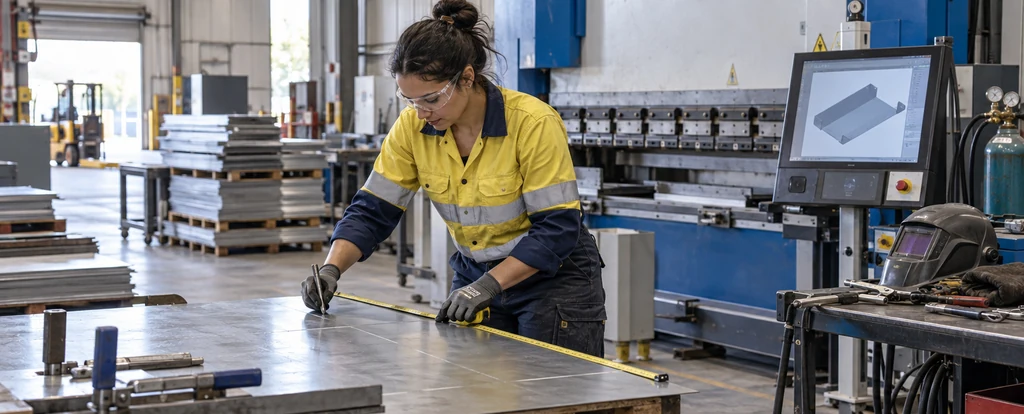
- Measuring and marking out sheet metal to the dimensions shown on drawings or CAD models
- Cutting and shaping metal using guillotines, shears, press brakes and CNC equipment
- Fabricating and assembling ducting, flashings, enclosures and metal components
- Joining metal sections by welding, riveting, soldering or folding and seaming
- Installing finished products such as ventilation ducting, roofing and cladding on site
What skills do sheet metal workers need?
Employers look for hand and power tool work, reading plans and specifications, fabrication and finishing, backed by AutoCAD fluency and strong attention to detail.
Specialist skills
- Hand and power tool work
- Reading plans and specifications
- Fabrication and finishing
- Installation and maintenance
- Worksite safety management
Software and tools
- AutoCAD
- SolidWorks
- Lantek
- RADAN
- CNC press brake controllers
General skills
- Attention to detail
- Problem solving
Is the job growing?
About 4,100 people work as sheet metal workers in Australia, and employment is projected to grow 10.5% over the decade to 2035. That's healthy, above-average growth, and the role should stay in solid demand.
How do you become a sheet metal worker?
Here's the path most sheet metal workers take, step by step.
- 1Start a Certificate III in Engineering (Fabrication Trade)
This is the standard trade qualification, and it is usually completed as part of a four-year apprenticeship that combines paid work with TAFE study.
- 2Find an apprenticeship with a fabrication or ductwork employer
You need supervised time on real jobs to finish the qualification, so the employer matters as much as the course. School-based apprenticeships let you start while still at school.
- 3Get a construction induction card if you will work on sites
A White Card is required in every state before you can set foot on a construction site, and it takes only a short course to obtain.
- 4Add licences and post-trade training as you specialise
Scaffolding, elevating work platforms or rigging each need a high risk work licence, and TAFE short courses in CNC operation or coded welding open up more specialised work.
Ready to apply as a sheet metal worker?
Whether you're working toward becoming a sheet metal worker or already are one and want a hand with the next step (sharpening your resume for ATS screening, tightening your cover letter, or knowing what you'll actually be asked at interview), here are examples grounded in this specific role, not generic templates.
What jobs can a sheet metal worker move to?
Moving into Production Manager typically comes with the biggest pay rise, worth $47,700 a year more on average.
| Move to | Typical pay change | Overlap | Retraining |
|---|---|---|---|
| Production Manager Sheet metal workers can step into production management, using their fabrication knowledge to supervise workflows while gaining management skills.Known move | +$47,700 | 3% | reskill |
| Air Conditioning Technician Sheet metal workers move into air conditioning work using their ducting and metal forming skills, with electrical licensing study required.Known move | +$37,400 | 61% | requalify |
| Pressure Welder Sheet metal workers can specialise in pressure welding, applying their metal joining knowledge to coded pipe and vessel work. | +$24,400 | 100% | reskill |
| Metal Fabricator Sheet metal workers bring light gauge cutting, forming and joining skills to heavier fabrication, adapting to thicker materials and structural work.Known move | +$16,000 | 70% | reskill |
| Welder Sheet metal workers bring metal cutting and forming experience to welding, building on their joining skills with further welding certification.Known move | +$16,000 | 70% | reskill |
Moves are chosen from Jobs and Skills Australia's Data on Occupation Mobility, which follows income tax records between 2011-12 and 2020-21, together with entry requirements and skill overlap. A known move is one people were seen making in that data. Pay change compares median full-time pay for the two roles.
Who works as a sheet metal worker?
The typical sheet metal worker is 28 years old; 94% are men, 100% work full-time, and full-timers average 43 hours a week.
- 28
- Median age
- 6%
- Female share
- 100%
- Full-time
- +3h
- vs all-jobs avg
What's it like being a sheet metal worker?
The work has a clear rhythm: a job is measured, cut and formed in the workshop, then often installed on site, so weeks move between the machine shop and a building under construction. It suits people who like seeing a finished product and who don't mind noise, standing work and the occasional awkward install. In most shops precision counts for more than speed, because a duct run that doesn't fit wastes the whole sheet.
What people like
- You can see what you made. A finished duct run, a flashed roof or a fabricated enclosure is visible and in use, not a document that disappears into a system.
- The work moves around. Time splits between the workshop and site, so the days vary more than they do in a single fixed workplace.
- The skills transfer. Forming and joining light gauge metal is useful across manufacturing, construction and transport, so the trade travels between industries.
- You are on the tools early. Apprentices spend most of their week in the workshop from the start, learning by doing alongside the TAFE course.
What people find hard
- Noise, fumes and heat. Guillotines, grinders and welders are loud, and hearing protection, eye protection and ventilation are part of every day.
- Awkward installation work. Ducting goes overhead and cladding goes on roofs, so you can spend hours on ladders, in ceiling spaces or on your knees.
- Waiting on other trades. On site you can only install once the frame, roof or services are ready, and delays elsewhere in the build stop your work.
- Weather on outside jobs. Roofing and cladding happen in heat, cold and rain, while workshop jobs stay under cover.
Based on our synthesis of professional-body surveys and public accounts of the role, not first-person verified reviews.
Which industries employ sheet metal workers?
Manufacturing employs the largest share of sheet metal workers, followed by Construction.
Top employing industries
- 1Manufacturing
- 2Construction
- 3Transport, Postal and Warehousing
Ranked by employment share; the source doesn't publish an exact percentage per industry.
| Certificate III/IV | 62.4% | |
|---|---|---|
| Year 12 or below | 29.6% | |
| Diploma / Advanced Diploma | 3% | |
| Bachelor degree | 1.8% | |
| Postgraduate | 0.4% |
Will AI replace sheet metal workers?
Sheet metal work is moderately exposed to automation. Design and nesting software now produces cut files and layouts directly from a CAD model, and CNC press brakes and plasma tables run much of the forming and cutting. What has not changed is the setting up, checking, fitting and installing, which still depends on someone who can read a drawing and work with their hands.
Share of typical working time by exposure level
- Cutting and forming on guillotines, press brakes and CNC equipmentThe machine runs the cut once it is programmed, but someone still loads the sheet, sets the tooling and checks the first part against the drawing.30%moderate
- Fabricating and assembling componentsWelding robots suit long runs of identical parts, while one-off flashings and enclosure work are still fitted, tacked and finished by hand.30%moderate
- Measuring and marking out from drawingsNesting software and CAD models generate the cut list and machine file, so the tape-and-scriber work that once filled a morning is now mostly done on screen.20%high
- Installing ducting, roofing and cladding on siteLifting duct sections into a ceiling space or fixing cladding to a roof happens in a real building with real obstacles, and no machine does that yet.20%low
Moves least exposed to AI
These career moves from sheet metal worker work are rated low for AI exposure:
- Metal Fabricator
High skill overlap (70%), reskill to get there, and a low automation-risk profile.
- Welder
High skill overlap (70%), reskill to get there, and a low automation-risk profile.
- Air Conditioning Technician
High skill overlap (61%), requalify to get there, and a low automation-risk profile.
- Pressure Welder
High skill overlap (100%), reskill to get there, and a low automation-risk profile.
Common questions about becoming a sheet metal worker
Straight answers to the questions people ask most.
How much does a sheet metal worker earn?
The median for full-time sheet metal workers is $71,800 per year before tax. Pay depends heavily on the award or enterprise agreement you work under, and site work, shift work and overtime usually sit above workshop rates.
How do you become a sheet metal worker?
The usual route is a Certificate III in Engineering (Fabrication Trade) through an apprenticeship, which takes about four years and is paid work rather than full-time study. You need an employer willing to take you on, because the qualification requires supervised workshop hours.
Are sheet metal workers in demand?
Sheet metal workers are currently in shortage nationally, and employment is projected to grow 10.5% over the decade to 2035. The occupation is small, so the number of openings each year is limited, and it is worth checking which fabricators and ductwork contractors near you are hiring rather than going on the national picture alone.
Will AI or automation replace sheet metal workers?
Automation has already taken over part of the job: nesting software works out how to fit parts on a sheet, and CNC machines run the cuts from a CAD model. Someone still has to read the drawing, set and check the machine, and fit and install the result, which keeps the trade's exposure moderate rather than high.
What can sheet metal workers move into?
Moving into metal fabrication is a common step, and the shift to heavier gauge work pays $16,000 more. Air conditioning technician work builds on ducting and forming skills but needs electrical licensing study, and pays $37,400 more. Pressure welding is a narrower specialisation for those who gain coded welding qualifications, paying $24,400 more.
Is sheet metal work physically demanding?
Yes, it is physical. You stand at machines or benches for long stretches, lift and hold sheets of metal, and work overhead or in tight ceiling spaces when installing ducting on site.
Related roles
Not sure this is you? Take the career quiz and get a ranked shortlist of roles that fit how you like to work.