Welder
Welders fuse metal parts with heat, electricity or pressure, following drawings to build and repair structures, pipework and machinery.
- Median salary
- $87,800
4.3%vs last year, before tax
- People employed
- 19,900
1.0%vs last year
- Projected growth
- +7.5%
to 2035
- AI exposure*
- Low
- automation risk
- Average hours
- 44/wk
+4h vs all jobs
- Shortage status
- In shortage
national
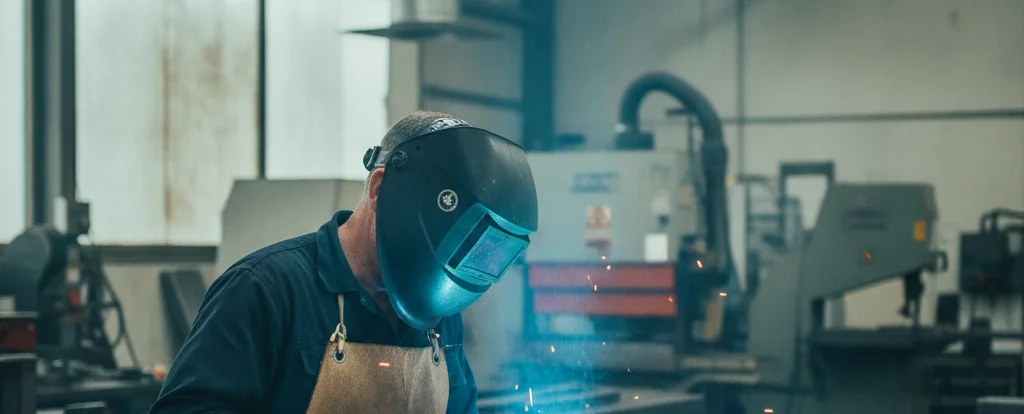
Welders work in fabrication workshops, manufacturing plants, construction sites and mine maintenance crews, and the process they use, MIG, TIG or stick, is chosen to suit the metal and the job. The trade sits close to boilermaking and fitting, and the difference is the joint: a boilermaker cuts, shapes and assembles the structure, while the welder makes the seam hold. Most of the day is spent in a mask, often in an awkward position, and each finished weld is checked against a standard before the job moves on.
How much do welders earn?
The median full-time salary for a welder is $87,800 per annum, before tax, up $18,500 since 2018.
Sector is the biggest variable: mine maintenance and shutdown work, construction sites and factory production welding each pay on different arrangements, and plenty of welders travel to follow the projects. Shift work and overtime carry penalty rates, and casual or contract roles usually include a loading in place of paid leave. Certification for coded or pressure welding opens up work that uncertified welders cannot take on, which is the usual way to lift earnings without leaving the trade.
What does a welder do day to day?
The list below is what fills most weeks; the exact mix shifts with seniority and whatever stage the current work is at.
- Reading drawings and job specifications to work out the weld type, sequence and which process suits the material
- Prepping edges with a grinder or wire brush, and clamping parts so they stay aligned while the weld takes
- Running beads in a mask and gloves for long stretches, sometimes overhead or in corners where the whole joint stays out of sight
- Checking finished welds for cracks, porosity or distortion, and cutting out and redoing any that fail the standard
- Keeping the machine, gas supply and fume extraction in order, and managing the burn and fume risks that come with the work
What skills do welders need?
Employers look for reading plans and specifications, hand and power tool work, fabrication and finishing, backed by MIG welder fluency and strong attention to detail.
Specialist skills
- Reading plans and specifications
- Hand and power tool work
- Fabrication and finishing
- Building codes and standards
- Worksite safety management
Software and tools
- MIG welder
- TIG welder
- Arc welder
- Angle grinder
- Blueprint reader
General skills
- Attention to detail
- Problem solving
Is the job growing?
About 19,900 people work as welders in Australia, and employment is projected to grow 7.5% over the decade to 2035. That's modest growth: demand is steady rather than booming.
How do you become a welder?
Here's the path most welders take, step by step.
- 1Start with a pre-apprenticeship or Certificate II in Engineering
A short course at TAFE or a registered training organisation covers workshop basics, hand tools and safety, and gives you something concrete to show employers when you apply for an apprenticeship. It is not required, but it puts you ahead of applicants with no workshop experience.
- 2Take on an engineering fabrication apprenticeship
The apprenticeship runs about four years, is paid from the first day, and combines on-the-job work with TAFE study toward a Certificate III in Engineering (Fabrication Trade). Finishing it makes you a qualified tradesperson, which is the credential most employers ask for.
- 3Learn the processes the work needs
Training usually covers stick and MIG welding, with TIG often picked up on the job or in a short course. Structural and pressure work also needs certification to the relevant Australian standard, tested by an accredited body, and employers generally want it before they will put you on coded jobs.
- 4Add the licences and qualifications for the sites you want
Construction work needs a White Card, and mine and shutdown jobs usually require confined space, working at heights and site inductions completed before you start. A rigging or crane licence widens the work you can take on once you are qualified.
Ready to apply as a welder?
Whether you're working toward becoming a welder or already are one and want a hand with the next step (sharpening your resume for ATS screening, tightening your cover letter, or knowing what you'll actually be asked at interview), here are examples grounded in this specific role, not generic templates.
What jobs can a welder move to?
Moving into Miner typically comes with the biggest pay rise, worth $63,400 a year more on average.
| Move to | Typical pay change | Overlap | Retraining |
|---|---|---|---|
| Miner A welder brings maintenance and fabrication skills to mining, with site tickets and safety training for remote mine work.Known move | +$63,400 | 31% | reskill |
| Production Manager An experienced welder brings hands-on fabrication knowledge to production management, with further study in supervising teams and workflows.Known move | +$31,700 | 3% | reskill |
| Pressure Welder A welder brings existing metal joining skills to pressure welding, adding certification for code welding on pipework and vessels.Known move | +$8,400 | 70% | reskill |
| Sheet Metal Worker A welder brings fabrication skills to sheet metal work, with training in cutting, forming and assembling thin gauge metal.Known move | −$16,000 | 70% | reskill |
Moves are chosen from Jobs and Skills Australia's Data on Occupation Mobility, which follows income tax records between 2011-12 and 2020-21, together with entry requirements and skill overlap. A known move is one people were seen making in that data. Pay change compares median full-time pay for the two roles.
Who works as a welder?
The typical welder is 42 years old; 99% are men, 87% work full-time, and full-timers average 44 hours a week.
- 42
- Median age
- 1%
- Female share
- 87%
- Full-time
- +4h
- vs all-jobs avg
What's it like being a welder?
Welding is a job of concentrated bursts: you set up, tack, check, then run a bead that has to be right, and much of the day passes in a mask with the arc for company. It is physical, often hot, and the trade suits people who like seeing a finished thing they made with their own hands and do not mind a workshop that is loud, dirty and sometimes cold. Crew size varies from a two-person shop to a site team of dozens, and shift work, overtime and travel come with the territory.
What people like
- You can see what you made. At the end of a shift there is a frame, tank or pipe run that was not there that morning, and it either holds or it does not.
- A skill that travels. Welding is used in almost every industry that builds things, so the qualification moves with you between sectors, states and countries.
- Paid training from the start. Apprentices earn while they learn, so the trade comes without a tuition debt and with four years of workshop experience behind it.
- Focused, hands-on work. The concentration under the mask, working one joint at a time until it is clean, is the part many welders enjoy most.
What people find hard
- Heat, fume and sparks. Welding throws off intense heat and metal fume, so extraction, ventilation and a good mask are non-negotiable rather than optional.
- Awkward positions. Tight corners, overhead work and kneeling on a steel floor for hours are normal, and the body notices over a career.
- Production welding is repetitive. Factory work can mean the same joint on the same part all day, which suits some welders and wears down others.
- Weather, travel and shutdowns. Site and mine work can mean remote rosters, long drives and schedules that shift with the project and the weather.
Based on our synthesis of professional-body surveys and public accounts of the role, not first-person verified reviews.
Which industries employ welders?
Manufacturing employs the largest share of welders, followed by Construction.
Top employing industries
- 1Manufacturing
- 2Construction
Ranked by employment share; the source doesn't publish an exact percentage per industry.
| Certificate III/IV | 51.9% | |
|---|---|---|
| Year 12 or below | 34.8% | |
| Diploma / Advanced Diploma | 4.4% | |
| Bachelor degree | 2.8% | |
| Postgraduate | 0.6% |
Will AI replace welders?
Welding has low exposure to AI overall, because the work happens on metal that is never quite identical: fitting up a repair on a worn excavator bucket or a pipe in a trench is not a repeatable path that a robot can follow. Automation is real in high-volume factories, where robot cells run long production welds, but that generally shifts the welder's day toward setup, programming and inspection. Coded work is also tested joint by joint, so someone qualified still makes and checks each one.
Share of typical working time by exposure level
- Fitting up and welding repairs in the fieldA cracked chassis, a worn bucket or a pipe in a trench has to be assessed, cut back and fitted by hand, and no two of those jobs are the same.35%low
- Reading drawings, measuring and checking welds against the standardInterpreting a drawing, checking alignment and measuring a finished joint against a welding code are still done by the tradesperson on the job.30%low
- Programming and tending automated welding equipmentSetting up a robotic cell, adjusting parameters and watching the arc is a growing part of the job in larger fabrication shops.20%moderate
- Running production welds on repeat partsRobot cells already handle long runs of identical components in manufacturing, so this is where a welder is most likely to be loading, checking and reworking rather than welding.15%high
Common questions about becoming a welder
Straight answers to the questions people ask most.
How much do welders earn in Australia?
Median full-time pay for welders is $87,800 per year before tax. What you actually take home depends on the sector, how much shift and overtime work you do, and whether you hold certification for coded or pressure welding, so the median sits between the best-paid site jobs and ordinary workshop rates. Casual and contract arrangements usually trade paid leave for a loading.
How do you become a welder?
Most welders start with an engineering fabrication apprenticeship, which takes about four years, is paid, and leads to a Certificate III in Engineering (Fabrication Trade). A pre-apprenticeship or Certificate II in Engineering (MEM20105) first can help you get taken on, and career changers usually enter through the same apprenticeship route.
Is welding in demand in Australia?
Welders are currently in shortage nationally, and employment is projected to grow 7.5% over the decade to 2035. Demand follows construction, mining and manufacturing activity, so contract and shutdown work comes and goes with project schedules, and keeping your certifications current matters most when you are between jobs.
Do welders work long hours?
Full-time welders average 44 hours a week, with overtime and shift rosters common on site and during plant shutdowns. Workshop roles are usually closer to standard hours, though a deadline can still push a day out.
Will AI and automation replace welders?
The trade has low exposure overall: automated cells already handle long production runs in factories, but repairs, field work and one-off fabrication are still done by hand. Where robots are used, welders tend to spend more of the week setting up and monitoring the equipment and less of it under a mask.
What can welders move into?
Pressure welding uses the same metal joining skills with added certification and pays $8,400 more, while mine work applies fabrication and maintenance skills on site with extra qualifications. Experienced welders also move into production management once they would rather supervise than weld, and many end up running their own fabrication or mobile welding business, which is often where earnings grow.
Related roles
Not sure this is you? Take the career quiz and get a ranked shortlist of roles that fit how you like to work.