Small Engine Mechanic
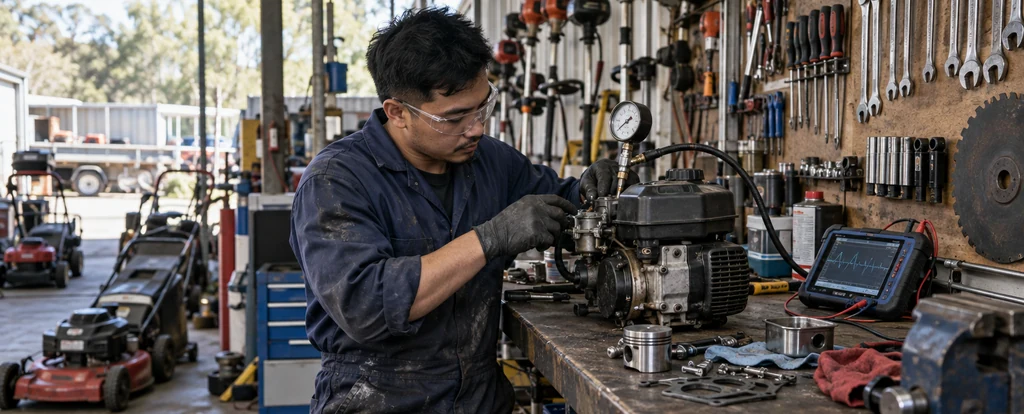
Small engine mechanics diagnose, service and repair the petrol and diesel engines in mowers, chainsaws, generators, pumps and other outdoor power equipment.
- Median salary*
- $65,000
3.5%vs last year, before tax
- People employed
- 940
4.4%vs last year
- Projected growth*
- +1.5%
to 2035
- AI exposure*
- Moderate
- automation risk
- Average hours*
- 40/wk
matches all-jobs average
- Shortage status*
- Not in shortage
national
The work happens in repair workshops, dealer service centres and, for some, a mobile van that visits farms, schools and councils. What separates it from motor mechanics is the machinery: mostly small engines, often running on two-stroke mix, and repairs weighed against the cost of replacing equipment that may be cheaper to replace than to fix. Many mechanics also look after everything around the engine, sharpening mower blades and replacing belts, cables and drives.
How much do small engine mechanics earn?
The median full-time salary for a small engine mechanic is $65,000 per annum, before tax, up $13,800 since 2018.
Pay follows the award or enterprise agreement covering the workshop, so a dealership service centre and a small independent repair shop can sit at different points on the same scale. Overtime through the spring and pre-winter rush, a mobile servicing run, and work in agricultural or mining equipment hire all add to the base rate. Manufacturer training and experience with electronic fuel injection give you more room to negotiate than years alone.
What does a small engine mechanic do day to day?
The list below is what fills most weeks; the exact mix shifts with seniority and whatever stage the current work is at.
- Listening to an engine run, then confirming the fault with a compression test or spark check
- Servicing mowers, trimmers and chainsaws at the start of the season, changing oil, plugs, filters and blades
- Stripping and rebuilding carburettors and adjusting them so the engine idles and revs cleanly
- Replacing worn parts such as pistons, bearings, belts and cables, then reassembling to the manufacturer's specifications
- Testing equipment under load after a repair and explaining to the customer what was wrong and what it cost
What skills do small engine mechanics need?
Employers look for hand and power tool work, installation and maintenance, inventory management, backed by Multimeter fluency and strong problem solving.
Specialist skills
- Hand and power tool work
- Installation and maintenance
- Inventory management
- Plant and equipment operation
Software and tools
- Multimeter
- Compression tester
- Oscilloscope
- Briggs & Stratton diagnostic software
- Stihl diagnostic software
General skills
- Problem solving
- Attention to detail
- Customer service
- Safety and compliance awareness
Is the job growing?
About 940 people work as small engine mechanics in Australia, and employment is projected to grow 1.5% over the decade to 2035. That's modest growth: demand is steady rather than booming.
How do you become a small engine mechanic?
Here's the path most small engine mechanics take, step by step.
- 1Finish school with maths and manual subjects
There is no formal prerequisite, but Year 10 or Year 12 maths helps with the measuring and electrical work, and workshop or metalwork subjects show an employer you are comfortable with tools.
- 2Start an apprenticeship
The standard entry is a Certificate III in Outdoor Power Equipment Technology (AUR30720), delivered as a paid apprenticeship over about three to four years through a dealer, a repair business or a group training organisation. You earn while you learn and finish trade qualified.
- 3Try a pre-apprenticeship if apprenticeships are scarce
A Certificate II in Automotive Vocational Preparation (AUR20720) is a short course at TAFE or a private provider that covers workshop basics and gives you something concrete to offer an employer when several people apply for the same apprenticeship.
- 4Get your driver's licence early
Most apprentices need to move between the workshop and customer sites, and a licence is what opens up mobile servicing and field work later on.
- 5Add manufacturer training and a specialisation
Dealers send staff to product courses run by the major equipment brands, and experience with electronic fuel injection or a particular brand is what employers look for when hiring beyond entry level.
Ready to apply as a small engine mechanic?
Whether you're working toward becoming a small engine mechanic or already are one and want a hand with the next step (sharpening your resume for ATS screening, tightening your cover letter, or knowing what you'll actually be asked at interview), here are examples grounded in this specific role, not generic templates.
What jobs can a small engine mechanic move to?
Moving into Motor Mechanic typically comes with the biggest pay rise, worth $19,300 a year more on average.
| Move to | Typical pay change | Overlap | Retraining |
|---|---|---|---|
| Motor Mechanic Small engine mechanics bring petrol engine diagnosis, service and repair skills to motor mechanics. | +$19,300 | 55% | reskill |
| Diesel Mechanic Small engine mechanics bring engine overhaul and fuel system skills to diesel mechanics. | +$15,600 | 63% | reskill |
| Marine Mechanic Small engine mechanics bring outboard and small petrol engine repair skills to marine mechanics. | +$10,400 | 68% | reskill |
| Agricultural Mechanic Small engine mechanics bring small engine and machinery repair skills to agricultural mechanics. | +$10,400 | 63% | reskill |
| Motorcycle Mechanic Small engine mechanics bring portable petrol engine, carburettor and ignition skills to motorcycle mechanics. | +$5,200 | 81% | reskill |
Moves are chosen from Jobs and Skills Australia's Data on Occupation Mobility, which follows income tax records between 2011-12 and 2020-21, together with entry requirements and skill overlap. A known move is one people were seen making in that data. Pay change compares median full-time pay for the two roles.
Who works as a small engine mechanic?
The typical small engine mechanic is 39 years old; 98% are men, 79% work full-time, and full-timers average 40 hours a week.
- 39
- Median age
- 2%
- Female share
- 79%
- Full-time
- +0h
- vs all-jobs avg
What's it like being a small engine mechanic?
The job has a seasonal rhythm: spring brings a queue of mower services, autumn is chainsaws and blowers, and winter is quieter apart from repairs and pre-season work for commercial customers. Most mechanics work full time, averaging around 40 hours a week, often standing at a bench with the noise, fuel and fumes that come with small engines. It suits someone who likes hearing an engine come right and does not mind repeating the same service many times over in a busy week.
What people like
- Faults you can hear. A small engine tells you a lot by sound and feel, so diagnosis is hands-on and immediate, and you often know what is wrong before you take anything apart.
- Something different each day. One morning might be a ride-on mower, the next a generator, a pump or a chainsaw, and each type has its own quirks and common failures.
- A trade without a long degree. You are paid from the first year of the apprenticeship and trade qualified in three or four years, with no course debt at the end.
- Customers who come back. Householders, farmers and councils return to the same workshop, so you get to know the machines and the people who own them.
What people find hard
- Peak season is relentless. When the first warm weekend arrives, every mower in town needs servicing at once and the queue does not clear for weeks.
- Dirty, noisy and physical. Two-stroke mix, fuel, oil, exhaust and sharp blades are part of the day, and the work is done standing and lifting.
- The repair or replace conversation. A repair can cost more than a new entry-level mower, and explaining that to a customer who wants the old one fixed is an awkward part of the job.
- Pay is modest in small workshops. Independent repair shops and retail service departments pay to the award, and the bigger jumps come from moving into agricultural, marine or mining equipment work or running your own business.
Based on our synthesis of professional-body surveys and public accounts of the role, not first-person verified reviews.
Which industries employ small engine mechanics?
Outdoor power equipment repair and maintenance employs the largest share of small engine mechanics, followed by Agricultural machinery and equipment retailing.
Top employing industries
- 1Outdoor power equipment repair and maintenance
- 2Agricultural machinery and equipment retailing
- 3Garden and hardware retailing
- 4Landscape and grounds maintenance services
- 5Construction and mining equipment hire
Ranked by employment share; the source doesn't publish an exact percentage per industry.
| Certificate III/IV | 34% | |
|---|---|---|
| Diploma / Advanced Diploma | 26% | |
| Bachelor degree | 20% | |
| Year 12 or below | 20% |
Will AI replace small engine mechanics?
Exposure is moderate: diagnostic software, electronic engine management and online parts catalogues now handle part of the fault-finding and most of the paperwork. The physical work on small engines, stripping them down, measuring wear, reassembling and running them under load, has not moved. A mechanic who can read a fault code and also hear what a carburettor is doing is in a stronger position than one who relies on either alone.
Share of typical working time by exposure level
- Rebuilding and replacing worn componentsPulling down an engine, measuring a cylinder for wear, fitting a piston and reassembling it to the right clearances is hands-on work that depends on judgement built over years.30%low
- Servicing and tuningRoutine service intervals and settings are increasingly guided by manufacturer software, and fuel injection has removed much of the manual carburettor adjustment this job once involved.25%moderate
- Quoting and ordering partsOnline catalogues and quoting systems speed up pricing a job and finding a part, though judging whether a repair is worth doing on a ten-year-old mower is still a conversation with the customer.25%high
- Diagnosing engine faultsA scan tool on a fuel-injected engine narrows the fault to a sensor or circuit, but a misfire on a two-stroke still comes down to feel, sound and a compression reading.20%moderate
Moves least exposed to AI
These career moves from small engine mechanic work are rated low for AI exposure:
- Motorcycle Mechanic
High skill overlap (81%), reskill to get there, and a low automation-risk profile.
- Agricultural Mechanic
High skill overlap (63%), reskill to get there, and a low automation-risk profile.
Common questions about becoming a small engine mechanic
Straight answers to the questions people ask most.
How much do small engine mechanics earn?
Small engine mechanics earn a median of $65,000 per annum, before tax. Pay follows the award or enterprise agreement of the workshop, and overtime in the seasonal rush, mobile servicing and manufacturer training push the figure up. The employer and sector move pay more than the trade itself, so a dealership service centre and a small independent repair shop can pay quite differently.
How do you become a small engine mechanic?
Most people enter through a paid apprenticeship that combines work with a Certificate III in Outdoor Power Equipment Technology (AUR30720), usually over three to four years. You need to handle tools and small engines reliably and get yourself to work each day, and a pre-apprenticeship course improves your chances if apprenticeships are scarce where you live. No degree or registration is required.
Are small engine mechanics in demand?
Small engine mechanics are currently not in shortage. Employment is projected to grow 1.5% over the decade to 2035, and with about 940 people in the trade, most openings come from replacing mechanics who retire or leave. Anyone training now should look across dealerships, independent repair shops, hire yards and councils instead of assuming one type of employer is hiring.
Will AI or automation replace small engine mechanics?
Diagnostic software, electronic engine management and online parts catalogues already do part of the job: fault codes point to a sensor and a scan tool confirms it. Carburettor work has shrunk as more equipment moves to fuel injection, so tuning is increasingly a software task. Stripping an engine, measuring wear, reassembling it and testing under load stays with the mechanic.
What can a small engine mechanic move into?
Small engine mechanics move into related mechanic trades, and the skills carry across. Motorcycle mechanic shares 81% of the skills and pays $5,200 more, marine mechanic pays $10,400 more, and diesel mechanic pays $15,600 more on the strength of the engine overhaul experience you already have. Many experienced mechanics instead open their own repair shop or run a mobile servicing round, which is often where earnings grow.
Do you need a licence to work as a small engine mechanic?
There is no licence or registration for the trade itself, but a driver's licence is close to essential for getting to jobs and for mobile servicing. If you work around hire equipment or in a yard, a forklift licence may also be required. Employers look for the trade qualification and manufacturer product training.
Related roles
- Motorcycle Mechanic
- Marine Mechanic
- Motor Mechanic
- Agricultural Mechanic
- Diesel Mechanic
- Mechanic's Assistant
Not sure this is you? Take the career quiz and get a ranked shortlist of roles that fit how you like to work.