Sports Commentator
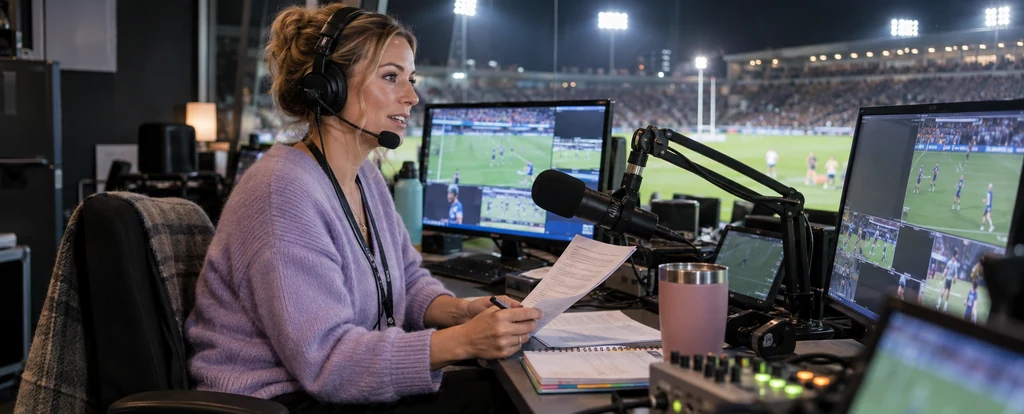
Sports commentators describe live sport as it happens, turning what is unfolding on the field into a story that viewers and listeners can follow.
- Median salary*
- $83,200
3.7%vs last year, before tax
- People employed*
- 1,500
0.0%vs last year
- Projected growth*
- +2%
to 2035
- AI exposure*
- Moderate
- automation risk
- Average hours*
- 40/wk
matches all-jobs average
- Shortage status*
- Not in shortage
national
Most commentators work in broadcast, calling matches for television, radio or an online stream as part of a small team with a producer and often a second voice beside them. The role sits close to a presenter or a sports journalist, but the commentary seat is judged on how well you read play in real time rather than how well you write it up afterwards. Much of the work is casual or freelance, so hours and income follow the sporting calendar rather than a standard week.
How much do sports commentators earn?
The median full-time salary for a sports commentator is $83,200 per annum, before tax, up $17,100 since 2018.
Pay depends on the level of the sport and the size of the audience as much as on experience, so a national league call and a local grand final sit at very different rates. Many commentators are paid per match or on short contracts, which means weekend and evening work without paid leave or the security of a staff role. Freelancers often build income across several competitions, plus writing, podcasts or corporate hosting.
What does a sports commentator do day to day?
The list below is what fills most weeks; the exact mix shifts with seniority and whatever stage the current work is at.
- Researching teams, players and recent form before a broadcast
- Calling play-by-play as the action unfolds, describing what happens for listeners who cannot see it
- Adding colour and analysis between plays, often with a former player beside you
- Interviewing players, coaches and officials before or after the event
- Working with producers on running sheets, segment timings and crossovers to other coverage
What skills do sports commentators need?
Employers look for content creation and writing, backed by Champion Data fluency and strong written communication.
Specialist skills
- Content creation and writing
Software and tools
- Champion Data
- Adobe Audition
- Teleprompter software
- Zoom H6 recorder
- Social media platforms
General skills
- Written communication
- Presenting and data storytelling
- Attention to detail
- Time and deadline management
- Problem solving
- Digital literacy
Is the job growing?
About 1,500 people work as sports commentators in Australia, and employment is projected to grow 2% over the decade to 2035. That's modest growth: demand is steady rather than booming.
How do you become a sports commentator?
Here's the path most sports commentators take, step by step.
- 1Learn one or two sports properly
Know the laws, tactics, player histories and current form of a single sport inside out. Commentary seats go to people who can explain a passage of play without hesitating, and depth in one game counts for more than a broad interest in all of them.
- 2Study media, journalism or communications
A bachelor degree in journalism, communications or screen and media is the most common background, held by about 38% of the people working in this role, but it is not a registration requirement. TAFE diplomas and short broadcasting courses cover much of the same ground if a degree isn't for you.
- 3Call matches wherever you can
Community and junior sport is where most people start: local radio, a club livestream, a school carnival or your own podcast. Offer to do stats or boundary duty at a higher level as well, because being useful around a broadcast is how producers get to know your voice.
- 4Record a full match call
Send producers a complete call rather than a highlights package, plus a short piece of analysis and an interview. Network sport departments and production companies keep lists of voices they have heard work, and a solid recording is what gets you onto that list.
- 5Get in through a nearby role
Many commentators arrive from sports journalism, production assistant work or coverage of a minor competition before a network slot opens. Being in the building, or on the freelancer roster, is usually how the first paid call comes through.
Ready to apply as a sports commentator?
Whether you're working toward becoming a sports commentator or already are one and want a hand with the next step (sharpening your resume for ATS screening, tightening your cover letter, or knowing what you'll actually be asked at interview), here are examples grounded in this specific role, not generic templates.
What jobs can a sports commentator move to?
Moving into Radio Presenter typically comes with the biggest pay rise, worth $30,100 a year more on average.
| Move to | Typical pay change | Overlap | Retraining |
|---|---|---|---|
| Radio Presenter An engaging broadcast voice and ability to describe live action suit radio presenting, including sports shows and talkback. | +$30,100 | 64% | minimal |
| Television Presenter Live commentary and quick match analysis translate directly to presenting television programs, with on-camera presence already established. | +$6,800 | 80% | minimal |
| Journalist Strong match knowledge and concise storytelling carry across to sports journalism, live reporting and commentary-led features. | +$6,300 | 62% | minimal |
Moves are chosen from Jobs and Skills Australia's Data on Occupation Mobility, which follows income tax records between 2011-12 and 2020-21, together with entry requirements and skill overlap. A known move is one people were seen making in that data. Pay change compares median full-time pay for the two roles.
Who works as a sports commentator?
The typical sports commentator is 44 years old; 90% are men, 50% work full-time, and full-timers average 40 hours a week.
- 44
- Median age
- 10%
- Female share
- 50%
- Full-time
- +0h
- vs all-jobs avg
What's it like being a sports commentator?
The job follows the sporting calendar, so a normal week might hold two evening matches, a research day and a long drive to a regional ground, then nothing at all in the off season. Most calls are over in a few hours, but the pressure sits in the opening minutes, when you have to identify players, set the scene and keep talking while the producer speaks in your ear. It suits people who are comfortable performing without a script and who watch sport closely enough to explain it well.
What people like
- Calling the moment it happens. A tight finish cannot be rehearsed. You describe what is in front of you, live, and either get it right or don't.
- Getting paid to study the game. Reading form, watching replays and talking to coaches is the job, not something squeezed in around it.
- A small team with shared shorthand. Most broadcasts run with a caller, an analyst, a producer and a stats spotter, and the understanding built over a season makes a difficult call easier.
- A clear end to the shift. A match has a final siren. Once the wrap-up segment is done, the day's work is finished.
What people find hard
- Weekends and public holidays belong to the sport. The biggest fixtures fall when everyone else is off, and the calendar runs across summer and winter depending on the code.
- Per-match and short-contract pay. A lot of commentary work is paid per event, so income moves with the season and there is nothing coming in between gigs.
- Being judged by strangers. Talkback, social media and post-match reaction land on the commentator as much as the players, and a single call can be clipped and replayed well beyond the broadcast.
- Few full-time seats. Networks keep a small core of commentators and fill the rest from a freelancer list, so steady work often means covering several sports or competitions.
Based on our synthesis of professional-body surveys and public accounts of the role, not first-person verified reviews.
Which industries employ sports commentators?
Television broadcasting employs the largest share of sports commentators, followed by Radio broadcasting.
Top employing industries
- 1Television broadcasting
- 2Radio broadcasting
- 3Internet publishing and streaming
- 4Sports and physical recreation activities
- 5Newspaper, periodical, book and directory publishing
Ranked by employment share; the source doesn't publish an exact percentage per industry.
| Bachelor degree | 38% | |
|---|---|---|
| Diploma / Advanced Diploma | 24% | |
| Certificate III/IV | 20% | |
| Postgraduate | 10% | |
| Other | 8% |
Will AI replace sports commentators?
Commentary sits in the middle: the work around the call is being automated faster than the call itself. Data feeds such as Champion Data and automated graphics now deliver statistics in real time, and AI can draft match summaries, social posts and text coverage from the same feed, which removes preparation and writing that used to sit with the commentator. The live performance, the judgement about when to speak and the relationship with a co-commentator and an audience are the parts technology has not taken over.
Share of typical working time by exposure level
- Calling play-by-playDescribing what is happening as it happens depends on watching, timing and a voice that can carry a two-hour broadcast, which no current tool reproduces.40%low
- Analysis and opinion between playsA tool can surface the trend or the number, but deciding which one explains the passage of play, and saying it in a way that lands, is still the commentator's work.25%moderate
- Research and match preparationForm lines, head-to-head records and historical statistics arrive already assembled from services such as Champion Data, so much of the note-taking is now done for you and the value shifts to interpreting it.20%high
- Interviews and pre-match segmentsLive interviews with players and coaches rest on conversation and quick follow-up questions; transcription and clip-cutting are automated, the exchange is not.15%low
Common questions about becoming a sports commentator
Straight answers to the questions people ask most.
How much do sports commentators earn?
Sports commentators earn $83,200 per year before tax at the median for full-time work. That figure reflects staff and regular freelance roles, while per-match rates for community and lower-grade sport are much lower. Pay is also driven by the size of the audience, so the level of the competition you call matters as much as your experience.
How do you become a sports commentator?
Learn one or two sports deeply, get practice calling local matches for community radio, club streams or a podcast, then send producers a recording of a full match rather than highlights. A degree in journalism, communications or media is common but not required, and plenty of people come across from sports journalism or production work.
Are sports commentators in demand?
Sports commentators are currently not in shortage. Employment in the role is projected to grow 2% over the decade to 2035, from a small base of about 1,500 people, so most openings appear when a competition adds coverage or an established commentator moves on. Knowing producers before a slot opens is often what turns a one-off call into regular work.
Will AI replace sports commentators?
Not the live call. Data services and automated graphics now supply statistics that a commentator once looked up, and AI can draft match summaries, social clips and text coverage of lower-grade games, which takes away some of the preparation and writing around a broadcast. Reading the tempo of a game, knowing when to stay quiet and holding a two-hour conversation with a co-commentator are the parts audiences still rely on a person for.
What can sports commentators move into?
Television presenting uses the same on-camera composure and pays $6,800 more at the median, while radio presenting leans on the live voice and pays $30,100 more. Sports journalism draws on match knowledge and fast storytelling, and pays $6,300 more. Within commentary, progress usually means bigger competitions, more prominent matches and a longer season.
Do you need to have played the sport?
No, but knowing one sport unusually well is what matters. Former players often move into the analyst chair beside the caller, while play-by-play roles commonly come through broadcasting or journalism rather than a playing career. Clubs and competitions also hire callers and statisticians who have never played at a high level.
Related roles
Not sure this is you? Take the career quiz and get a ranked shortlist of roles that fit how you like to work.