Vending Machine Attendant
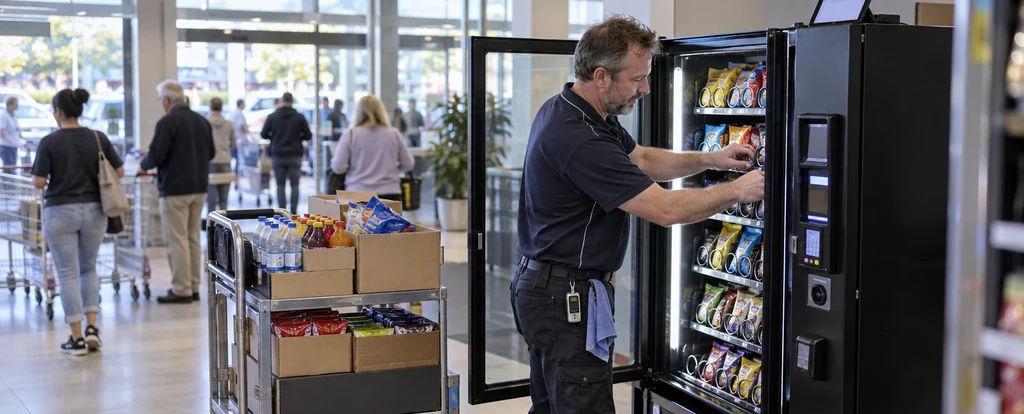
Vending machine attendants restock, clean and repair the machines that sell snacks and drinks, driving a route from site to site.
- Median salary
- $59,800
3.6%vs last year, before tax
- People employed
- 4,500
0.0%vs last year
- Projected growth
- +4.4%
to 2035
- AI exposure*
- Moderate
- automation risk
- Average hours
- 40/wk
matches all-jobs average
- Shortage status*
- Not in shortage
national
The work happens on the road as much as at the machine: attendants load a van, drive between offices, schools, hospitals and factories, and leave each machine full, clean and working. Most are employed by vending operators or by the food service companies that run vending alongside catering, and the attendant is often the person a site manager calls when a machine jams. It differs from retail shop work because the customer is usually absent, so the machine, its stock and its cash box are the whole interaction.
How much do vending machine attendants earn?
The median full-time salary for a vending machine attendant is $59,800 per annum, before tax, up $12,700 since 2018.
The award or enterprise agreement covering the employer sets the base rate, and because machines sell around the clock, penalty rates for early mornings, weekends and public holidays make up a real part of take-home pay. Attendants who run a longer route with more machines, or who take on supervision of other drivers, generally earn more than someone on a single short run. Whether the employer supplies the vehicle and fuel also changes what the job is worth in practice.
What does a vending machine attendant do day to day?
The list below is what fills most weeks; the exact mix shifts with seniority and whatever stage the current work is at.
- Loading the van with cartons of snacks and drinks at the start of the route
- Restocking each machine, rotating older stock to the front and pulling anything past its date
- Clearing coin and note jams, emptying the cash box and reconciling takings against the route report
- Cleaning the glass, shelves and dispensing mechanisms, and wiping down the cabinet and the floor around it
- Diagnosing faults such as a failed refrigeration unit or a bent spiral, then fixing what can be fixed on site or booking a technician visit
What skills do vending machine attendants need?
Employers look for plant and equipment operation, cleaning and grounds maintenance, inventory management, backed by Route accounting software fluency and strong attention to detail.
Specialist skills
- Plant and equipment operation
- Cleaning and grounds maintenance
- Inventory management
- Operations management
- Driving and transport operations
Software and tools
- Route accounting software
- Cash counting machines
- Hand trucks
- Tablet-based inventory apps
- Diagnostic testers
General skills
- Attention to detail
- Customer service
- Safety and compliance awareness
Is the job growing?
About 4,500 people work as vending machine attendants in Australia, and employment is projected to grow 4.4% over the decade to 2035. That's modest growth: demand is steady rather than booming.
How do you become a vending machine attendant?
Here's the path most vending machine attendants take, step by step.
- 1Hold a full driver's licence
Most attendants drive a van between sites, so a full licence is usually asked for before you start, and a reasonably clean driving record matters because the vehicle is part of the job.
- 2Apply directly to vending operators and food service companies
Employers advertise on job boards or hire at the depot, and no formal study is required: 55% of people in the job list Year 12 or below as their highest qualification.
- 3Learn the route and the machines on the job
Paid training usually runs for a few weeks alongside an experienced attendant, covering stock rotation, cash reconciliation, the order of stops and the faults you can fix yourself.
- 4Add licences or a qualification if you want to specialise
A forklift licence helps in depot and warehouse roles, while a Certificate III in Retail (SIR30216) or a food safety certificate can support a move into supervision or into similar work such as service station attending.
Ready to apply as a vending machine attendant?
Whether you're working toward becoming a vending machine attendant or already are one and want a hand with the next step (sharpening your resume for ATS screening, tightening your cover letter, or knowing what you'll actually be asked at interview), here are examples grounded in this specific role, not generic templates.
What jobs can a vending machine attendant move to?
Moving into Gaming Attendant typically comes with the biggest pay rise, worth $20,200 a year more on average.
| Move to | Typical pay change | Overlap | Retraining |
|---|---|---|---|
| Gaming Attendant Cash handling and machine servicing routines transfer directly into gaming floor work, with a gaming licence and hospitality training completing the move.Known move | +$20,200 | 13% | reskill |
| Bartender Customer service and stock handling carry into bar work, with drink preparation and responsible service training added.Known move | +$18,200 | 7% | reskill |
| Service Station Attendant Restocking, cash handling and basic machine upkeep transfer directly, so the move needs little beyond site induction. | +$4,300 | 63% | minimal |
Moves are chosen from Jobs and Skills Australia's Data on Occupation Mobility, which follows income tax records between 2011-12 and 2020-21, together with entry requirements and skill overlap. A known move is one people were seen making in that data. Pay change compares median full-time pay for the two roles.
Who works as a vending machine attendant?
The typical vending machine attendant is 32 years old; 70% are women, 59% work full-time, and full-timers average 40 hours a week.
- 32
- Median age
- 70%
- Female share
- 59%
- Full-time
- +0h
- vs all-jobs avg
What's it like being a vending machine attendant?
A vending attendant's day has a clear shape: load the van, work through the stops, bring the cash and paperwork back to the depot. The pressure comes from the schedule, since a breakdown, a badly jammed machine or heavy traffic pushes the rest of the run later, and much of the work is done alone at sites where nobody is expecting you. It suits people who like driving, working independently and finishing a task they can see the end of.
What people like
- You run your own day. Once the van is loaded you work through the route on your own, choosing the order of stops and how long to spend at each machine.
- A run that finishes when the van is empty. The job has a visible end point each day, which suits people who prefer steady progress to a queue that keeps building.
- Different sites every day. Schools, hospitals, factories and office floors all present differently, and the round changes enough that the week doesn't feel like one location.
- Machines you learn to fix yourself. A jammed spiral or a sticking coin mechanism is usually cleared in a few minutes, and that practical skill builds quickly over the first months.
What people find hard
- Early starts and long stretches behind the wheel. Routes often begin before business hours so machines are full when staff arrive, and city traffic can stretch a run well past its scheduled finish.
- Heavy cartons in all weather. Drinks come in crates and slabs, and loading them in and out of a van through heat, cold or rain is the physical part of a job that otherwise looks light.
- Repeat faults and vandalism. Machines at busy or unattended sites get jammed, damaged or emptied of stock, and the same machine can absorb time on several visits in a row.
- Accountability for stock and cash. Attendants are responsible for the takings and the stock on their route, and a shortfall in either is investigated with whoever ran it.
Based on our synthesis of professional-body surveys and public accounts of the role, not first-person verified reviews.
Which industries employ vending machine attendants?
Accommodation and Food Services employs the largest share of vending machine attendants, followed by Arts and Recreation Services.
Top employing industries
- 1Accommodation and Food Services
- 2Arts and Recreation Services
Ranked by employment share; the source doesn't publish an exact percentage per industry.
| Year 12 or below | 54.8% | |
|---|---|---|
| Certificate III/IV | 18.1% | |
| Diploma / Advanced Diploma | 9.8% | |
| Bachelor degree | 9.6% | |
| Postgraduate | 2.9% |
Will AI replace vending machine attendants?
Vending machine attendants work with technology that already carries part of the job: telemetry reports stock levels and faults from each machine, and route software orders the stops. Restocking, cleaning, cash collection and on-site repairs still need someone physically at the machine, so overall exposure is moderate. Payment is the area changing fastest, as card readers and mobile payments replace coin and note handling on many sites.
Share of typical working time by exposure level
- Restocking and rotating stockTelemetry tells you roughly what each machine needs, but filling the shelves and pulling short-dated stock to the front is still manual work at every stop.35%low
- Diagnosing faults and servicing machinesRemote error reports and diagnostic testers point to the likely fault, but swapping a coin mechanism or freeing a jammed spiral still happens in person.25%moderate
- Cash collection and reconciliationRoute accounting software already matches takings to recorded sales, and card and mobile payment readers are removing the coin and note handling altogether.20%high
- Cleaning machines and the space around themWiping down cabinets, clearing spills and cleaning dispensing mechanisms across thousands of scattered sites remains hands-on.20%low
Common questions about becoming a vending machine attendant
Straight answers to the questions people ask most.
How much does a vending machine attendant earn?
$59,800 per year before tax is the median for full-time vending machine attendants, so half earn more and half earn less. Penalty rates for early mornings, weekends and public holidays, and whether the employer provides the vehicle and fuel, tend to shift that figure more than experience does.
How do you become a vending machine attendant?
You apply directly to a vending operator or a food service company, and there is no qualification or registration to complete first. A full driver's licence is the main requirement, because the job is a driving route with a van full of stock, and the rest is learned on the job over the first few weeks.
Are vending machine attendants in demand?
Vending machine attendants are currently not in shortage. Employment is projected to grow 4.4% over the decade to 2035, and with about 4,500 people working in the job nationally, most openings come from attendants leaving rather than from new machines being installed.
Will AI or automation replace vending machine attendants?
Telemetry and route software already handle part of the job, with machines reporting their own stock levels and faults and software sequencing the stops. That cuts paperwork and wasted trips but doesn't fill a shelf or clear a jam, so the role is moderately exposed rather than likely to disappear. Cash handling is the part changing fastest as more sites take card and mobile payments.
What jobs can a vending machine attendant move into?
Service station attending is a close match, with 63% of the skills overlapping, so the move needs little beyond a site induction. Gaming attendant and bartender pay more ($20,200 more and $18,200 more respectively) but need a gaming licence or responsible service of alcohol training first.
Do you need a driver's licence to be a vending machine attendant?
In most cases, yes. The job is usually a route you drive yourself, often in a company van, so employers ask for a full licence and a reasonable driving record. Some depot roles that service machines on a single large site may not require one.
Related roles
- Gaming Attendant
- Bartender
- Service Station Attendant
- Kitchen Hand
- Fast Food Cook
- Service Station Attendant
Not sure this is you? Take the career quiz and get a ranked shortlist of roles that fit how you like to work.