HomeCoursesSurveying and planningDiploma
Diploma · national qualification
Diploma of Surveying
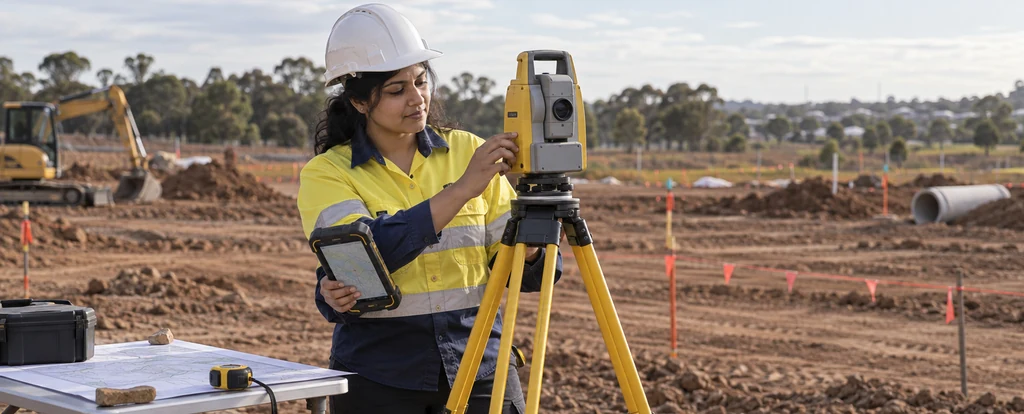
This diploma builds on the field and office skills of a surveying technician, taking them into precision measurement, setting out and the calculations behind large surveys.
- How long it takes
- 1 year
- full time at TAFE NSW
- How you can study
- On campus
- Main job
- Surveying Technician
- $87,400 (estimate) median pay
- Taught by
- 7 providers
- 5 states and territories
Is this course right for you?
What the Diploma of Surveying asks of you, and what you might want to check first.
It helps to have
- an interest in precise measurement and accurate records
- an enjoyment of both fieldwork and office based tasks
- good maths skills for calculations and computations
- patience and care when working with detailed plans
Before you start
Entry points to undertake the CPP50121 Diploma of Surveying are: CPP40216 Certificate IV in Surveying or CPP41721 Certificate IV in Surveying and Spatial Information Services (Surveying) or demonstrated relevant vocational experience, skills and knowledge commensurate with the scope of work covered in the CPP41721 Certificate IV in Surveying and Spatial Information Services (Surveying).
Where this course can take you
Jobs this qualification is a recognised route into, and the study that can follow it.
Jobs you can do with it
Surveying Technician
Surveying technicians measure and map land, boundaries and construction sites, and the data they collect keeps building, mining and infrastructure projects accurate and legally sound.
What else you need
This diploma leads to surveying technician roles doing fieldwork and mapping. It does not make you a registered surveyor, which needs further study and board registration, and a white card is needed for construction sites. Entry is usually via the Certificate IV or relevant experience.
Median pay$87,400 (estimate)
If you study further
Pay is the median for everyone in the job, and “In demand” means the job is on the national shortage list. Pay marked as an estimate is our own analysis, not a published figure.
Where you can study this course
There are 7 places you can study this course. When you compare them, check they teach it the way you want to study, how far you'd be from a campus, what it will cost you and what past students say about the teaching and support. They're listed by how often people search for them, and none of them pays to be here or to move up.
What students like
- Teachers are supportive and ready to help
- Staff are helpful and friendly
- Course content is practical and industry relevant
What to weigh up
- Enrolment and admin can be slow
- Some find front desk staff less helpful
What students like
- Lecturers are approachable and care about learning
What to weigh up
- Enrolment and admin can be slow
- Website for TAFE SA (opens in a new tab)

TAFE SA
26 campuses, SA
4.4from 1,339 Google reviews
What students like
- Lecturers are nice and helpful
What to weigh up
- Enrolment and admin can be slow
- Course information can be unclear
- Course page for North Metropolitan TAFE (opens in a new tab)
North Metropolitan TAFE
East Perth, WA
4.1from 903 Google reviews
- How you study
- On campus
What students like
- Lecturers are helpful and knowledgeable
- Courses provide strong practical skills
- Course page for South Regional TAFE (opens in a new tab)
South Regional TAFE
Bunbury, WA
5.0from 1 Google reviews
- How you study
- On campus
- Website for TAFE International Western Australia (opens in a new tab)

TAFE International Western Australia
TAFE International Western Australia, WA
3.6from 93 Google reviews
What students like
- Staff are friendly, patient and helpful
What to weigh up
- Enrolment and admin can be slow
- Communication can be inconsistent
- Website for Srdita (opens in a new tab)

Srdita
Scientific Research Development Institute of Technology Australia, QLD
5.0from 1 Google reviews


What you’ll learn
16 units: 8 that everyone takes and 8 you choose.
- GNSS surveys
- Engineering surveys
- Precision measurement and setting out
- Complex surveying computations
- Geodetic surveying
- Subsurface utility mapping
See all 8 core units
Core units
Everyone completes these. Select a unit to see what it covers.
Loading the details for CPPSSI5047…
Loading the details for CPPSSI5047…
Questions to ask before you enrol
Providers run this course differently, so the answers change from one to the next.
- When is the next intake, and how many are there each year?
- What is the total cost, including materials, checks and any placement costs?
- Can I study part time or online, and how does that change the length?
- Do the units count towards a higher qualification if I go on to study further?
Questions people ask
Who is this qualification for?
It prepares skilled surveying technicians to perform precise measurements and set out structures in the field, and to map measurements and draft plans in the office. It suits people with a Certificate IV in surveying or comparable experience.
Do I need experience or other qualifications first?
You need to have completed the CPP40216 Certificate IV in Surveying or the CPP41721 Certificate IV in Surveying and Spatial Information Services (Surveying), or have demonstrated relevant vocational experience, skills and knowledge. Check with the provider you choose, as they can set their own conditions.
Is a licence, registration or check required to work in this area?
Cadastral surveying must be carried out under the supervision of a registered surveyor. Check with your state or territory regulatory authority to confirm the requirements.