Surveying Technician
Surveying technicians measure and map land, boundaries and construction sites, and the data they collect keeps building, mining and infrastructure projects accurate and legally sound.
- Median salary*
- $87,400
4.4%vs last year, before tax
- People employed
- 1,200
0.0%vs last year
- Projected growth
- +14.2%
to 2035
- AI exposure*
- Moderate
- automation risk
- Average hours
- 42/wk
+2h vs all jobs
- Shortage status
- Not in shortage
national
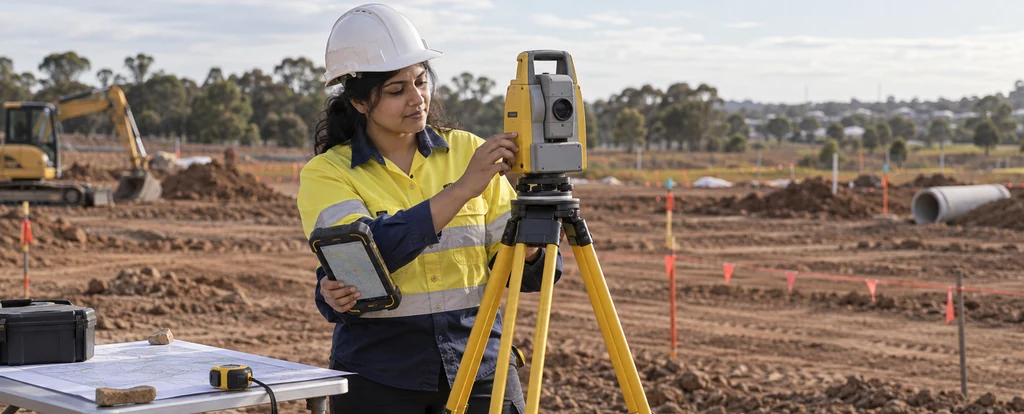
Surveying technicians split their time between the field and the office. On site they set up instruments and measure; back at the desk they turn those measurements into plans, maps and digital models. They work under a surveyor, who is the person registered to certify boundaries and sign off on plans, so the technician's job is to gather and prepare the measurements that make that certification possible.
How much do surveying technicians earn?
The median full-time salary for a surveying technician is $87,400 per annum, before tax, up $18,500 since 2018.
Where you work moves pay more than anything else: mining and remote construction sites carry site and FIFO allowances on top of base rates, while council and government roles tend to sit closer to the middle of the range. Enterprise agreements in construction set rates and penalty conditions for many technicians, and qualifications plus site experience move you up the scale inside a firm. A specialist field such as mine or hydrographic surveying pays more once you have the additional qualification those roles require.
What does a surveying technician do day to day?
The list below is what fills most weeks; the exact mix shifts with seniority and whatever stage the current work is at.
- Setting up and levelling total stations, automatic levels and GNSS receivers, then checking them against known survey marks before measuring
- Measuring distances, angles, elevations and boundaries, and marking out the position of roads, pipes and foundations for construction crews
- Downloading field data and checking it for gaps and errors before it goes anywhere near a plan
- Assisting surveyors with cadastral, topographic, engineering and as-built surveys, including hunting down existing marks and old survey records
- Drafting plans, cross sections and digital terrain models in AutoCAD Civil 3D or a GIS package
What skills do surveying technicians need?
Employers look for surveying and geospatial work, cAD and technical drawing, data analysis, backed by AutoCAD Civil 3D fluency and strong attention to detail.
Specialist skills
- Surveying and geospatial work
- CAD and technical drawing
- Data analysis
- Field inspection and testing
Software and tools
- AutoCAD Civil 3D
- Trimble Business Center
- Leica Infinity
- QGIS
- ArcGIS Pro
General skills
- Attention to detail
- Problem solving
- Written communication
Is the job growing?
About 1,200 people work as surveying technicians in Australia, and employment is projected to grow 14.2% over the decade to 2035. That's healthy, above-average growth, and the role should stay in solid demand.
How do you become a surveying technician?
Here's the path most surveying technicians take, step by step.
- 1Start as a survey assistant
Many technicians enter through a paid assistant or field hand role, which needs no qualification to begin and teaches instrument setup, mark searching and field procedure on real jobs.
- 2Study part-time while you work
A Certificate IV in Surveying and Spatial Information Services (CPP41721) through TAFE or a registered training organisation takes roughly 12 to 18 months and covers measurement, data reduction and CAD basics.
- 3Complete a diploma if you want the technician title
The Diploma of Surveying and Spatial Information Services is the qualification most employers list for technician roles, and the most common qualification in the current workforce is a Diploma / Advanced Diploma, held by 28% of technicians.
- 4Build experience across survey types
Cadastral, engineering, mining and hydrographic work each use different instruments, standards and site conditions, and employers value a technician who has worked across more than one.
- 5Take a degree if you want to become a surveyor
A Bachelor of Surveying, usually with an honours year, is the pathway to registration with the surveyors board in your state or territory, which is what allows someone to certify boundaries and plans.
Ready to apply as a surveying technician?
Whether you're working toward becoming a surveying technician or already are one and want a hand with the next step (sharpening your resume for ATS screening, tightening your cover letter, or knowing what you'll actually be asked at interview), here are examples grounded in this specific role, not generic templates.
What jobs can a surveying technician move to?
Moving into Mine Surveyor typically comes with the biggest pay rise, worth $37,400 a year more on average.
| Move to | Typical pay change | Overlap | Retraining |
|---|---|---|---|
| Mine Surveyor Surveying technicians with mining site experience can specialise as mine surveyors after gaining the required registration. | +$37,400 | 67% | requalify |
| Surveyor Surveying technicians bring field measurement and boundary skills to surveying, but need to complete the required surveyor qualification.Known move | +$32,200 | 57% | requalify |
| Hydrographic Surveyor Surveying technicians can move into hydrographic surveying, using their measurement skills while completing further study in the specialism. | +$21,800 | 50% | requalify |
| GIS Analyst Surveying technicians bring spatial mapping experience to geographic information systems analysis, though a degree is needed. | +$11,400 | 47% | requalify |
| Cartographer Surveying technicians bring mapping and spatial skills to cartography, though a degree is required for the role.Known move | +$3,600 | 36% | requalify |
Moves are chosen from Jobs and Skills Australia's Data on Occupation Mobility, which follows income tax records between 2011-12 and 2020-21, together with entry requirements and skill overlap. A known move is one people were seen making in that data. Pay change compares median full-time pay for the two roles.
Who works as a surveying technician?
The typical surveying technician is 39 years old; 77% are men, 79% work full-time, and full-timers average 42 hours a week.
- 39
- Median age
- 23%
- Female share
- 79%
- Full-time
- +2h
- vs all-jobs avg
What's it like being a surveying technician?
The job runs on a mix of field days and office days. Fieldwork is physical, weather-dependent and often starts early to beat traffic or heat, while office work is quiet, screen-based and detail-heavy, processing data that has to be right. People who like moving between the two, and who do not mind checking the same numbers twice, tend to settle into it.
What people like
- Fieldwork and office work in one job. Most roles rotate between site and desk, so you are neither outdoors in the rain every day nor at a screen five days a week.
- Your measurements hold a project together. The set-out you do in the first weeks is what the excavation and concrete crews build to, so the result of your work shows up quickly and visibly.
- Technical problems with a right answer. Closing a traverse or tracking down a 20 millimetre misclosure is a puzzle the software and the checks will usually help you solve.
- Room to specialise. Technicians move towards mining, cadastral, engineering or hydrographic work as they gain experience, and each specialism has its own tools, conditions and pay.
What people find hard
- The weather decides your day. Field days happen in heat, rain and mud, and measurements taken in poor conditions often have to be repeated.
- Repetition in the data processing. A lot of office time goes on cleaning, reducing and formatting the same kinds of measurements, and one small error can send you back through the whole set.
- Being the support, not the signatory. A surveyor certifies the plan and carries the legal responsibility for it, so technicians can spend years doing the measurement behind someone else's signature.
- Travel and site rosters. Mining and major infrastructure roles often run on FIFO or drive-in rosters that mean weeks away from home, which suits some people and not others.
Based on our synthesis of professional-body surveys and public accounts of the role, not first-person verified reviews.
Which industries employ surveying technicians?
Professional, Scientific and Technical Services employs the largest share of surveying technicians, followed by Public Administration and Safety.
Top employing industries
- 1Professional, Scientific and Technical Services
- 2Public Administration and Safety
- 3Construction
Ranked by employment share; the source doesn't publish an exact percentage per industry.
| Diploma / Advanced Diploma | 27.8% | |
|---|---|---|
| Bachelor degree | 21.9% | |
| Year 12 or below | 19.8% | |
| Certificate III/IV | 18.4% | |
| Postgraduate | 7.9% |
Will AI replace surveying technicians?
Exposure here is moderate. Survey software already adjusts and reduces measurements automatically, and point-cloud processing and automated drafting tools have taken over much of the routine plan production. What holds the exposure down is the fieldwork: instruments still have to be carried, set up and checked against existing marks, and the results feed a registered surveyor who carries the legal responsibility for the plan.
Share of typical working time by exposure level
- Field measurement and set-outSetting up a total station on a busy road or pegging a boundary through scrub is physical, site-specific work that still needs a person standing on the mark.35%low
- Processing and reducing survey dataSoftware handles the adjustment and coordinate computation, so the technician's time shifts to checking the output and chasing anything that does not close.25%high
- Drafting plans and digital modelsFeature extraction from point clouds speeds up routine planwork, but someone still sets the drawing standards and picks up what the software has misread.25%moderate
- Checking data and managing survey recordsOld plans, council records and existing survey marks are often paper or spread across systems, which limits how much of this checking can be automated.15%moderate
Moves least exposed to AI
These career moves from surveying technician work are rated low for AI exposure:
- Surveyor
Solid skill overlap (57%), requalify to get there, and a low automation-risk profile.
Common questions about becoming a surveying technician
Straight answers to the questions people ask most.
How much do surveying technicians earn?
$87,400 per year before tax for full-time work. The sector moves pay more than the state does, because mining and remote construction roles carry site and FIFO allowances that council and government work does not. Formal qualifications and a specialism lift you further up the scale.
How do you become a surveying technician?
Most people start as a survey assistant and study part-time, usually towards a Certificate IV or Diploma of Surveying (CPP50121) and Spatial Information Services at TAFE or a registered training organisation. The diploma is the level most employers ask for, and the paid field experience you gain while studying counts towards the role. A degree is only needed if you want to go on to become a registered surveyor.
Are surveying technicians in demand?
Surveying technicians are currently not in shortage, and employment is projected to grow 14.2% over the decade to 2035. The work follows construction and resource project pipelines, so openings cluster where those projects are running, including regional and remote sites. Gaining site experience and a diploma keeps you competitive for the roles that come up.
Will AI replace surveying technicians?
Exposure is moderate rather than dramatic. Software already handles the adjustment and reduction of survey data, and point-cloud processing and automated drafting have sped up routine plan production. The fieldwork still needs a person on site to set up instruments, find marks and verify measurements, and the results are checked by a registered surveyor.
What is the difference between a surveying technician and a surveyor?
A surveyor is registered with the state or territory board and is legally responsible for certifying boundaries and plans, while a surveying technician gathers and prepares the measurements under their direction. The step up means completing a surveying degree and being accepted for registration, and surveyors earn $32,200 more.
Where can surveying technicians move next?
Mine surveying is a common move for technicians with site experience, since the measurement work overlaps closely, and mine surveyors earn $37,400 more. GIS analysis uses the same spatial data in a desk-based role, paying $11,400 more, and cartography is similar work. Most of these moves need further study, and becoming a surveyor means a degree.
Related roles
Not sure this is you? Take the career quiz and get a ranked shortlist of roles that fit how you like to work.