Acoustic Engineer
Acoustic engineers work out how sound and vibration will behave in a building, a road or a product, then design what it takes to keep them within acceptable limits.
- Median salary*
- $109,200
3.7%vs last year, before tax
- People employed
- 810
1.3%vs last year
- Projected growth*
- +8%
to 2035
- AI exposure*
- Moderate
- automation risk
- Average hours*
- 40/wk
matches all-jobs average
- Shortage status*
- Not in shortage
national
Most acoustic engineers work for consulting firms in professional services, and their week moves between site measurements, modelling and reports that feed planning approvals. It is a small field of about 810 people, so the work tends to be specialist support on a larger project rather than a discipline with its own team. The nearest roles are mechanical and electrical engineering, but the questions here are about sound, vibration and how people hear a space rather than power, machines or circuits.
How much do acoustic engineers earn?
The median full-time salary for an acoustic engineer is $109,200 per annum, before tax, up $22,500 since 2018.
Pay climbs with experience and with chartership, so consultants who become CPEng through Engineers Australia and sign off their own assessments earn more than graduates doing measurements and drafting. Sector matters as well, with defence, rail and resources work generally paying above residential building work, and some employers add site or night-shift allowances for monitoring outside normal hours. In a field this small, moving between consultancies is often how people lift their pay rather than waiting for an internal step.
What does an acoustic engineer do day to day?
The list below is what fills most weeks; the exact mix shifts with seniority and whatever stage the current work is at.
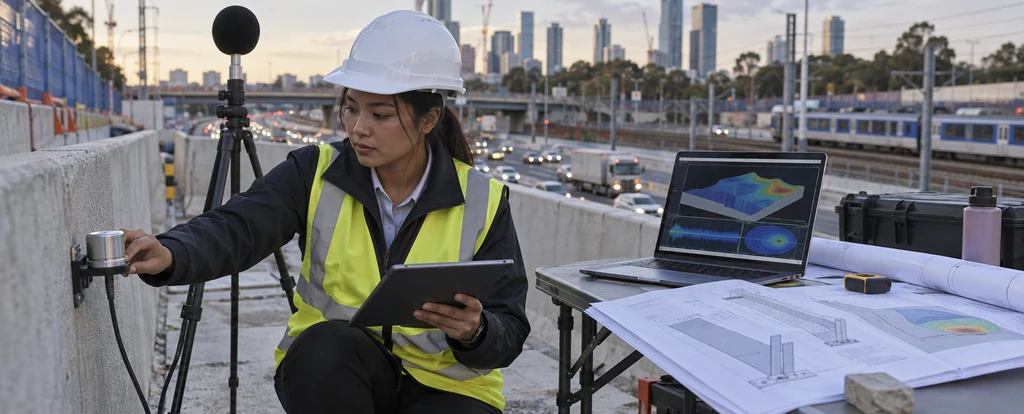
- Measuring noise and vibration on site, from building services plant to traffic and rail corridors
- Modelling sound propagation and room acoustics in software such as SoundPLAN, CadnaA or Odeon
- Designing noise control treatments, including barriers, absorbers and isolation mounts
- Preparing acoustic reports and assessments for development applications and environmental compliance
- Advising design teams on the noise limits and standards that apply to their project
What skills do acoustic engineers need?
Employers look for engineering design and analysis, cAD and technical drawing, field inspection and testing, backed by SoundPLAN fluency and strong problem solving.
Specialist skills
- Engineering design and analysis
- CAD and technical drawing
- Field inspection and testing
- Laboratory analysis
- Data analysis
- Regulatory compliance
- Project management
Software and tools
- SoundPLAN
- CadnaA
- INSUL
- Odeon
- MATLAB
General skills
- Problem solving
Is the job growing?
About 810 people work as acoustic engineers in Australia, and employment is projected to grow 8% over the decade to 2035. That's modest growth: demand is steady rather than booming.
How do you become an acoustic engineer?
Here's the path most acoustic engineers take, step by step.
- 1Complete an engineering degree
A four-year Bachelor of Engineering with honours in mechanical, electrical, civil or a related field is the usual entry point, and it should be accredited by Engineers Australia if you want to register as a professional engineer later. Acoustics electives are worth taking, because few graduates arrive knowing the subject.
- 2Add postgraduate acoustics study
Postgraduate qualifications are common in this field, with about 26% of people in the role holding one. A graduate certificate, graduate diploma or master's with acoustics and vibration subjects gives you the technical grounding consultancies look for, and several Australian universities offer these to working engineers.
- 3Start as a graduate in a consultancy
Most entry-level roles sit with acoustic or multi-disciplinary engineering consultancies, where you learn measurement, modelling and report writing on live projects under a senior engineer's supervision.
- 4Build range across project types
Two or three years of varied work, ideally spanning buildings, transport and industrial noise, gives you the breadth that chartership and more senior assessment work require.
- 5Become chartered
Chartered status (CPEng) through Engineers Australia, often alongside membership of the Australian Acoustical Society, is the credential clients and regulators recognise when they want an assessment signed off.
Ready to apply as an acoustic engineer?
Whether you're working toward becoming an acoustic engineer or already are one and want a hand with the next step (sharpening your resume for ATS screening, tightening your cover letter, or knowing what you'll actually be asked at interview), here are examples grounded in this specific role, not generic templates.
What jobs can an acoustic engineer move to?
Moving into Environmental Engineer typically comes with the biggest pay rise, worth $28,500 a year more on average.
| Move to | Typical pay change | Overlap | Retraining |
|---|---|---|---|
| Environmental Engineer Acoustic engineers bring noise and vibration assessment skills that suit environmental engineering, with a short course in environmental regulation. | +$28,500 | 57% | short course |
| Aerospace Engineer Acoustic engineers bring aeroacoustics and cabin noise experience that transfers to aerospace engineering, with a short course in aircraft systems. | +$28,500 | 48% | short course |
| Mechanical Engineer Acoustic engineers bring vibration, HVAC noise and machine dynamics knowledge that supports a move into mechanical engineering after further study. | +$26,700 | 36% | reskill |
| Electrical Engineer Acoustic engineers bring modelling, measurement and signal knowledge that carries into electrical engineering roles with little retraining. | +$23,600 | 62% | minimal |
| Transport Engineer Acoustic engineers bring traffic and rail noise modelling skills that transfer to transport engineering, with a short course in transport design. | +$5,200 | 52% | short course |
Moves are chosen from Jobs and Skills Australia's Data on Occupation Mobility, which follows income tax records between 2011-12 and 2020-21, together with entry requirements and skill overlap. A known move is one people were seen making in that data. Pay change compares median full-time pay for the two roles.
Who works as an acoustic engineer?
The typical acoustic engineer is 35 years old; 88% are men, 85% work full-time, and full-timers average 40 hours a week.
- 35
- Median age
- 12%
- Female share
- 85%
- Full-time
- +0h
- vs all-jobs avg
What's it like being an acoustic engineer?
The job runs on project deadlines: a burst of site measurement, a stretch of modelling and writing, then a meeting where you explain what the numbers mean for someone else's design. The pressure comes from the standards and from other people's schedules, since development approvals and construction programs rarely move for you. It suits people who like a technical problem with a measurable answer and don't mind that few of the people around them will understand the detail.
What people like
- You can hear the result. Measure a plant room before and after treatment, or sit in a hall you helped tune, and your work is audible rather than buried in a spreadsheet.
- A wide range of settings. The same skills apply to apartments, hospitals, rail corridors, wind farms and aircraft cabins, so the projects and the clients change often.
- Others depend on your assessment. You are usually the only acoustics person on a project, so architects, builders and planners act on your advice instead of folding it into a committee decision.
- Site work and desk work together. Measuring outdoors, modelling at a computer and writing up findings means the week rarely settles into a single mode.
What people find hard
- A small field with few employers. With only a few hundred people in the role nationally, most jobs sit with consultancies in the capital cities or on large infrastructure and defence projects, which can mean relocating or travelling.
- Contentious projects. Noise complaints put you between residents, developers and regulators, and the report you write may end up being tested in a planning appeal.
- Awkward hours on site. Rail and traffic noise often has to be measured at night or in a shutdown window, and the weather does not always cooperate.
- Report-heavy work. A large share of the week goes into documenting an assessment against the standards, and the paperwork can outweigh the analysis.
Based on our synthesis of professional-body surveys and public accounts of the role, not first-person verified reviews.
Which industries employ acoustic engineers?
Professional, Scientific and Technical Services employs the largest share of acoustic engineers, followed by Construction.
Top employing industries
- 1Professional, Scientific and Technical Services
- 2Construction
- 3Manufacturing
- 4Transport, Postal and Warehousing
- 5Electricity, Gas, Water and Waste Services
Ranked by employment share; the source doesn't publish an exact percentage per industry.
| Bachelor degree | 52% | |
|---|---|---|
| Postgraduate | 26% | |
| Diploma / Advanced Diploma | 13% | |
| Other | 9% |
Will AI replace acoustic engineers?
Acoustic engineering sits in the middle. The modelling, standard checks and report writing that fill much of the week are increasingly assisted by software and AI, while measuring on site and deciding what the numbers mean for a particular building or client still comes down to an engineer. Tools such as SoundPLAN and CadnaA have handled propagation calculations for years, so the shift is in how quickly a model can be set up and a first draft produced, not in who signs the assessment.
Share of typical working time by exposure level
- Sound propagation and room acoustics modellingSoftware such as SoundPLAN, CadnaA and Odeon already does the calculation, and AI-assisted model setup and parameter checks are cutting the time this takes.30%high
- Noise measurement and site surveysPlacing microphones and loggers, noticing when wind or a passing truck is skewing a reading, and knowing which measurement point will satisfy the regulator are all on-site judgements.25%low
- Report writing and compliance assessmentsDrafting an assessment against the relevant noise standards is structured writing that AI tools handle well, leaving the engineer to verify the inputs and the conclusion.25%high
- Design of noise control treatments and client adviceChoosing barriers, absorbers and isolation mounts depends on cost, available space and how the building will actually be constructed, and explaining those trade-offs to a client or a planning panel is still a conversation.20%moderate
Common questions about becoming an acoustic engineer
Straight answers to the questions people ask most.
How much do acoustic engineers earn?
Acoustic engineers earn a median of $109,200 per year before tax. What you earn depends on your experience, whether you hold chartered status through Engineers Australia, and the sector, with defence, rail and resources work generally paying above residential building work.
How do you become an acoustic engineer?
Start with a four-year engineering degree accredited by Engineers Australia, then build specialist knowledge through postgraduate acoustics subjects or a graduate certificate. Most people then join a consultancy as a graduate and learn measurement, modelling and reporting on the job.
Are acoustic engineers in demand?
Acoustic engineers are currently not in shortage, and employment is projected to grow 8% over the decade to 2035. The field is small, with about 810 people in the role nationally, so openings depend on consultancies and infrastructure projects winning work rather than on steady turnover.
Will AI replace acoustic engineers?
Parts of the job are already automated: propagation calculations, standard checks and the first draft of a report are areas where software and AI tools save time. The site measurement, the judgement about whether model inputs reflect the real building, and the advice given to a client or a planning panel still need an engineer.
Do you need a master's degree to work as an acoustic engineer?
No, though further study helps. About 52% of people in the role hold a bachelor degree as their highest qualification, and a graduate certificate or master's in acoustics is the usual way to specialise, particularly for people moving across from physics, mathematics or audio engineering.
What can acoustic engineers move into?
Electrical engineering is a close step, because modelling and signal knowledge carry across and the median there is $23,600 more. Environmental engineering suits those already doing noise and vibration assessment, with the median $28,500 more, and transport engineering is a shorter move again for people with traffic and rail noise experience. Some experienced acoustic engineers go on to start their own consultancy, which is often where earnings grow most.
Related roles
- Electrical Engineer
- Environmental Engineer
- Transport Engineer
- Mechanical Engineer
- Aerospace Engineer
- Engineering Technologist
Not sure this is you? Take the career quiz and get a ranked shortlist of roles that fit how you like to work.