Archaeologist
Archaeologists piece together how people lived in the past from the objects, structures and landscapes they left behind, and much of the work today is assessing and protecting heritage sites before development goes ahead.
- Median salary*
- $88,400
4.0%vs last year, before tax
- People employed
- 750
7.1%vs last year
- Projected growth
- +21.2%
to 2035
- AI exposure*
- Low
- automation risk
- Average hours
- 41/wk
+1h vs all jobs
- Shortage status
- Not in shortage
national
Most archaeologists in Australia work for heritage consultancies, government agencies, museums or universities, moving between field projects and desk-based analysis. The job sits between fieldwork and regulation: excavation is one part of it, and the assessment and reporting that follow often decide whether a site is protected or a project proceeds. It is often confused with palaeontology, which studies fossils and dinosaurs, and with history, which works mainly from written records.
How much do archaeologists earn?
The median full-time salary for an archaeologist is $88,400 per annum, before tax, up $18,400 since 2018.
What you earn depends mostly on the sector: private heritage consultancies set their own rates above the award for experienced field staff, while government agencies and universities pay on fixed classification scales. Field work is often contracted by the day or the project, so a year's earnings move with how much work is approved. Remote and interstate projects usually come with travel allowances or living-away-from-home payments, which add to a field season's income.
What does an archaeologist do day to day?
The list below is what fills most weeks; the exact mix shifts with seniority and whatever stage the current work is at.
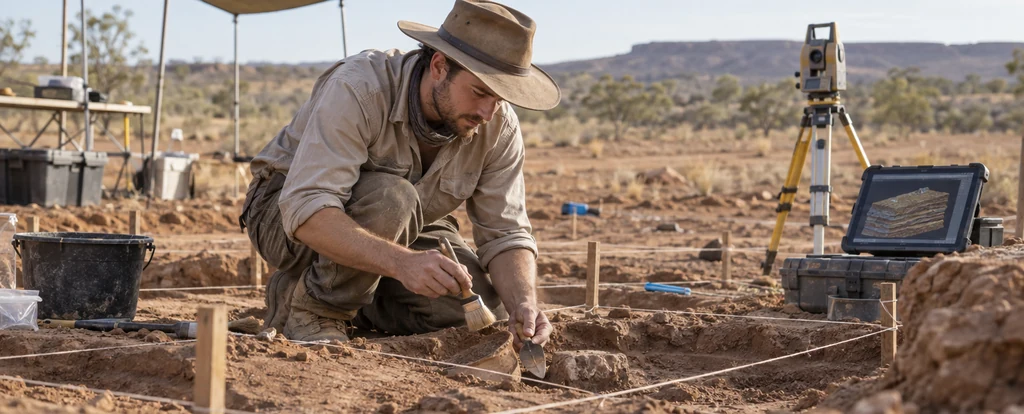
- Surveying development sites for surface scatters, stone arrangements and other traces of past occupation
- Excavating test pits and trenches, then recording stratigraphy, contexts and finds on site forms
- Mapping sites and artefact distributions with GIS, total station and drone photogrammetry
- Consulting Aboriginal and Torres Strait Islander groups about sites, significance and how they should be managed
- Writing heritage assessment reports and permit applications that satisfy state and territory legislation
What skills do archaeologists need?
Employers look for field research and sampling, laboratory analysis, surveying and geospatial work, backed by ArcGIS fluency and strong stakeholder management.
Specialist skills
- Field research and sampling
- Laboratory analysis
- Surveying and geospatial work
- Environmental assessment
- Regulatory compliance
Software and tools
- ArcGIS
- QGIS
- Total station
- Ground-penetrating radar
- Photogrammetry software
General skills
- Stakeholder management
- Attention to detail
- Written communication
Is the job growing?
About 750 people work as archaeologists in Australia, and employment is projected to grow 21.2% over the decade to 2035. That's very strong growth. Few roles in Australia are expanding this fast, and it points to solid demand for years to come.
How do you become an archaeologist?
Here's the path most archaeologists take, step by step.
- 1Start with a bachelor degree in archaeology
Three years full time, including field schools and laboratory units. Combining it with anthropology, history or environmental science widens the roles you can apply for later, and an honours year is common because consulting firms and research employers often expect it.
- 2Add postgraduate study if you want to specialise
A large share of the current workforce holds a postgraduate qualification, and a masters or PhD is usually needed for research, museum collections work or senior heritage roles. Coursework masters suit people moving in from related fields such as environmental science or history.
- 3Get field experience early
Volunteer on digs, enrol in a field school and take casual work as a field assistant with a consultancy. This is where you learn to record a section properly, and where the referees for your first paid job usually come from.
- 4Learn the legislation where you want to work
Heritage approvals are handled by state and territory governments, and Aboriginal heritage and planning rules differ between them, so there is no single national licence. Joining the Australian Archaeological Association or the Australian Association of Consulting Archaeologists connects you to the standards and networks that consulting employers look for.
- 5Choose a sector and build a specialty
Consulting rewards fast, accurate reporting and client management; government heritage agencies reward assessment and policy work; museums and universities reward research and collections expertise. Specialising in a period, a material type or a region makes you easier to hire project by project.
Ready to apply as an archaeologist?
Whether you're working toward becoming an archaeologist or already are one and want a hand with the next step (sharpening your resume for ATS screening, tightening your cover letter, or knowing what you'll actually be asked at interview), here are examples grounded in this specific role, not generic templates.
What jobs can an archaeologist move to?
None of the roles archaeologists typically move into pay more than the role itself. Curator is the closest match. If a bigger salary is the goal, moving up into a senior or principal position within the role is usually the faster route than moving sideways.
| Move to | Typical pay change | Overlap | Retraining |
|---|---|---|---|
| Curator Archaeologists bring artefact analysis and heritage interpretation to museum collections, though curatorial work needs further qualification. | −$1,000 | 10% | requalify |
Moves are chosen from Jobs and Skills Australia's Data on Occupation Mobility, which follows income tax records between 2011-12 and 2020-21, together with entry requirements and skill overlap. A known move is one people were seen making in that data. Pay change compares median full-time pay for the two roles.
Who works as an archaeologist?
The typical archaeologist is 37 years old; 58% are women, 69% work full-time, and full-timers average 41 hours a week.
- 37
- Median age
- 58%
- Female share
- 69%
- Full-time
- +1h
- vs all-jobs avg
What's it like being an archaeologist?
The job runs in cycles: a stretch of long days on site, often camping near a project, then months of cataloguing, analysis and report writing back at a desk. Development approvals drive much of the demand, so workloads rise and fall with construction and mining activity. It suits people who like combining physical work outdoors with careful recording and a clear legal purpose behind the paperwork.
What people like
- Reading a site from the ground up. Working out what happened at a place from the layering of deposits, the position of a hearth or the pattern of stone tools is the part of the job most archaeologists describe as the reason they started.
- Field seasons in different places. Projects move around the country, from coastal middens to inland river systems, and a season away often means working in country you would not otherwise see.
- Findings that carry legal weight. Your assessment can change what happens to a site, whether that means a design alteration, an excavation program or a protection order, which gives the reporting a purpose beyond the file.
- Analysis and lab days. Cataloguing artefacts, sorting samples and reviewing dating results is quiet, detailed work that rewards patience and sits in contrast to the pace of a site.
What people find hard
- Reporting takes more of the year than digging. Consulting archaeologists spend far more time writing assessments, permit applications and client reports than they do excavating, and deadlines are set by the project schedule.
- Long stints away from home. Field work can mean weeks in a camp, in heat or rain, with early starts and basic facilities, which is hard on family life and on people who like their own bed.
- Work that follows the construction calendar. Many roles are contracted project by project, so income is uneven and quiet periods between approvals are common in smaller consultancies.
- Evidence that will not settle the question. Sites are usually disturbed or partial, so you often have to state what the evidence supports and leave the rest open, which frustrates people who want a definite answer.
Based on our synthesis of professional-body surveys and public accounts of the role, not first-person verified reviews.
Which industries employ archaeologists?
Professional, Scientific and Technical Services employs the largest share of archaeologists, followed by Public Administration and Safety.
Top employing industries
- 1Professional, Scientific and Technical Services
- 2Public Administration and Safety
Ranked by employment share; the source doesn't publish an exact percentage per industry.
| Bachelor degree | 49.5% | |
|---|---|---|
| Postgraduate | 44.1% | |
| Year 12 or below | 3.9% | |
| Certificate III/IV | 0.8% | |
| Diploma / Advanced Diploma | 0.5% |
Will AI replace archaeologists?
Archaeology is one of the least exposed jobs to AI, because its core is physical work on sites that cannot be done remotely and judgements that carry legal weight. Software is already part of the toolkit, with GIS, drone photogrammetry, ground-penetrating radar and site databases handling mapping, survey coverage and cataloguing. What stays with people is interpreting a deposit, arguing significance under heritage legislation and negotiating with communities and clients.
Share of typical working time by exposure level
- Excavation and on-site recordingReading a section, deciding where a context begins and ends, and recording it accurately are hands-on judgements made in the trench, though photos and notes can be typed up later with software help.30%low
- Heritage assessment reports and permit applicationsDrafting tools speed up the standard sections of an assessment, but the significance argument, the legislative recommendations and the sign-off remain the archaeologist's responsibility.30%moderate
- Mapping and remote sensing surveyDrone photogrammetry, ground-penetrating radar and GIS automate a lot of survey coverage and produce site plans quickly, but someone still has to interpret the results and decide where to dig.25%moderate
- Cataloguing finds and managing site dataImage recognition and database tools can label artefact photographs and sort records by type or context, which cuts hours of manual entry on large assemblages.15%high
Common questions about becoming an archaeologist
Straight answers to the questions people ask most.
How much do archaeologists earn?
Median full-time pay is $88,400 per annum, before tax, and full-time archaeologists average about 41 hours a week. Consulting firms, government agencies and universities each pay differently, and contract field work paid by the day makes annual earnings uneven. Specialising or running your own heritage consultancy is where the higher figures sit.
How do you become an archaeologist?
The usual route is a bachelor degree in archaeology, then field experience, then an honours or postgraduate qualification if you want to specialise. Because approvals are managed by state and territory governments, learning the heritage legislation where you plan to work matters as much as the degree. Joining a professional association helps with the standards consulting employers expect.
Are archaeologists in demand in Australia?
Archaeologists are currently not in shortage, and employment is projected to grow 21.2% over the decade to 2035. Most openings come from heritage assessments tied to development, mining and infrastructure approvals, plus government heritage agencies and museums. The workforce is small at about 750 people, so a handful of large projects can shift the picture in a state quite quickly.
Will AI replace archaeologists?
No, and the work is among the least exposed to automation. GIS, drone photogrammetry, ground-penetrating radar and site databases already speed up survey, mapping and cataloguing, and image recognition can sort artefact photographs. Deciding what a deposit means, whether a site is significant under heritage legislation, and how to work with Traditional Owners stays with the archaeologist.
What else can archaeologists do?
Environmental science is a close neighbour: site assessment, sampling and reporting carry across, the work overlaps substantially, and pay is $13,200 less. Moving into museum curatorial work is possible but usually needs further qualification in collections management, and pay is $1,000 less. Many experienced archaeologists eventually run their own heritage consultancy or work as sole traders, which is often where earnings grow.
Do archaeologists dig up dinosaurs?
No, that is palaeontology, which studies fossils and extinct life. Archaeologists study material left by people, from stone tools and hearths to buildings and historical rubbish deposits, and in Australia that usually means sites from the last tens of thousands of years.
Related roles
Not sure this is you? Take the career quiz and get a ranked shortlist of roles that fit how you like to work.