Soil Scientist
Soil scientists study how soils form, behave and change, and their findings guide how land is farmed, built on and restored.
- Median salary*
- $96,200
3.7%vs last year, before tax
- People employed*
- 1,700
0.0%vs last year
- Projected growth*
- +7%
to 2035
- AI exposure*
- Moderate
- automation risk
- Average hours*
- 39/wk
−1h vs all jobs
- Shortage status*
- Not in shortage
national
Most of the work is field sampling, laboratory analysis and reporting, with time in an office turning results into advice for clients, agencies or research teams. It is often mixed up with agronomy, which focuses on crop production advice, and with geology, which looks at deeper rock and sediment rather than the soil layer. Soil scientists work for government agencies, environmental consultancies, agricultural research bodies and mining companies.
How much do soil scientists earn?
The median full-time salary for a soil scientist is $96,200 per annum, before tax, up $20,500 since 2018.
Pay varies more by employer than by job title. Government and university roles follow fixed classification scales, while environmental and mining consultancies pay more for project work, remote placements and specialist skills such as contaminated site assessment. A postgraduate qualification and a recognised speciality are the two things that most reliably lift a soil scientist's pay.
What does a soil scientist do day to day?
The list below is what fills most weeks; the exact mix shifts with seniority and whatever stage the current work is at.
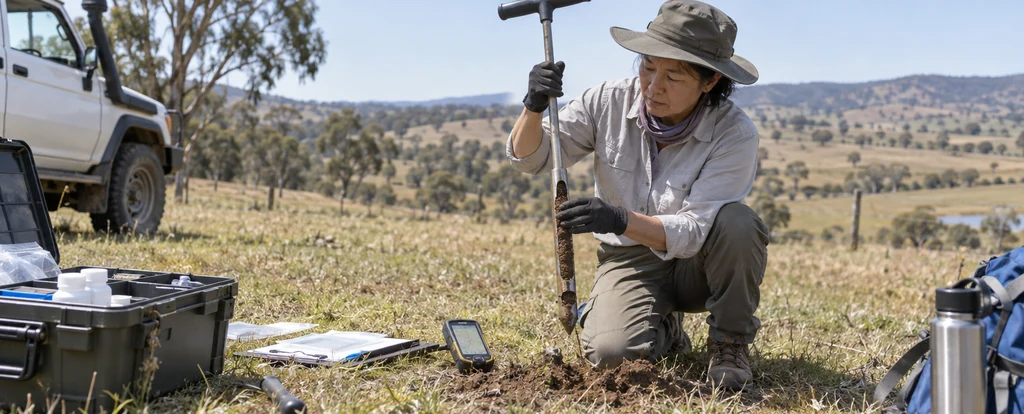
- Collecting soil samples from paddocks, building sites and contaminated land, using augers and cores and recording each location with GPS
- Analysing soil chemistry, biology and structure in the laboratory, from pH and nutrient levels to microbial activity
- Mapping soil types and properties with GIS software so land managers can see how conditions change across a property or region
- Assessing soil health and fertility for agricultural clients, then recommending changes to fertiliser use, cropping or grazing
- Writing contamination and land capability assessments for regulators, developers and research programs
What skills do soil scientists need?
Employers look for field research and sampling, laboratory analysis, environmental assessment, backed by ArcGIS fluency and strong written communication.
Specialist skills
- Field research and sampling
- Laboratory analysis
- Environmental assessment
- Data analysis
- Surveying and geospatial work
Software and tools
- ArcGIS
- QGIS
- R
- SPSS
- LIMS
General skills
- Written communication
- Problem solving
- Attention to detail
Is the job growing?
About 1,700 people work as soil scientists in Australia, and employment is projected to grow 7% over the decade to 2035. That's modest growth: demand is steady rather than booming.
How do you become a soil scientist?
Here's the path most soil scientists take, step by step.
- 1Complete a science degree
Soil science, environmental science, agricultural science and earth science degrees all lead into the job, and most take three years full time. Choose a course with chemistry, biology and fieldwork units, because sampling and laboratory analysis are the everyday core of the work.
- 2Get field and laboratory experience while you study
Vacation work with a consultancy, a research project in your final year or casual work as a field technician all count when you apply for your first role. Employers look for people who have handled a soil auger and worked to a sampling plan, not just studied the theory.
- 3Consider honours or a masters
About 26% of people working as soil scientists hold a postgraduate qualification. Honours or a research masters helps for government science and research roles, and for specialist areas such as contaminated land.
- 4Build a speciality and professional recognition
Soil Science Australia offers certification as a certified professional soil scientist, which some consultancies and agencies look for in senior hires. Specialising in an area such as salinity, acid sulfate soils or contamination is what shapes the projects you are offered later.
Ready to apply as a soil scientist?
Whether you're working toward becoming a soil scientist or already are one and want a hand with the next step (sharpening your resume for ATS screening, tightening your cover letter, or knowing what you'll actually be asked at interview), here are examples grounded in this specific role, not generic templates.
What jobs can a soil scientist move to?
Moving into Geologist typically comes with the biggest pay rise, worth $55,300 a year more on average.
| Move to | Typical pay change | Overlap | Retraining |
|---|---|---|---|
| Geologist Soil scientists bring skills in soil formation and sediment analysis to geology roles in exploration and land assessment. | +$55,300 | 67% | requalify |
| Agronomist Soil scientists bring expertise in soil health and nutrient cycling to agronomy roles advising on crop production. | +$11,600 | 74% | minimal |
| Hydrologist Soil scientists bring knowledge of soil-water interactions to hydrology roles studying water movement and catchment behaviour. | +$10,400 | 76% | requalify |
| Environmental Scientist Soil scientists bring soil contamination and land capability knowledge to environmental science roles assessing impacted sites. | +$5,400 | 64% | requalify |
| Botanist Soil scientists bring understanding of soil-plant relationships to botany roles researching plant ecology and conservation. | +$0 | 94% | requalify |
Moves are chosen from Jobs and Skills Australia's Data on Occupation Mobility, which follows income tax records between 2011-12 and 2020-21, together with entry requirements and skill overlap. A known move is one people were seen making in that data. Pay change compares median full-time pay for the two roles.
Who works as a soil scientist?
The typical soil scientist is 42 years old; 55% are men, 80% work full-time, and full-timers average 39 hours a week.
- 42
- Median age
- 45%
- Female share
- 80%
- Full-time
- −1h
- vs all-jobs avg
What's it like being a soil scientist?
The work runs in projects: a stretch of fieldwork collecting samples, weeks in the laboratory and on analysis, then a report or set of recommendations for whoever commissioned it. Fieldwork can be hot, muddy and a long way from home, and much of the year is spent at a desk with data and maps. About 1,700 people work as soil scientists in Australia, spread across farming, consulting, government, mining and research.
What people like
- Fieldwork on real country. Sampling takes you onto farms, mine sites, construction sites and conservation reserves, and you see how soils actually behave in places no lecture theatre can show you.
- Results that change a decision. A fertility report can shift what a grower plants next season, and a contamination assessment can determine whether a site is built on at all.
- Time split between outdoors and analysis. The job alternates between physical days in the field and quieter stretches with data, maps and instruments, which suits people who want both rather than one or the other.
- Work that spans several industries. Soil expertise is wanted in agriculture, mining, construction, conservation and research, so you can change sectors without leaving the discipline.
What people find hard
- Weather is part of the job. Sampling happens when the project needs it, which can mean wet clay in winter, dust in summer and long drives to remote sites.
- Reports take longer than the sampling. A few days in the field can produce weeks of data entry, analysis and writing before the client sees anything.
- Work comes in projects. Consultancy and research roles run on contracts and funding rounds, so the next job is not always confirmed before the current one ends.
- Some days are physically hard. Augers, cores and crates of samples are heavy, and a full day of digging and carrying takes a toll regardless of your qualifications.
Based on our synthesis of professional-body surveys and public accounts of the role, not first-person verified reviews.
Which industries employ soil scientists?
Agriculture, Forestry and Fishing employs the largest share of soil scientists, followed by Professional, Scientific and Technical Services.
Top employing industries
- 1Agriculture, Forestry and Fishing
- 2Professional, Scientific and Technical Services
- 3Public Administration and Safety
- 4Education and Training
- 5Mining
Ranked by employment share; the source doesn't publish an exact percentage per industry.
| Bachelor degree | 52% | |
|---|---|---|
| Postgraduate | 26% | |
| Diploma / Advanced Diploma | 13% | |
| Other | 9% |
Will AI replace soil scientists?
Soil science sits in the middle: the analysis and reporting side of the job is exposed to AI, while the fieldwork is not. Machine learning speeds up soil mapping and the processing of large sample datasets, and laboratory instruments increasingly handle their own calibration and quality checks. Deciding where to sample, reading a landscape and advising a client on what the results mean still rest on judgement built from time in the field.
Share of typical working time by exposure level
- Field sampling and site loggingChoosing sample points, reading ground conditions and collecting a representative core are physical, site-specific calls that no tool makes for you.30%low
- Reporting and client adviceDrafting tools speed up the standard sections of an assessment report, while the interpretation and recommendations for a particular site are written by the scientist.30%moderate
- Laboratory analysis and instrument workAutomated analysers run routine chemistry and flag out-of-range results, but sample preparation and unusual readings still come back to a person.20%moderate
- Soil mapping and spatial analysisMachine learning models now interpolate soil properties across a region from scattered sample points, which removes much of the manual mapping work.20%high
Common questions about becoming a soil scientist
Straight answers to the questions people ask most.
How much do soil scientists earn?
The median is $96,200 per year before tax. Pay depends heavily on the employer: government and university roles follow set classification scales, while consultancies and mining companies pay more for project work, remote placements and specialist skills. Experience in contaminated land or acid sulfate soils tends to sit at the higher end.
How do you become a soil scientist?
About 52% of people working as soil scientists hold a bachelor degree as their highest qualification, usually in soil science, environmental science, agricultural science or earth science. Field and laboratory experience matters as much as the degree, so vacation work, a final year research project or a technician role are worth chasing while you study.
Are soil scientists in demand?
Soil scientists are currently not in shortage, and employment is projected to grow 7% over the decade to 2035. Soil expertise is needed across agriculture, mining, construction and land management, so graduates with fieldwork and laboratory experience have several sectors to look at.
Will AI replace soil scientists?
AI is changing parts of the work rather than replacing the role. Machine learning now interpolates soil properties across large areas from scattered sample points, and automated instruments handle routine laboratory chemistry, which cuts the manual analysis and mapping time. Deciding where to sample, reading a site and advising a client on what the results mean still needs someone who has been in the field.
What can soil scientists move into?
Agronomy draws on the same soil fertility knowledge, and the two roles share 74% of their skills, with agronomists earning $11,600 more at the median. Hydrology uses the same understanding of how water moves through soil, and hydrologists earn $10,400 more. Environmental scientists assessing contaminated sites use similar sampling and land assessment skills, and they earn $5,400 more.
Do soil scientists need to be registered?
There is no mandatory registration for soil scientists in Australia, so you can start work with a relevant degree and no licence. Soil Science Australia offers voluntary certification for experienced practitioners, which some consultancies and government agencies look for when hiring senior staff.
Related roles
Not sure this is you? Take the career quiz and get a ranked shortlist of roles that fit how you like to work.