Computer Hardware Technician
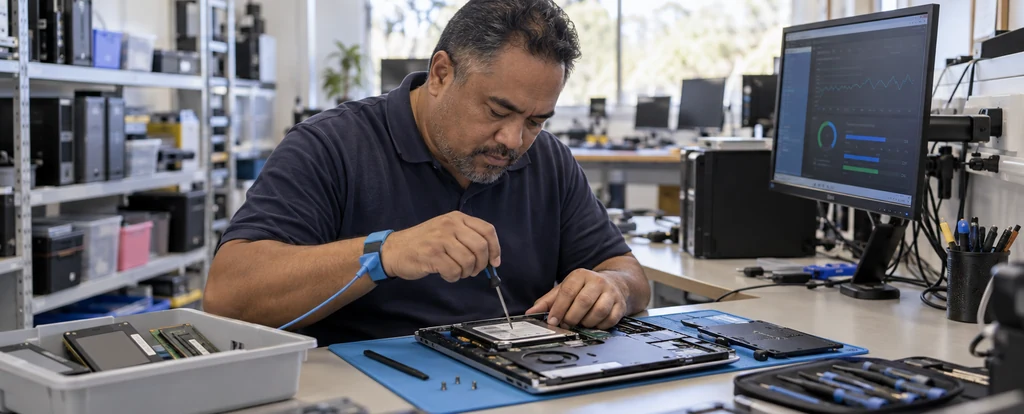
Computer hardware technicians install, diagnose and repair the physical devices people and businesses rely on, from laptops and desktops to servers and printers.
- Median salary*
- $75,400
3.6%vs last year, before tax
- People employed
- 1,500
0.0%vs last year
- Projected growth
- +17.4%
to 2035
- AI exposure*
- Moderate
- automation risk
- Average hours
- 42/wk
+2h vs all jobs
- Shortage status
- Not in shortage
national
Computer hardware technicians build, maintain and repair desktops, laptops, servers and the peripherals around them. The work is hands-on with the machine itself, which separates it from IT support roles focused on accounts, software and user requests, though in small organisations one person often does both. Most of the week is spent at a bench in a workshop or repair shop, with site visits when a server or a fleet of machines needs attention where it stands.
How much do computer hardware technicians earn?
The median full-time salary for a computer hardware technician is $75,400 per annum, before tax, up $16,100 since 2018.
Pay moves with the setting more than with the job title: corporate IT teams and managed service providers pay above retail repair counters, and vendor certifications or warranty accreditation usually come with a step up. After-hours callouts and on-call rosters add to the total in some roles, and these figures cover full-time employees, so casual and part-time arrangements work differently.
What does a computer hardware technician do day to day?
The list below is what fills most weeks; the exact mix shifts with seniority and whatever stage the current work is at.
- Diagnosing hardware faults in desktops, laptops and servers, from failed drives to intermittent power problems
- Replacing or repairing components such as memory, storage, power supplies and screens
- Installing operating systems, drivers and firmware, and imaging machines in batches
- Assembling or upgrading systems to a customer's specification and budget
- Keeping repair records and asset registers, and explaining the fault and the cost to the customer
What skills do computer hardware technicians need?
Employers look for technical support and troubleshooting, installation and maintenance, networks and systems administration, backed by Windows fluency and strong problem solving.
Specialist skills
- Technical support and troubleshooting
- Installation and maintenance
- Networks and systems administration
- Plant and equipment operation
Software and tools
- Windows
- Linux
- MemTest86
- HWMonitor
- CrystalDiskInfo
General skills
- Problem solving
- Attention to detail
- Customer service
- Written communication
Is the job growing?
About 1,500 people work as computer hardware technicians in Australia, and employment is projected to grow 17.4% over the decade to 2035. That's healthy, above-average growth, and the role should stay in solid demand.
How do you become a computer hardware technician?
Here's the path most computer hardware technicians take, step by step.
- 1Start with a Certificate III or IV in Information Technology
TAFE and private providers offer both, and the Certificate IV in IT (Support) covers hardware, operating systems and troubleshooting. Full-time study takes about a year, or longer around a job.
- 2Take a traineeship or an entry-level repair job
A traineeship or a counter job at a repair shop pays you while you learn, and it is where most technicians first see the same faults repeatedly enough to recognise them quickly.
- 3Add vendor certifications
CompTIA A+ is the common starting point, and manufacturer accreditation for brands such as Dell, HP and Lenovo lets your employer carry out warranty repairs, which many service businesses look for when hiring.
- 4Practise on your own bench
Assembling, upgrading and repairing machines for friends and family builds real diagnostic habits. Keeping a record of what you fixed and how gives you something concrete to talk about in an interview.
Ready to apply as a computer hardware technician?
Whether you're working toward becoming a computer hardware technician or already are one and want a hand with the next step (sharpening your resume for ATS screening, tightening your cover letter, or knowing what you'll actually be asked at interview), here are examples grounded in this specific role, not generic templates.
What jobs can a computer hardware technician move to?
Moving into Systems Administrator typically comes with the biggest pay rise, worth $52,600 a year more on average.
| Move to | Typical pay change | Overlap | Retraining |
|---|---|---|---|
| Systems Administrator Hardware and operating system familiarity supports server administration, with reskilling in networks and system management.Known move | +$52,600 | 16% | reskill |
| Network Engineer Hardware installation experience transfers to network equipment, with substantial study in routing, switching and network design.Known move | +$44,700 | 16% | reskill |
| Electronic Engineering Technician Hardware testing and fault finding transfer to electronic engineering support, with reskilling in circuit design and engineering principles.Known move | +$36,000 | 24% | reskill |
| IT Support Officer Hardware repair and diagnostic skills carry into user support, with a short course building service desk and ticketing skills.Known move | +$12,300 | 53% | short course |
| Electronics Technician Bench repair and component knowledge carry into electronics work, but an electronics trade apprenticeship is needed.Known move | +$1,600 | 31% | requalify |
Moves are chosen from Jobs and Skills Australia's Data on Occupation Mobility, which follows income tax records between 2011-12 and 2020-21, together with entry requirements and skill overlap. A known move is one people were seen making in that data. Pay change compares median full-time pay for the two roles.
Who works as a computer hardware technician?
The typical computer hardware technician is 38 years old; 92% are men, 70% work full-time, and full-timers average 42 hours a week.
- 38
- Median age
- 8%
- Female share
- 70%
- Full-time
- +2h
- vs all-jobs avg
What's it like being a computer hardware technician?
The work runs as a queue of jobs: diagnose, quote, repair, test, hand back, with a mix of bench time and callouts to offices or homes. It gets pressured when a machine that other people depend on stops working, and it suits someone who likes a fault with a definite cause and a clear finish.
What people like
- Faults with a definite answer. A machine that will not boot has a cause you can find with a memory test, a known-good part or a POST card. That kind of puzzle rewards patience and gives you a clear result.
- Time with the hardware itself. If you would rather be at a bench with a screwdriver than in a ticketing queue all day, this role keeps you close to the physical machine.
- Variety across devices. A week can run from a laptop keyboard replacement to a server rack install and a printer that jams only on Tuesdays, so the work rarely sits on one product.
- A job you can hand back. Most repairs end with a working machine and a customer who can get on with their day, which gives the work a visible endpoint.
What people find hard
- Customers hoping an old machine can be saved. Repair often costs more than a replacement, and explaining that a five-year-old laptop is not worth the parts bill is part of the job.
- Repeat failures and warranty work. Some weeks are the same three faults on the same model, and vendor warranty jobs come with paperwork, parts return deadlines and turnaround targets.
- Pressure when a business is down. A failed server or point-of-sale terminal stops other people working, so those jobs arrive with a hurry attached.
- Waiting on parts. When a component is backordered you are caught between a supplier and a customer, and the delay is not something you can fix from the bench.
Based on our synthesis of professional-body surveys and public accounts of the role, not first-person verified reviews.
Which industries employ computer hardware technicians?
Professional, Scientific and Technical Services employs the largest share of computer hardware technicians, followed by Other Services.
Top employing industries
- 1Professional, Scientific and Technical Services
- 2Other Services
- 3Retail Trade
Ranked by employment share; the source doesn't publish an exact percentage per industry.
| Year 12 or below | 26.5% | |
|---|---|---|
| Bachelor degree | 25% | |
| Certificate III/IV | 17.1% | |
| Diploma / Advanced Diploma | 16% | |
| Postgraduate | 8.7% |
Will AI replace computer hardware technicians?
AI sits alongside the diagnostic and setup parts of this job rather than replacing the job itself. Error logs, telemetry and AI-assisted diagnostic tools now suggest likely causes quickly, and deployment software handles much of the imaging work, but the physical repair, board-level work and site visits still need someone with tools.
Share of typical working time by exposure level
- Replacing and repairing componentsSwapping a drive, reseating memory or replacing a power supply is physical work, and board-level repair with a soldering iron has no automated equivalent in a typical workshop.35%low
- Diagnosing faults from symptoms and error logsDiagnostic tools can rank likely causes from error codes and hardware telemetry, but someone still has to confirm the fault on the bench before replacing anything.25%moderate
- Setting up and configuring new machinesImaging tools and management platforms automate most of a standard build, so the technician's time goes to unusual configurations and getting the device into the user's hands.25%moderate
- Talking to customers about faults and costsExplaining that a repair is not worth the parts bill, or that data recovery is a separate and uncertain job, is a conversation most customers want to have with a person.15%low
Common questions about becoming a computer hardware technician
Straight answers to the questions people ask most.
How much does a computer hardware technician earn?
Computer hardware technicians earn $75,400 per year before tax at the median, working full time. Pay depends heavily on the setting: corporate IT teams and managed service providers pay more than retail repair counters, and vendor certifications or warranty accreditation usually add to that. It is a median figure, so individual salaries sit above and below it.
How do you become a computer hardware technician?
A Certificate III or IV in Information Technology is the usual starting point, covering hardware, operating systems and troubleshooting. A traineeship or an entry-level repair job gives you paid bench time while you study, and certifications such as CompTIA A+ or manufacturer warranty accreditation are what many employers look for when hiring.
Are computer hardware technicians in demand?
Computer hardware technicians are currently not in shortage, and employment is projected to grow 17.4% over the decade to 2035. It is a small occupation, so openings are concentrated in IT services firms, repair businesses and organisations that maintain their own device fleets.
Will AI replace computer hardware technicians?
Parts of the job, not all of it. Diagnostic tools that read error logs and hardware telemetry now point to likely faults quickly, and deployment software automates much of a standard machine build. The physical side, opening a machine, swapping a board, testing it and working on site, still needs someone with tools in hand.
What can a computer hardware technician move into?
IT support officer is a common move, since troubleshooting and customer service carry across with a short course in service desk tools, and pay is $12,300 more. Network engineer and systems administrator both build on hardware installation experience but need substantial reskilling in routing, switching and system management. Some technicians go the other way and open their own repair or mobile service business, which is often where earnings grow.
What is the difference between a computer hardware technician and an IT support officer?
A hardware technician works on the device itself, diagnosing, repairing and replacing physical parts. An IT support officer spends more of the week on user accounts, software, permissions and requests, usually through a service desk, though in a small organisation one person often covers both.
Related roles
- IT Support Officer
- Electronics Technician
- Network Engineer
- Systems Administrator
- Electronic Engineering Technician
- Electronics Technician
Not sure this is you? Take the career quiz and get a ranked shortlist of roles that fit how you like to work.