Crowd Controller
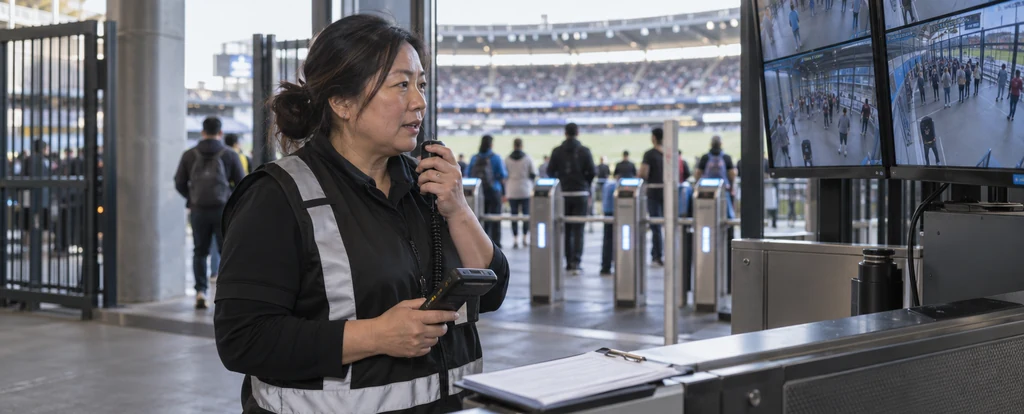
Crowd controllers keep people safe at venues and events, managing how crowds enter, move through and leave a site.
- Median salary*
- $65,000
3.8%vs last year, before tax
- People employed
- 520
4.0%vs last year
- Projected growth*
- +7%
to 2035
- AI exposure*
- Moderate
- automation risk
- Average hours*
- 38/wk
−2h vs all jobs
- Shortage status*
- Not in shortage
national
Crowd controllers work at licensed venues, stadiums, festivals and entertainment precincts, usually as part of a team that also includes venue staff, first aiders and police. What sets the role apart from general security work is its focus on patron behaviour: reading a crowd, refusing entry and defusing trouble before it spreads. Most states and territories license crowd controllers separately from other security work, so you hold a licence with a crowd control endorsement rather than a plain security licence, and the requirements differ by state.
How much do crowd controllers earn?
The median full-time salary for a crowd controller is $65,000 per annum, before tax, up $13,500 since 2018.
Pay moves most with the licence you hold, the venue and the shift you work. Late-night, weekend and public holiday work attracts penalty rates, and casual event staff usually earn an hourly rate plus a casual loading, so two crowd controllers on the same award can take home very different amounts. Permanent in-house roles at stadiums and large venues tend to pay more steadily than event-by-event casual work.
What does a crowd controller do day to day?
The list below is what fills most weeks; the exact mix shifts with seniority and whatever stage the current work is at.
- Directing patrons through entry points, checking entry passes, identification and accreditation
- Watching crowd density in stands, queues and walkways, and easing pressure points before they build
- Responding to altercations, ejections and medical incidents, and calling police or ambulance when needed
- Enforcing venue rules and responsible service of alcohol requirements, including refusing entry
- Writing incident reports and handing over to the next shift, since a clear record protects both the venue and you
What skills do crowd controllers need?
Employers look for security operations, emergency response, backed by Two-way radios fluency and strong safety and compliance awareness.
Specialist skills
- Security operations
- Emergency response
Software and tools
- Two-way radios
- CCTV systems
- ID scanners
- Incident reporting software
- Access control systems
General skills
- Safety and compliance awareness
- Customer service
- Written communication
- Problem solving
- Physical stamina and dexterity
Is the job growing?
About 520 people work as crowd controllers in Australia, and employment is projected to grow 7% over the decade to 2035. That's modest growth: demand is steady rather than booming.
How do you become a crowd controller?
Here's the path most crowd controllers take, step by step.
- 1Check your state's licensing requirements
Crowd controllers must be at least 18 and hold a security licence with a crowd control endorsement, issued by the state or territory regulator. A national police check is part of the application and some offences disqualify you, so it is worth checking before you pay for training.
- 2Complete the required training
The standard entry point is a Certificate II in Security Operations (CPP20218) that includes the crowd control units, delivered by a registered training organisation over a few weeks of classroom work and practical scenarios. Some states ask for additional units or a current first aid certificate.
- 3Apply for your licence
You lodge the application with your state regulator, with the certificate, police check and photo identification, and pay the licence fee. Processing takes a few weeks and you cannot work crowd control until the licence is issued.
- 4Add an RSA certificate and start with an events or venue employer
Responsible service of alcohol certification is often required to work inside licensed venues, and event security companies hire casual staff for festivals, stadiums and clubs. Casual shifts are a common way in because an employer can try you on one event before offering regular work.
- 5Build toward supervision if you want to stay in the industry
Experienced crowd controllers move into team leader and supervisor roles, and a Certificate IV in Security and Risk Management or a diploma supports the step into venue security management.
Ready to apply as a crowd controller?
Whether you're working toward becoming a crowd controller or already are one and want a hand with the next step (sharpening your resume for ATS screening, tightening your cover letter, or knowing what you'll actually be asked at interview), here are examples grounded in this specific role, not generic templates.
What jobs can a crowd controller move to?
Moving into Security Manager typically comes with the biggest pay rise, worth $48,400 a year more on average.
| Move to | Typical pay change | Overlap | Retraining |
|---|---|---|---|
| Security Manager Crowd controllers bring venue security and incident response experience to security manager roles, needing further study or experience in operations. | +$48,400 | 16% | reskill |
| Security Guard Crowd controllers bring security licence and patron management skills to general security guard work, needing little extra training. | +$29,500 | 62% | minimal |
| Protective Services Officer Crowd controllers bring public safety and conflict management skills to protective services work, with a short course for legal powers. | +$10,400 | 67% | short course |
| Security Screening Officer Crowd controllers bring security awareness and conflict management to screening roles, with a short course for screening equipment and procedures. | +$0 | 60% | short course |
| Security Monitoring Operator Crowd controllers bring security licence and incident response skills to monitoring roles, with a short course in surveillance systems. | +$0 | 54% | short course |
Moves are chosen from Jobs and Skills Australia's Data on Occupation Mobility, which follows income tax records between 2011-12 and 2020-21, together with entry requirements and skill overlap. A known move is one people were seen making in that data. Pay change compares median full-time pay for the two roles.
Who works as a crowd controller?
The typical crowd controller is 30 years old; 84% are men, 26% work full-time, and full-timers average 38 hours a week.
- 30
- Median age
- 16%
- Female share
- 26%
- Full-time
- −2h
- vs all-jobs avg
What's it like being a crowd controller?
Crowd control follows the event calendar rather than the working week. Shifts cluster on Friday and Saturday nights, public holidays and the summer festival season, and much of the job is standing at a gate or in a walkway watching for the moment a crowd starts to push. It suits people who stay calm when someone is angry with them and who enjoy the atmosphere of a live venue more than watching it from home.
What people like
- You see the event from the inside. Working a gate, a stand or a stage barrier puts you in the middle of a concert or a grand final rather than in the queue outside it, and the atmosphere is part of what people stay for.
- Shiftwork suits study or another job. Event and nightclub work is largely casual and concentrated in evenings and weekends, so it can fit around a course or a day job, though the hours are not guaranteed.
- The rules are clear. Your licence, the venue's conditions and the responsible service of alcohol rules tell you what you can and cannot do, which makes a difficult call easier to defend.
- You work as a team. Crowd controllers work in pairs and larger teams, alongside first aiders, venue staff and often police, so you are rarely dealing with a situation alone.
What people find hard
- The hours land when everyone else is out. Friday and Saturday nights, public holidays and the festival season are the busy times, and outdoor queues and gates mean working in heat, cold and rain.
- Aggression is part of the job. Refusing entry, ejecting someone or cutting off drinks regularly draws an angry response, and you are expected to absorb it without escalating the situation.
- Long stretches on your feet. Most of a shift is spent standing, walking the perimeter or holding a position, with breaks fitted around what the crowd is doing.
- Work is uneven. Shifts depend on the event calendar and venue rosters, so quiet periods mean fewer hours and casual workers feel that first.
Based on our synthesis of professional-body surveys and public accounts of the role, not first-person verified reviews.
Which industries employ crowd controllers?
Security and investigation services employs the largest share of crowd controllers, followed by Sports and recreation.
Top employing industries
- 1Security and investigation services
- 2Sports and recreation
- 3Performing arts and events
- 4Pubs, clubs and nightclubs
- 5Retail trade
Ranked by employment share; the source doesn't publish an exact percentage per industry.
| Certificate III/IV | 34% | |
|---|---|---|
| Diploma / Advanced Diploma | 26% | |
| Bachelor degree | 20% | |
| Year 12 or below | 20% |
Will AI replace crowd controllers?
Crowd control sits in the middle of the range: parts of the job have already been automated, but the physical and legal core has not. ID scanners, digital entry passes, CCTV people-counting and rostering software now handle entry verification and help venues spot crowding earlier than a person on the ground can. None of those tools can refuse entry, remove someone or take responsibility for what happens at the gate, which is why a licensed controller stays on site.
Share of typical working time by exposure level
- Responding to incidents and ejectionsReading an escalating argument, deciding to eject someone and physically walking them out carries legal risk that software cannot take on.30%low
- Watching crowd density and flowCCTV analytics and people-counting software flag crowding before the eye catches it, but opening extra lanes and moving patrons along is still done in person.25%moderate
- Incident reports and shift handoversReport templates and dictation tools now assemble much of the paperwork, leaving the controller to check the account and add the details that matter.25%high
- Entry screening and ID checksScanners and digital entry passes verify most identification automatically, though someone still has to judge the refused, expired or unclear cases.20%moderate
Moves least exposed to AI
These career moves from crowd controller work are rated low for AI exposure:
- Protective Services Officer
High skill overlap (67%), short course to get there, and a low automation-risk profile.
Common questions about becoming a crowd controller
Straight answers to the questions people ask most.
How much do crowd controllers earn?
Crowd controllers earn a median of $65,000 per annum, before tax. Casual event work usually pays an hourly rate plus a casual loading, and late-night, weekend and public holiday shifts attract penalty rates, so earnings vary a lot between a permanent venue role and event-by-event work.
How do you become a crowd controller?
You need a security licence with a crowd control endorsement from your state or territory regulator, which means completing a Certificate II in Security Operations (CPP20218) that includes the crowd control units and passing a police check. Some states also require a first aid certificate or extra units, so check the regulator's requirements before you enrol.
Are crowd controllers in demand?
Crowd controllers are currently not in shortage. About 520 people work in the role, and employment is projected to grow 7% over the decade to 2035. Hiring in this industry is mostly casual and tied to venue rosters and the event calendar.
Will AI replace crowd controllers?
AI and automation handle parts of the job rather than the whole of it. ID scanners, digital entry passes and CCTV crowd analytics speed up entry checks and help venues spot density problems early, but standing at a gate, refusing entry and calming a situation still needs a licensed person on site.
What can crowd controllers move into?
General security guard work pays $29,500 more and uses the same licence and patron management experience, with minimal extra training. Protective services officer roles pay $10,400 more and need a short course covering legal powers, and security manager roles pay $48,400 more but usually require further study or operations experience.
What is the difference between a crowd controller and a security guard?
A security guard covers a broad range of work such as patrolling sites, monitoring alarms and controlling access, while a crowd controller is licensed specifically to manage patrons at licensed venues and events. In most states the crowd control endorsement is granted on top of the same security licence, and many people hold both.
Related roles
- Security Guard
- Security Screening Officer
- Protective Services Officer
- Security Monitoring Operator
- Security Manager
- Security Guard
Not sure this is you? Take the career quiz and get a ranked shortlist of roles that fit how you like to work.