Data Cabler
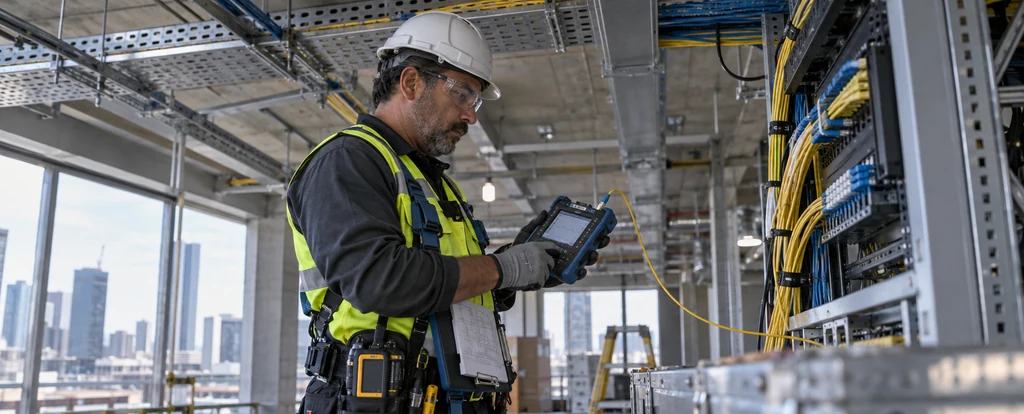
Data cablers install, terminate and test the structured cabling that carries data, voice and video through buildings and across networks.
- Median salary*
- $80,600
4.4%vs last year, before tax
- People employed
- 1,400
0.0%vs last year
- Projected growth
- +3.8%
to 2035
- AI exposure*
- Low
- automation risk
- Average hours
- 41/wk
+1h vs all jobs
- Shortage status
- In shortage
national
Most data cablers work on commercial construction sites, data centres and telecommunications projects, running copper and fibre cable through ceilings, risers and cable trays, then testing and certifying every link before handover. The trade sits alongside electrical work but is separate from it: cablers deal with low-voltage communications cable and how well it performs, while electricians handle the power circuits, and the two often work side by side on the same fit-out. Cabling work must be done by someone with registration through the Australian Communications and Media Authority (ACMA), which is why most people enter through an apprenticeship or traineeship.
How much do data cablers earn?
The median full-time salary for a data cabler is $80,600 per annum, before tax, up $17,000 since 2018.
Pay moves with the sector and the size of the project: cablers on large commercial builds, data centres and carrier network work are usually covered by enterprise agreements that pay above the award, while residential and small fit-off jobs sit closer to the minimum. Sole traders and subcontractors quote per job, so earnings depend on how much work they win against the cost of test equipment, a vehicle and insurance. Holding optical fibre and coaxial endorsements opens up carrier and data centre work, which is where the better rates are.
What does a data cabler do day to day?
The list below is what fills most weeks; the exact mix shifts with seniority and whatever stage the current work is at.
- Running copper and fibre cable through ceilings, risers, conduits and cable trays
- Terminating cable onto patch panels, outlets and network equipment
- Testing and certifying links with cable certifiers and optical time domain reflectometers
- Reading cabling plans and building drawings to work out cable routes and outlet positions
- Tracing faults when a link fails or a tenant reports a dead outlet, using a tone generator or an OTDR
What skills do data cablers need?
Employers look for installation and maintenance, reading plans and specifications, worksite safety management, backed by Fluke Networks cable certifiers fluency and strong problem solving.
Specialist skills
- Installation and maintenance
- Reading plans and specifications
- Worksite safety management
- Plant and equipment operation
- Regulatory compliance
Software and tools
- Fluke Networks cable certifiers
- Optical time domain reflectometer (OTDR)
- Fusion splicer
- Tone generator and probe
- Cable labelling systems
General skills
- Problem solving
- Attention to detail
Is the job growing?
About 1,400 people work as data cablers in Australia, and employment is projected to grow 3.8% over the decade to 2035. That's modest growth: demand is steady rather than booming.
How do you become a data cabler?
Here's the path most data cablers take, step by step.
- 1Finish Year 12 or a pre-apprenticeship
Year 12 is not strictly required, but sound maths and English help, and a certificate II in electrotechnology or telecommunications gives you something to show an employer when you apply for an apprenticeship.
- 2Start an apprenticeship or traineeship
The usual route is an Australian Apprenticeship in telecommunications technology, which combines paid work on site with study toward the Certificate III in Telecommunications Technology (ICT30524). A full apprenticeship runs about three to four years, and a traineeship can be shorter.
- 3Complete the Certificate III in Telecommunications Technology
Delivered by TAFE and other registered training organisations, the certificate covers structured cabling, fibre, testing and the standards that apply, and it is the qualification your registration is built on.
- 4Get your ACMA cabling registration
Registration is required by law to carry out cabling work, and you apply once you hold the qualification. Endorsements cover structured cabling, optical fibre and coaxial cable, and without the right ones you cannot take on that work.
- 5Add further study for design or supervisory roles
A Certificate IV or a Diploma of Telecommunications Network Engineering supports moves into network design, project supervision or carrier work later in your career.
Ready to apply as a data cabler?
Whether you're working toward becoming a data cabler or already are one and want a hand with the next step (sharpening your resume for ATS screening, tightening your cover letter, or knowing what you'll actually be asked at interview), here are examples grounded in this specific role, not generic templates.
What jobs can a data cabler move to?
Moving into Electrician typically comes with the biggest pay rise, worth $33,300 a year more on average.
| Move to | Typical pay change | Overlap | Retraining |
|---|---|---|---|
| Electrician Electrical wiring and cabling knowledge carries across, but becoming an electrician requires a full apprenticeship and licensing.Known move | +$33,300 | 61% | requalify |
| Telecommunications Technologist Cabling experience supports a move into a telecommunications technologist role, with further study in network design and engineering.Known move | +$15,600 | 30% | reskill |
| Telecommunications Technician Cabling experience leads into testing and maintaining telecommunications networks, though an apprenticeship or equivalent qualification is required.Known move | +$10,400 | 52% | requalify |
| Telecommunications Cable Jointer Cable jointing builds directly on cabling skills, with a short course needed for specialised splicing and network connections.Known move | +$10,400 | 50% | short course |
Moves are chosen from Jobs and Skills Australia's Data on Occupation Mobility, which follows income tax records between 2011-12 and 2020-21, together with entry requirements and skill overlap. A known move is one people were seen making in that data. Pay change compares median full-time pay for the two roles.
Who works as a data cabler?
The typical data cabler is 45 years old; 97% are men, 63% work full-time, and full-timers average 41 hours a week.
- 45
- Median age
- 3%
- Female share
- 63%
- Full-time
- +1h
- vs all-jobs avg
What's it like being a data cabler?
Cabling work runs on projects rather than a fixed routine. A commercial fit-out might mean days of pulling cable and fitting outlets before other trades move in, followed by a push of testing and certification close to handover, with early starts and travel between sites built into the week. Cablers who stay in the trade tend to like work they can see finished and problems they can solve with their hands.
What people like
- Seeing a job come together. Cable runs disappear behind plaster, but the certified test results and a tidy patch panel are proof the installation is right.
- Variety between sites. Data centres, schools, hospitals and office fit-outs each bring different routes, access constraints and equipment to work around.
- Skilled work with fibre. Splicing and certifying fibre takes practice, and it opens the door to carrier and data centre work that not every cabler can do.
- Solving faults. Tracing a failing link through a building, finding the cause and getting it working again is a satisfying part of the trade.
What people find hard
- Working in ceilings and risers. A lot of the job happens above ceiling tiles, inside risers or under floors, often dusty, hot or cramped.
- Depending on other trades. Cable routes wait on framing, electrical rough-in and site access, so a hold-up elsewhere can stall your day.
- Handover pressure. Testing and certification land near the end of a fit-out, when the deadline is close and other trades are working in the same spaces.
- The business side if you subcontract. Quoting, invoicing, chasing payment and keeping test records for compliance all come with the tools when you work for yourself.
Based on our synthesis of professional-body surveys and public accounts of the role, not first-person verified reviews.
Which industries employ data cablers?
Construction employs the largest share of data cablers, followed by Information Media and Telecommunications.
Top employing industries
- 1Construction
- 2Information Media and Telecommunications
Ranked by employment share; the source doesn't publish an exact percentage per industry.
| Certificate III/IV | 45.4% | |
|---|---|---|
| Year 12 or below | 33.7% | |
| Diploma / Advanced Diploma | 7.5% | |
| Bachelor degree | 7% | |
| Postgraduate | 2.4% |
Will AI replace data cablers?
AI exposure in this trade is low, because most of the work is physical: pulling cable through buildings, terminating it and testing each link on site. Design software and building models now show routes before you start, and modern testers log results automatically, which trims the paperwork rather than the job itself. Software helps most with documentation and narrowing down faults, but someone still has to install, certify and repair the cabling.
Share of typical working time by exposure level
- Pulling and installing cableRunning copper and fibre through ceilings, risers and cable trays is manual site work that no software can do for you.35%low
- Terminating and testing linksCertifiers and OTDRs record results and generate reports automatically, but the termination is done by hand and someone still has to interpret a failed test.25%moderate
- Tracing and fixing faultsA tone generator or OTDR narrows down where a link has failed, but the fix usually means opening an outlet or re-terminating a connection.20%low
- Site documentation and compliance recordsSoftware generates test reports, as-built drawings and compliance paperwork, which cuts desk time but still needs checking against what was actually installed.20%moderate
Common questions about becoming a data cabler
Straight answers to the questions people ask most.
How much does a data cabler earn?
Full-time data cablers earn a median of $80,600 per annum, before tax. Enterprise agreements on large construction and carrier projects push earnings above that, while apprentice rates, residential fit-off and gaps between contracts sit below it.
How do you become a data cabler?
Most people start with an Australian Apprenticeship in telecommunications technology, which pairs paid site work with the Certificate III in Telecommunications Technology (ICT30524). Once qualified, you apply for ACMA cabling registration with the endorsements for the cable types you install, which is what makes the work legal to carry out.
Are data cablers in demand?
Data cablers are currently in shortage nationally. Employment is projected to grow 3.8% over the decade to 2035, and the work follows construction activity, data centre builds and network upgrades, so vacancies tend to cluster around those projects rather than being spread evenly across the country.
Will AI replace data cablers?
AI exposure in this trade is low, because the core of the job is physical: pulling cable through buildings, terminating it and testing each link by hand. Software has changed the paperwork, with testers and design tools logging results and routes automatically, but someone still has to install the cable, certify it and work out why a link failed.
What can a data cabler move into?
Cablers commonly move into telecommunications technician or cable jointing roles, and both build on skills you already have. A move into a telecommunications technician role pays $10,400 more and needs an apprenticeship or equivalent qualification, while cable jointing pays $10,400 more and needs a short course in splicing and network connections. Many experienced cablers also start their own cabling business or subcontract, which is often where earnings grow.
What is the difference between a data cabler and an electrician?
Data cablers work on low-voltage communications cable: copper and fibre carrying data, voice and video. Electricians install and maintain the power circuits that supply a building, and the two trades often work side by side on the same fit-out.
Related roles
- Telecommunications Technician
- Telecommunications Cable Jointer
- Electrician
- Telecommunications Technologist
- Telecommunications Cable Jointer
- Electrical Trades Assistant
Not sure this is you? Take the career quiz and get a ranked shortlist of roles that fit how you like to work.