Telecommunications Cable Jointer
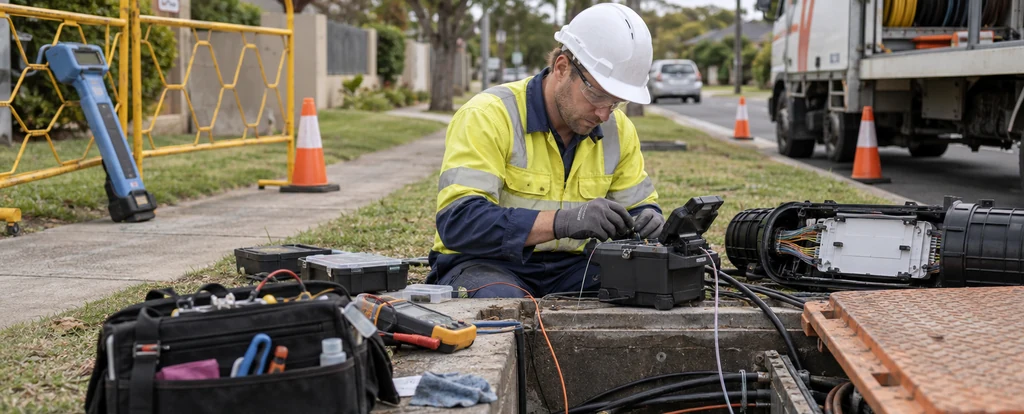
Telecommunications cable jointers splice, seal and test the copper and fibre cables that carry phone, internet and data services.
- Median salary*
- $91,000
3.8%vs last year, before tax
- People employed
- 610
1.7%vs last year
- Projected growth
- +3.8%
to 2035
- AI exposure*
- Low
- automation risk
- Average hours
- 42/wk
+2h vs all jobs
- Shortage status
- In shortage
national
They work for network operators, infrastructure contractors and utility builders, usually in pits, on poles or at customer premises. The job sits at the join rather than at the equipment, so a telecommunications technician commissions and configures gear while a jointer makes the cable itself carry the signal. Much of the work happens on live networks, which is why a construction induction card and carrier access accreditation come before the tools.
How much do telecommunications cable jointers earn?
The median full-time salary for a telecommunications cable jointer is $91,000 per annum, before tax, up $18,800 since 2018.
Rates usually come from the enterprise agreement or award you are employed under, so two jointers on the same street can earn differently depending on whether they work directly for a carrier, for a network contractor or for a small subcontractor. Penalty rates for after-hours fault restoration and allowances for confined space entry, working at heights and remote travel lift the base, and the accreditations you hold decide which jobs you can be sent to.
What does a telecommunications cable jointer do day to day?
The list below is what fills most weeks; the exact mix shifts with seniority and whatever stage the current work is at.
- Preparing cable ends, stripping insulation and cleaning conductors before a joint
- Splicing copper pairs and sealing joints against moisture
- Fusion splicing fibre strands and terminating them in closures and patch panels
- Testing joints and cable runs with an OTDR or power meter to check loss and continuity
- Reading network plans and using a cable locator to find buried or overhead cables before digging starts
What skills do telecommunications cable jointers need?
Employers look for installation and maintenance, plant and equipment operation, worksite safety management, backed by Fusion splicer fluency and strong attention to detail.
Specialist skills
- Installation and maintenance
- Plant and equipment operation
- Worksite safety management
- Hand and power tool work
Software and tools
- Fusion splicer
- Optical time domain reflectometer (OTDR)
- Optical power meter
- Cable locator
- Multimeter
General skills
- Attention to detail
- Problem solving
- Digital literacy
- Time and deadline management
Is the job growing?
About 610 people work as telecommunications cable jointers in Australia, and employment is projected to grow 3.8% over the decade to 2035. That's modest growth: demand is steady rather than booming.
How do you become a telecommunications cable jointer?
Here's the path most telecommunications cable jointers take, step by step.
- 1Get a construction induction card
Also called a White Card, this is required before you can start on most construction sites and takes about a day to complete.
- 2Start a Certificate III in telecommunications technology as a trainee
A traineeship usually runs three to four years and is paid, so you learn copper and fibre jointing on the job while completing the qualification through a registered training organisation.
- 3Register as a cabler with an ACMA-accredited registrar
Registration is required to work on customer cabling, and open registration covers the structured and telecommunications cabling a jointer handles.
- 4Add fibre splicing and testing competencies
Equipment suppliers and training providers run short fusion splicing and OTDR courses, and employers often put new jointers through them along with the carrier-specific network access accreditation needed to work on live plant.
- 5Coming from another trade
Cable jointers from the power sector already splice, seal and test heavy cable and usually need only a short course to move across, while electrical trades assistants can step up after completing a short course of their own.
Ready to apply as a telecommunications cable jointer?
Whether you're working toward becoming a telecommunications cable jointer or already are one and want a hand with the next step (sharpening your resume for ATS screening, tightening your cover letter, or knowing what you'll actually be asked at interview), here are examples grounded in this specific role, not generic templates.
What jobs can a telecommunications cable jointer move to?
None of the roles telecommunications cable jointers typically move into pay more than the role itself. Telecommunications Technician is the closest match. If a bigger salary is the goal, moving up into a senior or principal position within the role is usually the faster route than moving sideways.
| Move to | Typical pay change | Overlap | Retraining |
|---|---|---|---|
| Telecommunications Technician Cable jointing skills in copper and fibre transfer into installing and commissioning network equipment, though a telecommunications apprenticeship is required.Known move | +$0 | 55% | requalify |
| Telecommunications Linesworker Linesworkers build and maintain outside plant, so experience with underground and aerial cable networks carries straight across with minimal retraining.Known move | +$0 | 62% | minimal |
| Data Cabler Structured cabling uses the same termination, testing and fault finding skills, so the move needs only a short course.Known move | −$10,400 | 50% | short course |
Moves are chosen from Jobs and Skills Australia's Data on Occupation Mobility, which follows income tax records between 2011-12 and 2020-21, together with entry requirements and skill overlap. A known move is one people were seen making in that data. Pay change compares median full-time pay for the two roles.
Who works as a telecommunications cable jointer?
The typical telecommunications cable jointer is 37 years old; 97% are men, 80% work full-time, and full-timers average 42 hours a week.
- 37
- Median age
- 3%
- Female share
- 80%
- Full-time
- +2h
- vs all-jobs avg
What's it like being a telecommunications cable jointer?
The work runs on jobs rather than a fixed base, so a day might start with a fault in a suburban pit and finish with a fibre haul in a new estate. It suits people who like diagnosing a problem in the field and who are comfortable with the paperwork and permits that live network work brings. The trade is small and specialised, so jointers tend to know the networks they work on well.
What people like
- Tracking down a fault. A cable fault can be intermittent and hard to find, so locating it with a locator and an OTDR and then proving the repair with a test is the part many jointers enjoy most.
- A different site each week. New estates, road upgrades, exchange buildings and customer premises all need jointing, and the mix stops the day settling into a routine.
- Measurements that say it is right. Loss readings and continuity tests give a clear pass or fail, so there is little arguing about whether a joint is good.
- Room to specialise. You can lean towards fibre-heavy work, underground plant or aerial networks, and those preferences shape the jobs you take on.
What people find hard
- Confined spaces and pits. Much of the work happens in manholes and service pits, sometimes in wet conditions, and confined space entry brings its own procedures and permits.
- Weather and callouts. Aerial work stops in high wind, and fault restoration happens when the network goes down, which can mean nights, weekends and public holidays.
- Travelling between jobs. Work is where the cable is, so a regional or outer-suburban round can mean long drives between sites and an early start.
- Live network rules slow the job down. Carrier access procedures, permits and isolations add paperwork and waiting before a joint can be opened.
Based on our synthesis of professional-body surveys and public accounts of the role, not first-person verified reviews.
Which industries employ telecommunications cable jointers?
Information Media and Telecommunications employs the largest share of telecommunications cable jointers, followed by Construction.
Top employing industries
- 1Information Media and Telecommunications
- 2Construction
Ranked by employment share; the source doesn't publish an exact percentage per industry.
| Certificate III/IV | 46.7% | |
|---|---|---|
| Year 12 or below | 34.8% | |
| Bachelor degree | 6.1% | |
| Diploma / Advanced Diploma | 5.9% | |
| Postgraduate | 2.6% |
Will AI replace telecommunications cable jointers?
AI and automation have little reach into this job. A fusion splicer aligns and fuses the fibre strands itself, and OTDR software can point to the likely distance of a break along the cable, but someone still has to get into the pit, strip the cable back and prove the loss reading is within tolerance before the service is restored. Copper jointing is more manual again, done by hand on pairs that have often been in the ground for decades.
Share of typical working time by exposure level
- Preparing and sealing copper cable jointsStripping, cleaning and sealing a joint by hand in a pit or enclosure depends on feel as much as on the drawing.35%low
- Fusion splicing and terminating fibreA fusion splicer aligns and fuses the strands, but loading the fibres, inspecting the splice and packing it into a closure are manual steps.30%low
- Testing and fault finding with an OTDRSoftware can suggest where a break or a sharp bend is from the trace, and the jointer still has to confirm it and trace the cable to the right pit.25%moderate
- Job records, plans and network documentationAs-built records and test results are increasingly captured on a tablet in the field, which cuts the paperwork without changing the jointing.10%moderate
Common questions about becoming a telecommunications cable jointer
Straight answers to the questions people ask most.
How much does a telecommunications cable jointer earn?
Telecommunications cable jointers earn a median of $91,000 per annum, before tax. Enterprise agreements, penalty rates for after-hours fault work and site allowances for confined space or remote travel are what move that figure most.
How do you become a telecommunications cable jointer?
Most jointers start with a paid traineeship in telecommunications technology, which combines a Certificate III with on-the-job training over three to four years. You will also need a construction induction card for site work and ACMA cabler registration to work on customer cabling, plus carrier access accreditation before you touch live network plant.
Are telecommunications cable jointers in demand?
Telecommunications cable jointers are currently in shortage nationally, and employment is projected to grow 3.8% over the decade to 2035 over the decade to 2035. The workforce is small, so openings come mainly from retirements and from network build and maintenance programs rather than from rapid expansion. Employers often fill them from adjacent trades, so cabling experience is worth spelling out in an application.
Will AI replace telecommunications cable jointers?
Only a small part of this job is exposed to AI, because the joint itself is made by hand in a pit or on a pole. Planning tools and automated records change how jobs are scheduled and documented, and test software can flag a likely fault location from a trace, but someone still has to open the cable, splice it and prove the repair with a test.
Do you need a licence to work on telecommunications cables?
If you work on customer cabling you need registration as a cabler through an ACMA-accredited registrar, and separate carrier accreditation to work on live network plant. Site work also requires a construction induction card, and some employers ask for confined space and working at heights training.
What can a telecommunications cable jointer move into?
Cable jointing sits alongside several similar trades. Telecommunications linesworkers build and maintain the outside plant, and the move needs minimal retraining because underground and aerial cable experience carries over, with pay about the same. Moving into data cabling uses the same termination and testing skills after a short course and pays $10,400 less, while becoming a telecommunications technician takes longer because you requalify through an apprenticeship to install and commission network equipment, with pay about the same.
Related roles
- Telecommunications Technician
- Data Cabler
- Telecommunications Linesworker
- Cable Jointer
- Data Cabler
- Electrical Trades Assistant
Not sure this is you? Take the career quiz and get a ranked shortlist of roles that fit how you like to work.