Detector Dog Handler
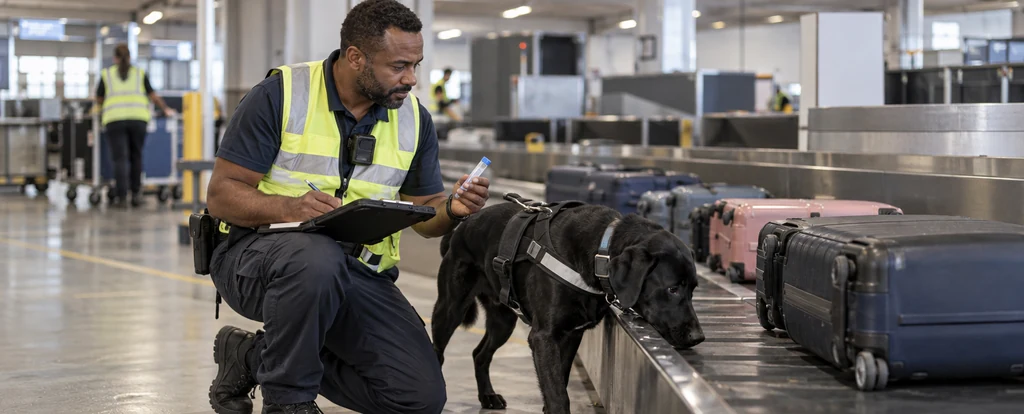
Detector dog handlers train dogs to find drugs, explosives or prohibited plant and animal material, then work alongside them on searches at airports, ports and mail centres.
- Median salary*
- $85,800
4.3%vs last year, before tax
- People employed*
- 1,200
0.0%vs last year
- Projected growth*
- +3%
to 2035
- AI exposure*
- Low
- automation risk
- Average hours*
- 38/wk
−2h vs all jobs
- Shortage status*
- Not in shortage
national
Most detector dog handlers work for a government agency, such as Australian Border Force, state police, biosecurity or corrective services, and they are usually officers in that agency before they take on a dog. The job differs from general security work because the dog does the detecting while the handler reads its behaviour, decides whether an indication is genuine and manages the search that follows. A handler and dog normally stay together as a team, training daily and deploying to whatever the roster brings, from a cold cargo shed at dawn to a passenger terminal at midnight.
How much do detector dog handlers earn?
The median full-time salary for a detector dog handler is $85,800 per annum, before tax, up $18,000 since 2018.
Most detector dog handlers are public servants, so an enterprise agreement or award sets the base rate and the classification level of the position matters more than which agency runs the unit. Shift penalties, weekend loadings and allowances for kennelling or caring for the dog sit on top of that base, which means a roster with nights and public holidays pays better than a Monday to Friday one. Private contract detection firms generally pay less than police, border force or biosecurity units and rarely match their leave and superannuation.
What does a detector dog handler do day to day?
The list below is what fills most weeks; the exact mix shifts with seniority and whatever stage the current work is at.
- Running daily scent training, hiding samples of the target odour so the dog learns to work a systematic search pattern
- Searching aircraft, baggage halls, shipping containers, mail sorting centres and vehicles for drugs, explosives or quarantined plant and animal material
- Keeping training logs, search records and seizure notes, since the paperwork can end up as evidence if a matter goes to court
- Feeding, grooming, exercising and checking the dog's health, because a dog that is lame or off its food cannot deploy
- Briefing police, customs or biosecurity officers on what the dog has indicated and handing the matter over to them
What skills do detector dog handlers need?
Employers look for security operations, animal care and handling, regulatory compliance, backed by Dog training aids fluency and strong attention to detail.
Specialist skills
- Security operations
- Animal care and handling
- Regulatory compliance
Software and tools
- Dog training aids
- GPS tracking collars
- Body-worn cameras
- Case management software
General skills
- Attention to detail
- Written communication
- Problem solving
- Safety and compliance awareness
Is the job growing?
About 1,200 people work as detector dog handlers in Australia, and employment is projected to grow 3% over the decade to 2035. That's modest growth: demand is steady rather than booming.
How do you become a detector dog handler?
Here's the path most detector dog handlers take, step by step.
- 1Choose the agency you want to work for
Almost all detector dog handlers start as police officers, Australian Border Force officers, biosecurity officers or corrective services staff and apply for the dog unit from inside, so the first decision is which of those agencies to join.
- 2Meet that agency's entry requirements
In practice that means a national police check, a security clearance, fitness and medical testing, and the agency's own recruit training, which runs for several weeks to a few months and is paid.
- 3Build qualifications that support the application
About 38% of people in the role hold a Bachelor degree, and others come through diplomas or certificates in security, animal studies or public safety; the qualification helps, but selection inside the agency usually matters more.
- 4Pass the handler selection and course
Units test how you read dogs and handle pressure, then put you through an in-house course covering scent theory, search patterns, record keeping and dog welfare. The dog is normally assigned to you at the end of it.
- 5Keep your clearance and any licensing current
Government roles need a security clearance that is reviewed periodically, and private sector detection work needs whatever security licence your state or territory requires.
Ready to apply as a detector dog handler?
Whether you're working toward becoming a detector dog handler or already are one and want a hand with the next step (sharpening your resume for ATS screening, tightening your cover letter, or knowing what you'll actually be asked at interview), here are examples grounded in this specific role, not generic templates.
What jobs can a detector dog handler move to?
Moving into Border Force Officer typically comes with the biggest pay rise, worth $11,000 a year more on average.
| Move to | Typical pay change | Overlap | Retraining |
|---|---|---|---|
| Border Force Officer A detector dog handler brings border detection experience, but broader border force powers require substantial reskilling. | +$11,000 | 30% | reskill |
| Sheriff's Officer A detector dog handler brings enforcement and security experience, and a short course covers court and prisoner transport duties. | +$5,200 | 71% | short course |
| Security Consultant A detector dog handler brings detection and security knowledge, and a short course supports risk assessment and consultancy work. | +$0 | 59% | short course |
Moves are chosen from Jobs and Skills Australia's Data on Occupation Mobility, which follows income tax records between 2011-12 and 2020-21, together with entry requirements and skill overlap. A known move is one people were seen making in that data. Pay change compares median full-time pay for the two roles.
Who works as a detector dog handler?
The typical detector dog handler is 35 years old; 75% are men, 85% work full-time, and full-timers average 38 hours a week.
- 35
- Median age
- 25%
- Female share
- 85%
- Full-time
- −2h
- vs all-jobs avg
What's it like being a detector dog handler?
The week runs on a routine that suits the dog: training first, then deployment, then care, often across shifts that include nights, weekends and public holidays. Handlers carry the pressure of a search that has to be done properly, because a missed find at a border or an airport has consequences, and much of the day is spent standing and walking in freight sheds, terminals and car parks rather than at a desk. People who do well in the job tend to enjoy working with animals and being part of a small, specialist team inside a larger enforcement agency.
What people like
- A working partnership with one dog. Handlers usually keep the same dog for years and learn its signals, its habits and when it is not working at its best.
- Results you can see. A search either produces a find or clears a load, and the answer comes within minutes rather than at the end of a long project.
- The site changes constantly. One week can be mail centres and freight sheds, the next a cruise terminal, a rural property, a prison or a regional airport.
- Solid conditions in government work. Because the roles sit inside police, border force or biosecurity agencies, pay, leave, superannuation and training are structured rather than negotiated case by case.
What people find hard
- Shift work and roster churn. Units run early starts, night shifts and weekend rosters, and the dog's feeding, exercise and kennelling routine has to fit around them.
- Long hours on hard surfaces. Searches happen on tarmac, in cargo sheds and in car parks, so a lot of the day is spent standing, kneeling and walking in whatever weather the site offers.
- Entry depends on a vacancy. Dog unit positions are few and are usually filled from within an agency, so handlers can wait years after joining before a place comes up.
- The dog's working life is short. A dog retires long before its handler does, and some dogs do not make the grade, so handlers deal with replacing a partner they know well.
Based on our synthesis of professional-body surveys and public accounts of the role, not first-person verified reviews.
Which industries employ detector dog handlers?
Public Administration and Safety employs the largest share of detector dog handlers, followed by Agriculture, Forestry and Fishing.
Top employing industries
- 1Public Administration and Safety
- 2Agriculture, Forestry and Fishing
- 3Transport, Postal and Warehousing
- 4Defence
Ranked by employment share; the source doesn't publish an exact percentage per industry.
| Bachelor degree | 38% | |
|---|---|---|
| Diploma / Advanced Diploma | 24% | |
| Certificate III/IV | 20% | |
| Postgraduate | 10% | |
| Other | 8% |
Will AI replace detector dog handlers?
Detector dog work sits at the low end of AI exposure, because the core task is a dog's nose and a handler's reading of it. Scanning technology at airports, freight terminals and mail centres has become much better at flagging suspicious items, and automated image recognition can point a screener to a bag, but it cannot smell a concealed substance inside a sealed container or a vehicle panel. What changes is where dog teams are sent and how the paperwork around a find is handled.
Share of typical working time by exposure level
- Daily scent training and dog careSessions are built around hiding samples and rewarding the dog for working a set pattern, and a handler adjusts them day by day depending on how the dog is performing.35%low
- Operational searches of cargo, baggage, mail and vehiclesThe dog works the line while the handler reads its body language and decides whether an indication is genuine, which is difficult to automate in a noisy, cluttered freight shed.30%low
- Search records, reports and evidence notesSearch logs and training records are increasingly drafted or checked with software, though the handler still signs off on what goes into a case file.20%high
- Search planning, briefings and deployment decisionsScheduling tools and screening data can suggest where teams are needed, but the handler decides how the search is run once the dog is on the ground.15%moderate
Common questions about becoming a detector dog handler
Straight answers to the questions people ask most.
How much do detector dog handlers earn?
Detector dog handlers earn $85,800 per annum, before tax. Since most work for police, border force or biosecurity agencies, an enterprise agreement sets the base rate and shift penalties, loadings and the classification level of the position explain most of the variation between one handler and another. It is a median for the role rather than a starting figure, so new handlers often begin below it.
How do you become a detector dog handler?
In most cases you join an agency that runs a dog unit, such as state police, Australian Border Force, biosecurity or corrective services, and apply for a handler position from inside. You need a police check, a security clearance and the agency's fitness and medical requirements, then an in-house course covering scent work, search patterns and dog welfare. A qualification in security or animal care can strengthen the application, but internal selection is the main gate.
Are detector dog handlers in demand?
Detector dog handlers are currently not in shortage, and employment is projected to grow 3% over the decade to 2035. The occupation is small, so a few new positions in one agency's dog unit can shift the total, and recruitment tends to arrive in rounds rather than steadily. If you are working towards the role, the practical step is to watch the agencies that run dog units for their next intake.
Will AI replace detector dog handlers?
No, AI has not removed the need for the dog's nose or the handler who reads it. Automated scanners and image recognition at airports, freight terminals and mail centres flag suspicious items and can send a dog team to a particular container or bag, while reporting software speeds up the paperwork around a find. Those tools change where handlers are deployed and how records are kept, not the detection itself.
What can a detector dog handler do next?
Sheriff's officer is a close move, since the enforcement and security background carries over, a short course covers the court and transport duties and the pay is $5,200 more. Security consulting pays about the same and suits handlers who would rather work on risk assessment than on a roster. Moving into a broader border force officer role pays $11,000 more but needs substantial reskilling for the wider powers that role carries.
Do you need a degree to be a detector dog handler?
Not as a rule. 38% of people in the role hold a Bachelor degree, which describes what the current workforce has rather than what every agency asks for. Police, border force and biosecurity units select handlers from their own staff and train them, so relevant service and a sound record with dogs count for more at that point.
Related roles
- Sheriff's Officer
- Border Force Officer
- Security Consultant
- Council Ranger
- Protective Services Officer
- Security Screening Officer
Not sure this is you? Take the career quiz and get a ranked shortlist of roles that fit how you like to work.