Energy Assessor
Energy assessors work out how much energy a building will use for heating and cooling, then rate it against the National Construction Code.
- Median salary*
- $80,100
4.3%vs last year, before tax
- People employed
- 370
7.5%vs last year
- Projected growth*
- +14%
to 2035
- AI exposure*
- Moderate
- automation risk
- Average hours*
- 38/wk
−2h vs all jobs
- Shortage status*
- Not in shortage
national
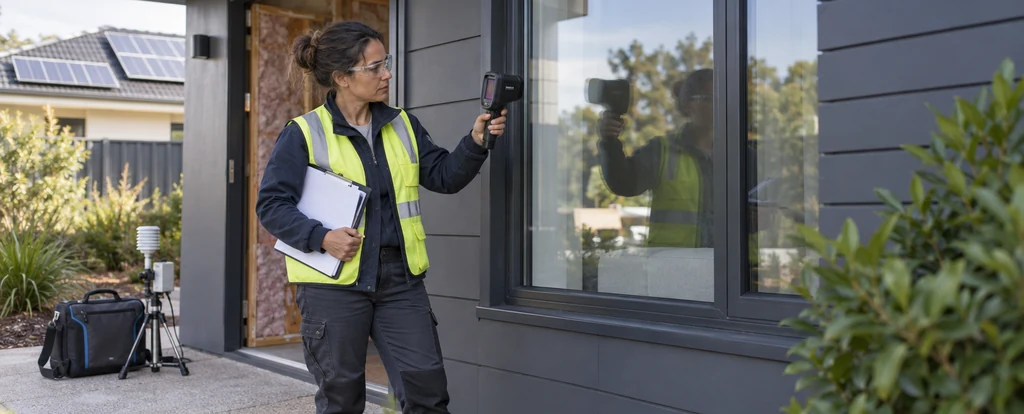
Energy assessors spend part of the week on site checking insulation, glazing, shading and orientation, and the rest at a desk turning those details into a thermal model. Most are accredited through NatHERS, the scheme behind the star ratings on new homes, and work as sole traders or for rating firms, builders, architects and energy consultancies. The role differs from a building surveyor's: an assessor rates how a building performs, while a surveyor certifies that it meets the code, even though both read the same document.
How much do energy assessors earn?
The median full-time salary for an energy assessor is $80,100 per annum, before tax, up $16,900 since 2018.
How the work is arranged makes most of the difference: salaried assessors in rating firms and consultancies sit on a set range, while sole traders are paid per assessment, so income follows how many jobs they complete. Accreditation for commercial buildings and experience with larger projects lift the rates an assessor can charge. The volume of building activity in your area matters more than the city itself.
What does an energy assessor do day to day?
The list below is what fills most weeks; the exact mix shifts with seniority and whatever stage the current work is at.
- Inspecting insulation, glazing, shading, orientation and building services on site
- Modelling thermal performance in accredited software such as FirstRate5, AccuRate or BERS Pro
- Issuing star rating certificates and compliance reports that support a building approval
- Advising homeowners and builders on insulation, draught sealing, glazing and appliance choices, and what each change is worth in stars
- Keeping accreditation current and tracking National Construction Code changes
What skills do energy assessors need?
Employers look for building codes and standards, environmental assessment, regulatory compliance, backed by FirstRate5 fluency and strong client relationships and advisory.
Specialist skills
- Building codes and standards
- Environmental assessment
- Regulatory compliance
- Data analysis
- Field inspection and testing
Software and tools
- FirstRate5
- AccuRate
- BERS Pro
- DesignBuilder
- SketchUp
General skills
- Client relationships and advisory
- Attention to detail
- Written communication
Is the job growing?
About 370 people work as energy assessors in Australia, and employment is projected to grow 14% over the decade to 2035. That's healthy, above-average growth, and the role should stay in solid demand.
How do you become an energy assessor?
Here's the path most energy assessors take, step by step.
- 1Build a building-science foundation
A certificate IV or diploma in building design or construction, or a degree in architecture, engineering or construction management, covers thermal performance, materials and how a building envelope works. Among people already in the role, Bachelor degree is the most common qualification and is held by 38% of them, though a diploma or certificate IV is a realistic entry point.
- 2Complete a NatHERS accredited assessor course
Training providers run courses in the accredited software, FirstRate5, AccuRate and BERS Pro among them, with an assessment at the end. Accreditation is what allows you to issue star ratings that count towards compliance, so the course is the step that makes the qualification usable.
- 3Learn on real buildings
Time with an established assessor or a rating firm teaches you what drawings leave out: how insulation is actually installed, where draughts come from in an existing home, and how shading behaves through the year.
- 4Keep your accreditation current
NatHERS accreditation is renewed on a cycle and requires ongoing professional development as the National Construction Code changes. Commercial work through NABERS or Green Star needs separate training and its own accreditation.
- 5Specialise or set up on your own
Once you have a client base, many assessors move into commercial buildings and sustainability consulting, or work for themselves quoting per assessment. Sole trading is common because the work is booked job by job.
Ready to apply as an energy assessor?
Whether you're working toward becoming an energy assessor or already are one and want a hand with the next step (sharpening your resume for ATS screening, tightening your cover letter, or knowing what you'll actually be asked at interview), here are examples grounded in this specific role, not generic templates.
What jobs can an energy assessor move to?
Moving into Building Inspector typically comes with the biggest pay rise, worth $38,500 a year more on average.
| Move to | Typical pay change | Overlap | Retraining |
|---|---|---|---|
| Building Inspector Energy rating and building code knowledge carries into building inspection, with further study in building surveying. | +$38,500 | 44% | reskill |
| Insurance Risk Surveyor Property assessment and compliance skills apply to insurance risk surveys, with further study in insurance and risk. | +$16,100 | 41% | reskill |
| Water Inspector Compliance inspection and building services knowledge transfer to water efficiency and plumbing compliance, with a short course. | +$10,900 | 59% | short course |
Moves are chosen from Jobs and Skills Australia's Data on Occupation Mobility, which follows income tax records between 2011-12 and 2020-21, together with entry requirements and skill overlap. A known move is one people were seen making in that data. Pay change compares median full-time pay for the two roles.
Who works as an energy assessor?
The typical energy assessor is 42 years old; 78% are men, 64% work full-time, and full-timers average 38 hours a week.
- 42
- Median age
- 22%
- Female share
- 64%
- Full-time
- −2h
- vs all-jobs avg
What's it like being an energy assessor?
The week splits between site visits and desk modelling, so the job suits someone who wants both rather than one or the other. Work arrives in bursts tied to building approvals, which means quiet stretches followed by several reports due at once. Accuracy matters more than speed, because a rating that misses a detail can send a design back for changes after the drawings were thought to be finished.
What people like
- You see the building, not just the spreadsheet. An assessor walks the frame, checks the insulation that went in and looks at how the afternoon sun lands, which keeps the work tied to something physical.
- Advice that changes a house. Moving a window, adding eaves or upgrading glazing can lift a rating, and you are the person who tells the owner which change buys the most.
- A small field with room to specialise. With few people in the occupation, assessors who add commercial accreditation or sustainability consulting stand out without competing against a crowd.
- The rules keep moving. Code updates change what a compliant home looks like, so the technical side of the job doesn't sit still for long.
What people find hard
- Driving between jobs eats the day. Assessments happen wherever the building is, and travel between sites is usually unpaid time in a per-job fee.
- Existing homes rarely match the drawings. Renovations and older houses often hide surprises in the walls, so the model has to be adjusted on site rather than at the desk.
- Builders sometimes push back on the rating. A low star result can mean extra cost on a project, and the assessor is often the one explaining why the change is needed.
- Deadlines cluster before approvals. Reports are needed before a building approval or a settlement date, which stacks several jobs into the same week.
Based on our synthesis of professional-body surveys and public accounts of the role, not first-person verified reviews.
Which industries employ energy assessors?
Professional, Scientific and Technical Services employs the largest share of energy assessors, followed by Construction.
Top employing industries
- 1Professional, Scientific and Technical Services
- 2Construction
- 3Electricity, Gas, Water and Waste Services
- 4Public Administration and Safety
- 5Rental, Hiring and Real Estate Services
Ranked by employment share; the source doesn't publish an exact percentage per industry.
| Bachelor degree | 38% | |
|---|---|---|
| Diploma / Advanced Diploma | 24% | |
| Certificate III/IV | 20% | |
| Postgraduate | 10% | |
| Other | 8% |
Will AI replace energy assessors?
This is a moderately exposed role. Accredited software such as FirstRate5 and AccuRate already does the thermal calculation, and AI tools are moving into report drafting and certificate generation, which takes hours out of the desk side. What keeps the exposure moderate is the site work: what is actually installed behind the plaster, how a renovation was built and what a client can realistically change are things the assessor still has to see and explain.
Share of typical working time by exposure level
- On-site inspection of building fabric and servicesChecking the insulation that was installed, the glazing that arrived and where shading actually falls cannot be done from a drawing.30%low
- Thermal modelling in accredited softwareFirstRate5 and AccuRate calculate the star result from the inputs, and AI-assisted tools are starting to suggest inputs from plans and photos.25%high
- Advising clients on retrofit and design optionsSoftware can rank upgrade options by cost per star, but the conversation about budget, heritage limits and what the owner will accept stays with the assessor.25%moderate
- Star rating certificates and compliance reportsCertificate templates and standard report wording can be generated automatically, though the assessor still signs off on the rating.20%moderate
Moves least exposed to AI
These career moves from energy assessor work are rated low for AI exposure:
- Building Inspector
Solid skill overlap (44%), reskill to get there, and a low automation-risk profile.
Common questions about becoming an energy assessor
Straight answers to the questions people ask most.
How much do energy assessors earn?
Median pay is $80,100 per year before tax, which is a guide rather than a fixed rate. Pay moves with how the work is arranged: salaried assessors in rating firms and consultancies sit on a set range, while sole traders are paid per assessment, so earnings follow job volume. Commercial accreditation and larger projects push rates higher.
How do you become an energy assessor?
Most assessors start with a qualification in building design, construction, architecture or engineering, then complete a NatHERS accredited course in assessment software. Accreditation is what lets you issue ratings used for code compliance, and site experience with an established assessor is what makes the modelling reliable.
Are energy assessors in demand?
Energy assessors are currently not in shortage. Employment in the role is projected to grow 14% over the decade to 2035, and because the occupation is small, openings come mainly from assessors leaving or firms expanding rather than from a continuous flow of advertised jobs. Work follows building activity and code requirements in your region.
Will AI replace energy assessors?
The modelling and report-writing side is the most exposed, since accredited software already runs much of the calculation and AI tools are moving into documentation. Site inspection, interpreting unusual construction and explaining options to a client stay with the assessor. In practice that shifts hours away from paperwork and towards the judgement calls.
What can energy assessors move into?
Energy rating and code knowledge carries into building inspection, a move that usually needs further study in building surveying and pays $38,500 more. Water inspection is a shorter step, since compliance and building services skills transfer with a short course, and it pays $10,900 more. Many experienced assessors stay in the field and run their own assessment business instead, which is often where earnings grow.
Do you need accreditation to work as an energy assessor?
To issue NatHERS ratings that count towards compliance, you need to complete an accredited assessor course and register through the scheme, and accreditation has to be renewed. Commercial assessment through NABERS or Green Star has its own training and accreditation. You can carry out energy audits without rating accreditation, but you cannot sign off on compliance ratings.
Related roles
- Building Inspector
- Water Inspector
- Insurance Risk Surveyor
- Plumbing Inspector
- Water Inspector
- Test and Tag Technician
Not sure this is you? Take the career quiz and get a ranked shortlist of roles that fit how you like to work.