Underground Services Locator
Underground services locators find and mark buried pipes and cables before work starts, so excavation does not cut through them.
- Median salary*
- $93,600
4.0%vs last year, before tax
- People employed*
- 4,500
0.0%vs last year
- Projected growth*
- +6%
to 2035
- AI exposure*
- Moderate
- automation risk
- Average hours*
- 42/wk
+2h vs all jobs
- Shortage status*
- In shortage (regional)
national
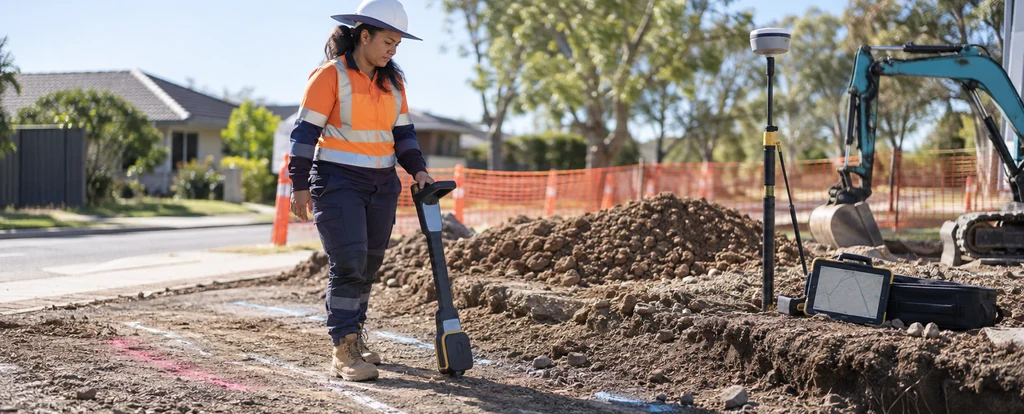
Underground services locators work on construction, civil and utility sites, tracing the water, gas, electricity and telecommunications lines that nobody can see from the surface. They start with Before You Dig Australia plans and asset records, then confirm what is really in the ground using an electromagnetic locator or ground penetrating radar. The role sits between surveying and civil construction: more time outdoors than a surveyor, more technical and more record-keeping than a machine operator.
How much do underground services locators earn?
The median full-time salary for an underground services locator is $93,600 per annum, before tax, up $19,500 since 2018.
Pay depends heavily on who you work for, since utilities, mining and local government roles generally pay more than small locating subcontractors, and enterprise agreements set rates on larger projects. Regional and remote work often attracts allowances, and overtime or shift work adds to the base on some sites. Because accuracy carries real liability, locators who handle complex jobs, ground penetrating radar work and supervision tend to move up the range.
What does an underground services locator do day to day?
The list below is what fills most weeks; the exact mix shifts with seniority and whatever stage the current work is at.
- Reading Before You Dig Australia plans and utility asset maps to work out where services are likely to run
- Sweeping an electromagnetic locator across the ground to trace conductive cables and metal pipes
- Switching to ground penetrating radar to check for plastic, concrete and other non-conductive services
- Marking alignments on the surface with paint, pegs and flags, and potholing to confirm depth where a strike would be costly
- Recording positions with GNSS gear and updating the asset register, then briefing the excavator operator on what was found
What skills do underground services locators need?
Employers look for reading plans and specifications, worksite safety management, plant and equipment operation, backed by Before You Dig Australia (BYDA) plans fluency and strong attention to detail.
Specialist skills
- Reading plans and specifications
- Worksite safety management
- Plant and equipment operation
- Field inspection and testing
- Regulatory compliance
Software and tools
- Before You Dig Australia (BYDA) plans
- Electromagnetic cable locator
- Ground penetrating radar (GPR)
- GNSS/GPS survey equipment
- GIS mapping software
General skills
- Attention to detail
- Written communication
- Problem solving
Is the job growing?
About 4,500 people work as underground services locators in Australia, and employment is projected to grow 6% over the decade to 2035. That's modest growth: demand is steady rather than booming.
How do you become an underground services locator?
Here's the path most underground services locators take, step by step.
- 1Get a construction induction card
Often called a White Card, this is required before you can work on most construction sites. It is a short course, and the card is issued by the work health and safety regulator in your state or territory.
- 2Build a base in civil construction or utilities
A Certificate II or III in Civil Construction, or a background in plumbing, electrical work, machine operating or surveying assistance, gives you the site knowledge employers expect. Many locators start as labourers, pipelayers or survey assistants and move across.
- 3Learn the locating equipment on the job
Employers train new locators on their own electromagnetic locators, radar and GNSS gear, and equipment suppliers run short courses. Before You Dig Australia also offers free online training on reading plans and working safely around services.
- 4Add a spatial qualification if you want to specialise
A Certificate IV in Surveying and Spatial Information Services (CPP41721) covers GIS, data capture and survey principles, which helps with radar interpretation, asset records and a later move into surveying.
- 5Check state registration and competency requirements
Licensing and registration rules differ by state, and some asset owners require accredited locators for work on their networks. Check the rules where you work before paying for a course.
Ready to apply as an underground services locator?
Whether you're working toward becoming an underground services locator or already are one and want a hand with the next step (sharpening your resume for ATS screening, tightening your cover letter, or knowing what you'll actually be asked at interview), here are examples grounded in this specific role, not generic templates.
What jobs can an underground services locator move to?
Moving into Surveyor typically comes with the biggest pay rise, worth $26,000 a year more on average.
| Move to | Typical pay change | Overlap | Retraining |
|---|---|---|---|
| Surveyor Surveyors manage site measurement and plans, so experienced locators can progress to surveyor through a surveying degree and registration. | +$26,000 | 33% | requalify |
| Building Inspector Building inspectors check site compliance and plans, so locators can move into inspection work with further study. | +$25,000 | 71% | reskill |
| Gas Network Technician Gas network technicians know buried gas mains and utility plans, so locators can move into network maintenance with a short course. | +$7,800 | 67% | short course |
| Surveying Technician Surveying technicians set out and measure sites, so locators can move into survey support work with further study. | −$6,200 | 22% | reskill |
| Data Cabler Cablers install and trace cables, so locators can move into telecommunications cabling with a short course. | −$13,000 | 67% | short course |
Moves are chosen from Jobs and Skills Australia's Data on Occupation Mobility, which follows income tax records between 2011-12 and 2020-21, together with entry requirements and skill overlap. A known move is one people were seen making in that data. Pay change compares median full-time pay for the two roles.
Who works as an underground services locator?
The typical underground services locator is 38 years old; 92% are men, 90% work full-time, and full-timers average 42 hours a week.
- 38
- Median age
- 8%
- Female share
- 90%
- Full-time
- +2h
- vs all-jobs avg
What's it like being an underground services locator?
The job runs on a steady rhythm of sites and handovers: read the plans, sweep the ground, mark it, brief the crew, move on. Most of it happens outdoors in whatever the weather is doing, and the pressure concentrates into the moment before excavation starts. Locators who enjoy solving a puzzle with equipment and carrying the responsibility for getting it right tend to settle into the work well.
What people like
- Out on site rather than at a desk. Most locators work across several sites a week, with equipment in the ute and plans on a tablet, which suits people who dislike being tied to one place.
- The trace is a puzzle worth solving. Working out where a service actually runs from a plan that may be decades old takes a bit of detective work, and getting it right is satisfying.
- Your marks stop a strike. When a crew uncovers exactly the cable you painted, the value of the job is obvious, and a reliable locator becomes the person the site calls first.
- A fair amount of independence. Many locators work alone or in a two-person crew, organising their own run of jobs and deciding how much ground to cover and how carefully.
What people find hard
- Weather and ground conditions. The work goes ahead in heat, rain and mud, and rocky or heavily trafficked ground makes signals harder to read and locating slower.
- Plans that do not match the ground. Records are often incomplete or out of date, so you are working with uncertainty and have to mark conservatively rather than trust the drawing.
- The cost of being wrong. A missed service can mean an outage, an expensive repair and a genuine risk of injury, and the responsibility sits with whoever signed off on the marks.
- Travel and early starts. Sites are spread across a region, so much of the week goes in driving between jobs, often starting well before the excavation crew arrives.
Based on our synthesis of professional-body surveys and public accounts of the role, not first-person verified reviews.
Which industries employ underground services locators?
Construction employs the largest share of underground services locators, followed by Utilities.
Top employing industries
- 1Construction
- 2Utilities
- 3Telecommunications
- 4Local Government
- 5Mining
Ranked by employment share; the source doesn't publish an exact percentage per industry.
| Certificate III/IV | 34% | |
|---|---|---|
| Diploma / Advanced Diploma | 26% | |
| Bachelor degree | 20% | |
| Year 12 or below | 20% |
Will AI replace underground services locators?
Locating is moderately exposed to AI. Plan interpretation, asset records and reporting are increasingly software-assisted, with GIS platforms and digital asset databases now standard, and radar processing improving. The physical side of the job, walking the ground and confirming what is actually buried, is much harder to automate, so the role is changing rather than disappearing.
Share of typical working time by exposure level
- Tracing services with an electromagnetic locatorThe sweep and the reading of a signal that bends around other metal is hands-on work, and automated location tools still struggle on congested inner-city sites.30%low
- Reading plans and asset recordsBefore You Dig Australia responses and utility records arrive as digital files that GIS tools can overlay on a site, but someone still has to judge how much to trust a plan that may be decades old.25%moderate
- Confirming and marking services on the groundPotholing, painting marks and deciding where an exclusion zone starts happen in real ground conditions, which no software can do for you.25%low
- Recording results and updating asset registersOnce a position is captured with GNSS, the data entry and GIS update are largely automated, making this the part of the job most likely to shrink.20%high
Moves least exposed to AI
These career moves from underground services locator work are rated low for AI exposure:
- Building Inspector
High skill overlap (71%), reskill to get there, and a low automation-risk profile.
- Data Cabler
High skill overlap (67%), short course to get there, and a low automation-risk profile.
- Surveyor
Some skill overlap (33%), requalify to get there, and a low automation-risk profile.
Common questions about becoming an underground services locator
Straight answers to the questions people ask most.
How much do underground services locators earn?
Underground services locators earn a median of $93,600 per annum, before tax, for full-time work. Pay moves with the employer and the project: utilities, mining and local government roles generally sit above small subcontracting firms, and site allowances, overtime and shift penalties add to the base. As with any median, half of locators earn more and half earn less.
How do you become an underground services locator?
Start with a construction induction card, then build experience on civil or utilities sites, since many locators come from plumbing, electrical work, machine operating or surveying assistance. Employers usually train you on their locating equipment and send you to supplier or Before You Dig Australia courses. A Certificate IV in Surveying and Spatial Information Services (CPP41721) helps if you want the radar and data side of the work.
Are underground services locators in demand?
Underground services locators are currently in shortage in regional areas, and employment in the role is projected to grow 6% over the decade to 2035. The work follows construction and utilities activity, so opportunities cluster where infrastructure, subdivision and network maintenance projects are running. Regional infrastructure work and utility maintenance contracts are worth watching if you are looking for a start.
Will AI replace underground services locators?
The role is moderately exposed rather than at risk of disappearing. Plan interpretation, asset records and reporting are increasingly software-assisted, with GIS platforms and asset databases now standard, and radar data processing keeps improving. Walking the ground with a locator and confirming what is actually buried remains hands-on work that is hard to automate on congested sites.
What can underground services locators move into?
Moves tend to be sideways into the utilities that own the assets or into surveying. A short course can take you into gas network maintenance as a gas network technician, where the work pays $7,800 more, and further study in surveying can lead to surveyor, paying $26,000 more. With their own locating equipment, experienced locators also take on subcontract work for construction companies and councils, and that is often where earnings grow.
Do you need a licence to locate underground services?
There is no single national licence for locating, but you need a construction induction card to work on most construction sites. Some states require specific training or registration for work near particular assets, and employers generally want demonstrated competency on the equipment you will use. Check the rules in your state rather than assuming one state's requirements apply everywhere.
Related roles
Not sure this is you? Take the career quiz and get a ranked shortlist of roles that fit how you like to work.