Panel Beater
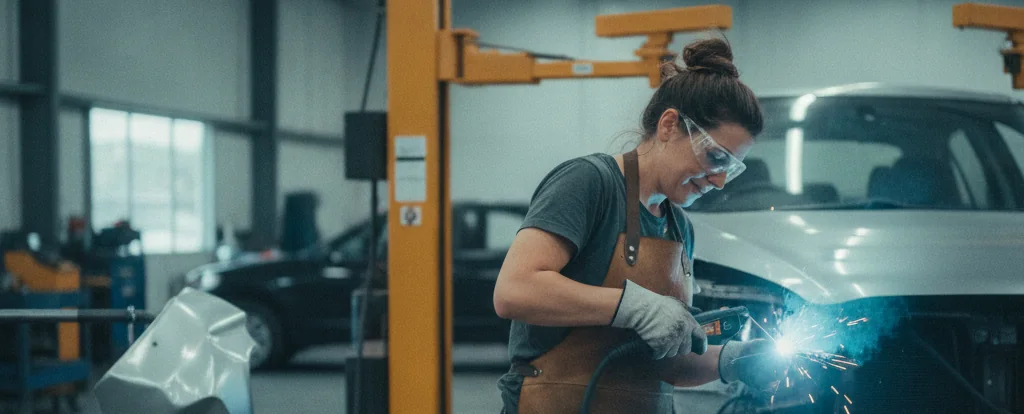
Panel beaters repair and reshape damaged vehicle bodywork so a car is structurally sound and safe to drive again.
- Median salary
- $96,100
4.5%vs last year, before tax
- People employed
- 11,400
0.0%vs last year
- Projected growth
- +0%
to 2035
- AI exposure*
- Low
- automation risk
- Average hours
- 42/wk
+2h vs all jobs
- Shortage status
- In shortage
national
Panel beaters work in smash repair shops, dealership bodyshops and fleet workshops, straightening or replacing the metal, plastic and fibreglass panels damaged in a crash. The job sits apart from spray painting, which starts once the panel work is finished, though many shops handle both trades under the same roof. Most repairs are quoted and approved by an insurer before work begins, which shapes how jobs get booked in and how quickly they move through the shop.
How much do panel beaters earn?
The median full-time salary for a panel beater is $96,100 per annum, before tax, up $20,300 since 2018.
Most panel beaters are paid under the vehicle repair industry award or a shop enterprise agreement, so the rate depends heavily on the business you work for. Overtime and weekend work lift the annual figure, and shops that specialise in prestige, heavy or fleet vehicles tend to pay above the ordinary crash repair rate. If you run your own shop or take contract work, what you earn comes down to the jobs you quote and win.
What does a panel beater do day to day?
The list below is what fills most weeks; the exact mix shifts with seniority and whatever stage the current work is at.
- Assessing crash damage and working out whether a panel can be straightened or needs replacing
- Pulling, hammering and jigging dented metal back to its original shape
- Welding, bonding and fitting replacement panels so they sit flush with the rest of the body
- Sanding and preparing repaired panels to a finish the painter can work with
- Costing the job and talking the repair through with the insurer and the owner
What skills do panel beaters need?
Employers look for hand and power tool work, reading plans and specifications, installation and maintenance, backed by hydraulic straightening frame fluency and strong problem solving.
Specialist skills
- Hand and power tool work
- Reading plans and specifications
- Installation and maintenance
- Worksite safety management
- Fabrication and finishing
- Plant and equipment operation
Software and tools
- hydraulic straightening frame
- dent puller and slide hammer
- MIG welder
- angle grinder
- measuring gauge and laser alignment
General skills
- Problem solving
- Attention to detail
Is the job growing?
About 11,400 people work as panel beaters in Australia, and employment is projected to grow 0% over the decade to 2035. That's modest growth: demand is steady rather than booming.
How do you become a panel beater?
Here's the path most panel beaters take, step by step.
- 1Finish Year 10 or Year 12
There are no strict prerequisites for an apprenticeship, but maths helps with measuring and quoting, and metalwork or manual arts subjects give you a feel for the tools before you start.
- 2Find an apprenticeship in a smash repair shop
Panel beating is learned on the job through a Certificate III in Automotive Body Repair Technology (AUR32126) apprenticeship, which usually runs three to four years and is paid from day one. Some people complete a Certificate II in Automotive Body Repair Technology (AUR20920) or a pre-apprenticeship first to get a foot in the door.
- 3Complete the trade qualification
You spend most weeks in the workshop and attend a registered training organisation for the theory and assessment, covering metal shaping, welding, panel replacement, structural repair and estimating.
- 4Add specialist repair skills
Once qualified, short courses in aluminium repair, heavy vehicle body repair or advanced structural repair open up work on trucks, buses and late-model cars built from mixed materials.
- 5Build experience with insurer and manufacturer repair methods
Larger shops and dealer networks value tradespeople who can assess damage accurately and follow manufacturer repair procedures, so time spent learning an insurer assessment system is worth having behind you.
Ready to apply as a panel beater?
Whether you're working toward becoming a panel beater or already are one and want a hand with the next step (sharpening your resume for ATS screening, tightening your cover letter, or knowing what you'll actually be asked at interview), here are examples grounded in this specific role, not generic templates.
What jobs can a panel beater move to?
Moving into Vehicle Spray Painter typically comes with the biggest pay rise, worth $1,700 a year more on average.
| Move to | Typical pay change | Overlap | Retraining |
|---|---|---|---|
| Vehicle Spray Painter Panel beaters bring surface preparation and body repair skills to vehicle spray painting, with additional training in spray techniques and colour matching.Known move | +$1,700 | 46% | reskill |
| Motor Mechanic Panel beaters can move into motor mechanics by building on shared automotive knowledge, but need training in engines, drivetrains and diagnostics.Known move | −$11,800 | 81% | reskill |
| Vehicle Body Builder Panel beaters bring metal shaping and body assembly skills to vehicle body building, with further training in structural fabrication and heavy vehicle standards.Known move | −$20,700 | 74% | reskill |
| Industrial Spray Painter Panel beaters can apply surface preparation and spray painting experience to industrial spray painting, needing a short course in industrial coatings and equipment.Known move | −$24,300 | 76% | short course |
Moves are chosen from Jobs and Skills Australia's Data on Occupation Mobility, which follows income tax records between 2011-12 and 2020-21, together with entry requirements and skill overlap. A known move is one people were seen making in that data. Pay change compares median full-time pay for the two roles.
Who works as a panel beater?
The typical panel beater is 41 years old; 100% are men, 92% work full-time, and full-timers average 42 hours a week.
- 41
- Median age
- 0%
- Female share
- 92%
- Full-time
- +2h
- vs all-jobs avg
What's it like being a panel beater?
The work has a clear rhythm: a damaged car arrives, an insurer approves a set repair time, and the job has to be finished inside it. Shops are noisy and dusty, the metal work is physical, and the trade suits people who enjoy a three-dimensional puzzle, working out where the damage starts and how to bring a bent structure back to where it began.
What people like
- You can see what you fixed. A car leaves the shop straight and finished, and a repair either holds up or it doesn't, so the feedback on your work is immediate.
- Every repair is a puzzle. No two crashes are quite the same, so you are constantly working out how far the damage travels and which way the metal wants to move.
- A trade that travels. A panel beating qualification is recognised across Australia and in many other countries, and experienced beaters move between independent shops, dealer networks and fleet workshops.
- Metal finishing is a craft worth learning. Planish a panel well and it needs very little filler, which takes years to master and is what keeps experienced beaters in demand.
What people find hard
- Dust, noise and fumes. Grinding, sanding and filler work fill the air, so a respirator, earmuffs and good ventilation are part of the job rather than optional extras.
- Quoted repair times are tight. Insurers approve a set number of hours for each job, and finishing within that time is what keeps the shop profitable and the pressure on.
- It is hard on the body. Panel beaters stand and bend for most of the day, and pulling a heavy panel back into line takes strength as well as technique.
- The workload swings with the weather. A severe hail storm can fill a shop's calendar for months, followed by quieter stretches, so the pace is uneven across the year.
Based on our synthesis of professional-body surveys and public accounts of the role, not first-person verified reviews.
Which industries employ panel beaters?
Other Services employs the largest share of panel beaters.
Top employing industries
- 1Other Services
Ranked by employment share; the source doesn't publish an exact percentage per industry.
| Certificate III/IV | 71.6% | |
|---|---|---|
| Year 12 or below | 21.6% | |
| Diploma / Advanced Diploma | 2.1% | |
| Bachelor degree | 1.4% | |
| Postgraduate | 0.2% |
Will AI replace panel beaters?
Panel beating has low exposure to AI, because a repair shop works on one damaged car at a time and every damaged structure is different. Robots weld and stamp panels on production lines, but bringing a bent body back to its original dimensions is still done by hand, with measuring equipment confirming what the beater has already felt. Software has taken over parts lookups, insurer approvals and job records, which removes administration rather than the repair work.
Share of typical working time by exposure level
- Straightening and pulling panels back into shapeWorking a dent out with a slide hammer or a hydraulic frame depends on feel and controlled force, which no current machine manages on a one-off repair.35%low
- Welding, cutting and fitting replacement panelsFitting a new quarter panel so the gaps and seams line up with the rest of the car is measured, cut and welded by hand, often on a vehicle the shop has never seen before.30%low
- Assessing damage and costing the repairPhoto-based estimating tools can suggest likely damage and parts from images, but deciding what is repairable and how long the job will really take still comes from experience.20%moderate
- Ordering parts and updating the job recordParts catalogues and insurer portals already match a VIN to the right panel and push status updates through, so this part of the job is largely automated.15%high
Common questions about becoming a panel beater
Straight answers to the questions people ask most.
How much do panel beaters earn?
The median for panel beaters is $96,100 per annum, before tax, for full-time work. What you actually take home depends on the shop, the overtime and weekend work available, and whether you specialise in prestige, heavy or fleet vehicles rather than everyday crash repair.
How do you become a panel beater?
The standard route is an apprenticeship in automotive body repair technology, which takes about three to four years and combines paid workshop time with study at a registered training organisation. You need a shop willing to take you on, and a pre-apprenticeship or Certificate II helps show you are serious about the trade.
Are panel beaters in demand?
Panel beaters are currently in shortage nationally, and employment is projected to stay flat over the decade to 2035 over the decade to 2035. Smash repair work is spread across independent shops, dealer bodyshops and fleet workshops, so it is worth applying to a few different types of business rather than pinning your search on one.
Will AI replace panel beaters?
The role has low exposure to AI, because the core of the job is physical: reading damage by eye and hand, pulling metal back into shape and welding panels into a one-off car. Software already handles parts lookups, insurer approvals and job records, which takes paperwork out of the day rather than the repair itself.
What can a panel beater move into?
Vehicle spray painting is a natural step, since the surface preparation carries over and pay is $1,700 more. Motor mechanics draws on shared automotive knowledge, though the pay difference is $11,800 less and you would need training in engines and diagnostics. Experienced panel beaters also open or run their own shop, which is often where earnings grow.
Is panel beating physically demanding?
Yes, most of the day is spent standing, bending and lifting, and straightening a heavy panel takes strength as much as technique. Shops use hoists, jigs and hydraulic equipment to take some of the load, but the work stays hands-on from start to finish.
Related roles
- Vehicle Spray Painter
- Motor Mechanic
- Vehicle Body Builder
- Industrial Spray Painter
- Vehicle Spray Painter
- Motor Mechanic
Not sure this is you? Take the career quiz and get a ranked shortlist of roles that fit how you like to work.