Fencer
Fencers build and repair the fences and gates that mark boundaries, contain livestock and secure homes, farms and commercial sites.
- Median salary
- $64,900
3.7%vs last year, before tax
- People employed
- 13,200
0.0%vs last year
- Projected growth
- +5.3%
to 2035
- AI exposure*
- Low
- automation risk
- Average hours
- 45/wk
+5h vs all jobs
- Shortage status
- Not in shortage
national
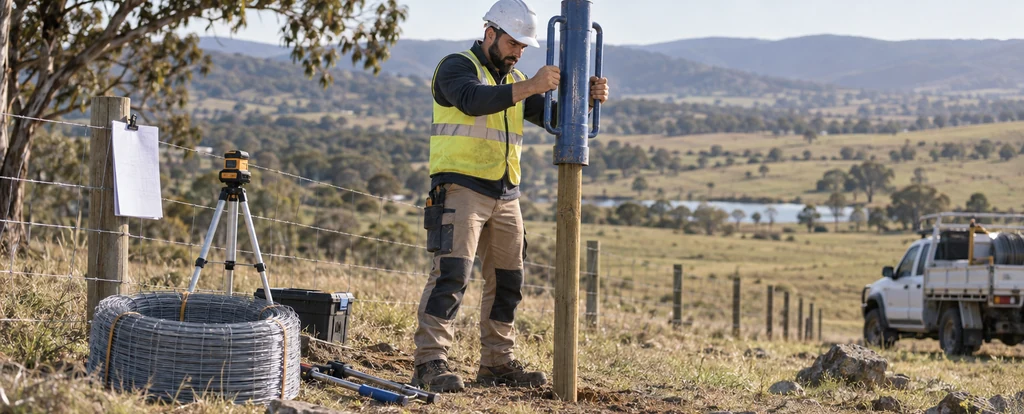
Fencers work outdoors on farms, new housing estates and commercial sites, setting posts and running wire, panels or palings. The trade sits close to landscaping and labouring, but the work is narrower: the fence and its gates are the whole job, and rural fencing in particular is often metred out across paddocks far from a shed or a power point. Most fencers work for small contracting businesses or run one themselves, and many come in without formal qualifications and learn on the job.
How much do fencers earn?
The median full-time salary for a fencer is $64,900 per annum, before tax, up $13,400 since 2018.
Fencing pay depends most on how you are engaged: wages and overtime as an employee, or a rate per metre or per job as a contractor, which is common in rural fencing. Travel, remote sites and the gear you bring usually affect what a job is worth, and contractors who quote accurately and finish quickly take on more work. Site-based commercial and residential work generally comes under construction industry awards and enterprise agreements.
What does a fencer do day to day?
The list below is what fills most weeks; the exact mix shifts with seniority and whatever stage the current work is at.
- Setting out fence lines and checking boundaries against plans, pegs and the client's own markers
- Digging or drilling post holes and setting posts in concrete, rammed earth, or driven straight into the ground
- Installing wire, panels, palings, rails and gates
- Tensioning and tying off wire, then fitting stays, fasteners and strainers
- Repairing storm and stock damage, replacing rotten posts and rails, and rehanging gates that have dropped
What skills do fencers need?
Employers look for hand and power tool work, installation and maintenance, worksite safety management, backed by Post driver and auger attachments fluency and strong physical stamina and dexterity.
Specialist skills
- Hand and power tool work
- Installation and maintenance
- Worksite safety management
- Reading plans and specifications
- Plant and equipment operation
- Quoting and estimating
Software and tools
- Post driver and auger attachments
- Laser level
- Wire strainer and tensioning tools
- Tradify job management app
- Xero invoicing
General skills
- Physical stamina and dexterity
Is the job growing?
About 13,200 people work as fencers in Australia, and employment is projected to grow 5.3% over the decade to 2035. That's modest growth: demand is steady rather than booming.
How do you become a fencer?
Here's the path most fencers take, step by step.
- 1Start on a crew as an offsider or labourer
Most fencers learn the trade on the job, carrying posts, holding the strainer and mixing concrete for someone more experienced. It is paid work and no prior qualification is needed, which is why it is the usual way in.
- 2Get a construction induction card
A White Card, issued by your state or territory, is required before you set foot on a building or civil site. Rural fencing on farms does not need one, so it matters mainly if you want residential and commercial work.
- 3Do a Certificate III in Fencing through an Australian Apprenticeship
TAFE and other registered training organisations deliver it as a traineeship, combining paid work with study. It covers rural and residential fencing, gate hanging, concrete work and reading plans, and it is the recognised qualification for the trade.
- 4Add the licences your work needs
A truck licence helps if you cart posts, wire and machinery, and a chainsaw qualification covers clearing and strainer work. Operating a skid steer or other plant on site needs a high risk work licence for that item.
- 5Go out on your own when you can price work
Many fencers end up contracting, which means an ABN, public liability insurance, and the quoting, scheduling and invoicing that come with running the business. It usually follows a few years of running crews for someone else.
Ready to apply as a fencer?
Whether you're working toward becoming a fencer or already are one and want a hand with the next step (sharpening your resume for ATS screening, tightening your cover letter, or knowing what you'll actually be asked at interview), here are examples grounded in this specific role, not generic templates.
What jobs can a fencer move to?
Moving into Concreter typically comes with the biggest pay rise, worth $50,000 a year more on average.
| Move to | Typical pay change | Overlap | Retraining |
|---|---|---|---|
| Concreter Fencers with concrete experience can move into concreting, setting posts, slabs and footings using similar formwork and finishing skills.Known move | +$50,000 | 54% | short course |
| Truck Driver Fencers who obtain a heavy vehicle licence can move into truck driving, using their site knowledge to transport materials and equipment.Known move | +$37,000 | 0% | reskill |
| Civil Construction Labourer Fencers bring trenching, concreting and site safety skills to civil construction labouring, moving into infrastructure projects with little retraining.Known move | +$2,700 | 80% | minimal |
| Builder's Labourer Fencers move into builder's labourer roles, using their site experience and hand tools on general construction tasks.Known move | +$100 | 52% | short course |
| Landscaper Fencers move into landscaping, applying their fencing and gate installation skills to garden structures, retaining walls and outdoor projects.Known move | +$100 | 60% | short course |
Moves are chosen from Jobs and Skills Australia's Data on Occupation Mobility, which follows income tax records between 2011-12 and 2020-21, together with entry requirements and skill overlap. A known move is one people were seen making in that data. Pay change compares median full-time pay for the two roles.
Who works as a fencer?
The typical fencer is 46 years old; 95% are men, 75% work full-time, and full-timers average 45 hours a week.
- 46
- Median age
- 5%
- Female share
- 75%
- Full-time
- +5h
- vs all-jobs avg
What's it like being a fencer?
Fencing is physical, outdoor work that moves with the weather and the job: a run of rural contract fencing one month, a suburban boundary replacement the next. Days start early to beat the heat, and much of the work is done in a small crew or alone, so you need to be comfortable making decisions on site. It suits people who like visible results and do not mind dirt, distance or heavy ground.
What people like
- A day's work you can see and touch. By the end of a good day there is a finished line of fence standing where there was nothing, and a customer who can see exactly what they paid for.
- Every site handles differently. Rock, clay, sand, black soil and steep country all need a different approach to setting posts and bracing corners, so the next job is rarely the same as the last.
- A clear path to running your own show. Rural fencing is commonly quoted by the metre or the job, so once you can price work and run a crew there is a straightforward route into contracting.
- You deal with the person who wants the fence. Clients are usually farmers, builders or homeowners with a plain problem, and you are often on site with them while the work happens rather than passing it down a chain of supervision.
What people find hard
- Weather and ground set the pace. Summer ground goes hard enough to need a bar or a rock breaker, and heavy rain turns a site into mud that bogs the ute and the post driver.
- The body pays for it. Post driving, wire tensioning and carrying gear load up the back, shoulders and hands, and many fencers are managing a niggle well before they retire.
- Travel and time away. Rural contracts can be hours from home, sometimes with a week or more away, and the drive out and back is unpaid time you still have to make.
- Wet weeks stop everything. Rural fencing shuts down in sustained rain, and if you are contracting the income stops with it while quoting, chasing invoices and keeping the gear running all come out of the same hours.
Based on our synthesis of professional-body surveys and public accounts of the role, not first-person verified reviews.
Which industries employ fencers?
Construction employs the largest share of fencers.
Top employing industries
- 1Construction
Ranked by employment share; the source doesn't publish an exact percentage per industry.
| Year 12 or below | 57.2% | |
|---|---|---|
| Certificate III/IV | 28.4% | |
| Diploma / Advanced Diploma | 4.8% | |
| Bachelor degree | 3.3% | |
| Postgraduate | 0.7% |
Will AI replace fencers?
Fencing has low exposure to AI and automation, because nearly all of the work happens in the ground and in the weather, with materials that have to be physically handled. Post drivers, augers and laser or GPS marking have taken much of the labour out of digging holes and setting out lines, and job management apps handle quoting and invoicing, but none of that puts a fence in. The judgement that decides a good job, how the ground will hold a post, where stock will push, how a gate has to hang, stays with the fencer.
Share of typical working time by exposure level
- Digging holes and setting postsA post driver on a tractor or skid steer makes short work of a fence line, but rocky, steep or tight suburban ground still ends up with a bar and a shovel.40%low
- Running wire, panels and gatesStrainers and tensioning tools help, yet the wire has to be run out, tied off and checked by hand, and a gate has to be hung so it swings true for years.35%low
- Quoting jobs and scheduling workApps like Tradify and Xero handle the quotes, invoices and job records, while the metre rate and what the ground will do to it still come from experience.15%high
- Setting out and marking fence linesGPS and laser levels speed up marking a line, but someone still walks the boundary on foot and reads what the ground is doing.10%moderate
Common questions about becoming a fencer
Straight answers to the questions people ask most.
How much does a fencer earn?
Fencers earn a median of $64,900 per year before tax. What moves that figure is how you are engaged: award or enterprise rates on a wage, or a per-metre rate as a contractor, plus allowances for travel and remote sites.
How do you become a fencer?
Most fencers start as a labourer or offsider on a crew and learn the tools on the job, which needs no prior qualification. A Certificate III in Fencing through an Australian Apprenticeship is the formal route and covers rural and residential fencing, gate hanging and reading plans. A construction induction card is needed if you work on building sites.
Are fencers in demand?
Fencers are currently not in shortage, and employment is projected to grow 5.3% over the decade to 2035. Work follows construction activity, farm maintenance and storm repairs, so being able to handle both rural and residential fencing and to travel for contracts keeps more jobs within reach.
Will AI or automation replace fencers?
Fencing has low exposure to AI and automation because nearly all of the work happens in the ground, in the weather, with materials that have to be handled. Post drivers, augers and laser or GPS marking have taken labour out of digging and setting out, and job apps handle the quoting and invoicing. None of that installs a fence, and the calls about how ground will hold a post or where a gate has to hang stay with the fencer.
What can a fencer move into?
Civil construction labouring is a common move, since trenching, concreting and site safety carry over with little retraining, and it pays $2,700 more. Landscapers apply the same fence and gate installation to garden structures, retaining walls and outdoor projects, and that move pays $100 more. The other well-worn path is going out on your own as a fencing contractor, which is often where earnings grow.
How many hours do fencers work?
Fencers work around 45 hours a week on average, and 75% work full time. Rural contracts often mean early starts, long drives and some nights away, while a wet week can cut the hours short.
Related roles
Not sure this is you? Take the career quiz and get a ranked shortlist of roles that fit how you like to work.