Civil Construction Labourer
Civil construction labourers do the hands-on work on roads, drainage and other infrastructure, from digging trenches to pouring kerbs and footpaths.
- Median salary*
- $67,600
4.3%vs last year, before tax
- People employed
- 2,000
0.0%vs last year
- Projected growth
- +6.4%
to 2035
- AI exposure*
- Low
- automation risk
- Average hours
- 44/wk
+4h vs all jobs
- Shortage status*
- Not in shortage
national
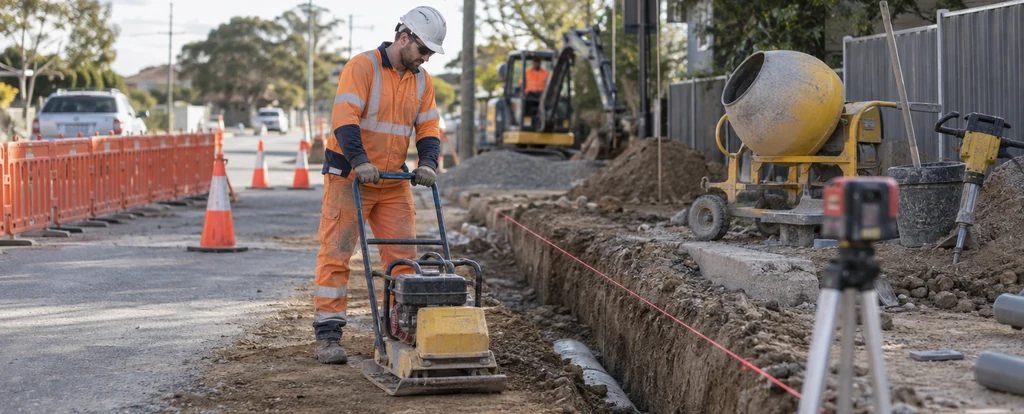
They work outdoors in crews on civil projects such as roads, bridges, subdivisions and water mains, usually for civil contractors, local councils or labour hire firms. The job sits close to a builder's labourer's, but the projects are public infrastructure rather than buildings, so there is more trenching, pipe laying and roadwork and less work inside a structure. A White Card and a driver licence are the usual entry requirements, and most training happens on site.
How much do civil construction labourers earn?
The median full-time salary for a civil construction labourer is $67,600 per annum, before tax, up $14,300 since 2018.
Most labourers are covered by the Building and Construction General On-site Award or by an enterprise agreement on the project, so pay depends on your classification level and the allowances that apply to the site. Overtime, penalty rates and travel or away-from-home allowances can add a lot to a base rate on large or remote jobs, and holding a Certificate III or a machinery competency usually moves you up a level. Casual and labour hire work often pays a loading instead of leave entitlements.
What does a civil construction labourer do day to day?
The list below is what fills most weeks; the exact mix shifts with seniority and whatever stage the current work is at.
- Digging trenches by hand and with machinery, working carefully around water, gas and telecommunications services
- Laying drainage pipes and stormwater lines, then backfilling and compacting the trench
- Using plate compactors, jackhammers, concrete mixers and hand tools to prepare and finish surfaces
- Pouring, spreading and screeding concrete for kerbs, footpaths and driveways
- Setting up traffic control, safety signage and barricades before work starts, then packing down at the end of the day
What skills do civil construction labourers need?
Employers look for hand and power tool work, worksite safety management, plant and equipment operation, backed by Shovel and hand tools fluency and strong physical stamina and dexterity.
Specialist skills
- Hand and power tool work
- Worksite safety management
- Plant and equipment operation
- Reading plans and specifications
- Installation and maintenance
Software and tools
- Shovel and hand tools
- Jackhammer
- Plate compactor
- Concrete mixer
- Laser level
General skills
- Physical stamina and dexterity
- Written communication
Is the job growing?
About 2,000 people work as civil construction labourers in Australia, and employment is projected to grow 6.4% over the decade to 2035. That's modest growth: demand is steady rather than booming.
How do you become a civil construction labourer?
Here's the path most civil construction labourers take, step by step.
- 1Get a White Card
General construction induction training is required before you can set foot on a construction site in any state or territory. It is a one-day course, and in most states you complete it before you start applying for work.
- 2Hold a driver licence
Civil sites are often outside the city or move as a project progresses, so employers ask for a car licence as a minimum. Some roles also want a light truck or heavy vehicle licence.
- 3Apply to civil contractors or labour hire firms
Entry is usually casual and on the job, and labour hire firms are a common way in because they place workers across several projects. At this stage, reliability, fitness and a willingness to learn matter more than formal qualifications.
- 4Add a Certificate II or III in Civil Construction
These are RII qualifications delivered by TAFE and private registered training organisations, often part time while you keep working. A Certificate III supports a higher classification and is usually expected before supervisory roles.
- 5Specialise in machinery or a trade
Most labourers who stay in civil construction gain a machinery competency, such as excavator, roller or skid steer, through a short course and an on-site assessment. That is the step that moves you from labouring into plant operation.
Ready to apply as a civil construction labourer?
Whether you're working toward becoming a civil construction labourer or already are one and want a hand with the next step (sharpening your resume for ATS screening, tightening your cover letter, or knowing what you'll actually be asked at interview), here are examples grounded in this specific role, not generic templates.
What jobs can a civil construction labourer move to?
Moving into Earthmoving Plant Operator typically comes with the biggest pay rise, worth $35,400 a year more on average.
| Move to | Typical pay change | Overlap | Retraining |
|---|---|---|---|
| Earthmoving Plant Operator Civil construction labourers move into earthmoving plant operation using their site experience, with a ticket required to run the machinery.Known move | +$35,400 | 50% | short course |
| Truck Driver Truck driving draws on site loading and transport awareness, but civil labourers need a heavy vehicle licence to move into haulage.Known move | +$34,300 | 4% | reskill |
| Excavator Operator Excavator operators use civil labouring experience of trenches and services, adding a ticket to operate digging plant.Known move | +$31,200 | 55% | short course |
| Roller Operator Roller operation builds on roadwork and compaction experience from civil sites, with a ticket needed to operate the plant. | +$28,600 | 45% | short course |
| Linemarker Linemarking builds on roadwork and site traffic experience, adding line marking and traffic control tickets to work on road surfaces. | +$0 | 78% | short course |
Moves are chosen from Jobs and Skills Australia's Data on Occupation Mobility, which follows income tax records between 2011-12 and 2020-21, together with entry requirements and skill overlap. A known move is one people were seen making in that data. Pay change compares median full-time pay for the two roles.
Who works as a civil construction labourer?
The typical civil construction labourer is 36 years old; 97% are men, 78% work full-time, and full-timers average 44 hours a week.
- 36
- Median age
- 3%
- Female share
- 78%
- Full-time
- +4h
- vs all-jobs avg
What's it like being a civil construction labourer?
The day has a clear rhythm: a pre-start briefing, a task for the shift, and a finish when the concrete is poured or the trench is backfilled. It is physical and weather-dependent work, and the pace lifts around deadlines such as a road reopening or a pour that cannot wait. People who like being outdoors, working with their hands and seeing a finished piece of infrastructure tend to enjoy it, while those who want quiet conditions and predictable hours often do not.
What people like
- You can see what you built. A drainage line, a footpath or a road shoulder is finished by the end of the day, so the result of the work is obvious.
- Every project is a different site. Crews move from a subdivision to a road upgrade to pipe replacement, so the ground, the people and the problems change with each job.
- Clear roles in a small crew. You work alongside the same people each day under a supervisor, with little ambiguity about what your job is.
- A way in without a long qualification. Most labourers start within weeks of getting their White Card and pick up their skills on site rather than in a classroom.
What people find hard
- Weather decides a lot of the day. Heat, rain, mud and dust are part of the job, and work stops when conditions become unsafe.
- Early starts and travel. Sites are often well outside the city and start before 7am, so a long commute is normal and working away from home is common on large projects.
- Hard on the body. Digging, lifting and hours on your feet add up, and back and shoulder strain is a common reason people look to move onto plant.
- Work follows the project pipeline. Hiring rises and falls with the amount of infrastructure work underway, so labouring jobs are often casual and a gap between projects is normal.
Based on our synthesis of professional-body surveys and public accounts of the role, not first-person verified reviews.
Which industries employ civil construction labourers?
Construction employs the largest share of civil construction labourers, followed by Other Services.
Top employing industries
- 1Construction
- 2Other Services
Ranked by employment share; the source doesn't publish an exact percentage per industry.
| Year 12 or below | 58.8% | |
|---|---|---|
| Certificate III/IV | 30.4% | |
| Diploma / Advanced Diploma | 3.4% | |
| Bachelor degree | 2.3% | |
| Postgraduate | 0.3% |
Will AI replace civil construction labourers?
Civil construction labouring has low exposure to AI and automation, because the job is defined by physical work in ground conditions that vary trench by trench, and machines cannot yet dig safely around live services or finish a kerb. Technology is already on site, including GPS machine guidance, laser levels and digital site diaries, but it changes how levels are set and how paperwork is done rather than who does the labouring.
Share of typical working time by exposure level
- Digging trenches and locating servicesHand digging around water, gas and communications lines depends on feel and on reading what the ground is doing, which is why service strikes remain a human risk.35%low
- Operating small plant and power toolsPlate compactors, jackhammers and mixers still need someone to run them and watch the surface as it compacts.25%low
- Placing and finishing concreteLaser screeds and ride-on trowels handle levelling and finishing on large pours, though kerbs, edges and small jobs are still finished by hand.20%moderate
- Reading plans and setting levelsDigital plans, GPS set-out and laser levels have replaced much string-line work, so a labourer is more likely to be checking a screen than a peg.20%moderate
Common questions about becoming a civil construction labourer
Straight answers to the questions people ask most.
How much do civil construction labourers earn?
Civil construction labourers earn a median of $67,600 per year before tax. What you take home depends on your classification under the award or enterprise agreement covering the project, plus allowances for travel, site conditions and working away from home. Overtime and penalty rates add to that when a project is running to a deadline.
How do you become a civil construction labourer?
Get your White Card, hold a driver licence and apply to civil contractors or labour hire firms, because most entry is on the job rather than through a qualification. A Certificate II in Civil Construction (RII20720) helps if you want to specialise later, and machinery competencies usually come after a year or two on site.
Are civil construction labourers in demand?
Civil construction labourers are currently not in shortage, and employment is projected to grow 6.4% over the decade to 2035. Because hiring follows the infrastructure pipeline rather than a steady trend, the practical question is how much road, water and subdivision work is underway near you.
Will AI replace civil construction labourers?
AI and automation have low exposure in this job, because the work happens in ground conditions that change from site to site and needs hands on the tools. GPS machine guidance, laser levels and digital site diaries have changed how levels are set and paperwork is done, but digging, pipe laying and concrete finishing still need people.
What jobs can civil construction labourers move into?
With site experience and a machinery competency, many move into earthmoving plant operation, which pays $35,400 more and uses much of the same site knowledge. Excavator operating is a similar step for people who like trench and service work and pays $31,200 more. Linemarking draws on the same roadwork experience and pays about the same.
How many hours do civil construction labourers work?
Full-time civil construction labourers average 44 hours a week, and overtime is common when a pour, a shutdown or a road reopening is scheduled. Shifts start earlier than most office work, with many crews on site between 6am and 7am.
Related roles
Not sure this is you? Take the career quiz and get a ranked shortlist of roles that fit how you like to work.