Home Manufacturing & Production
Foundry Moulder
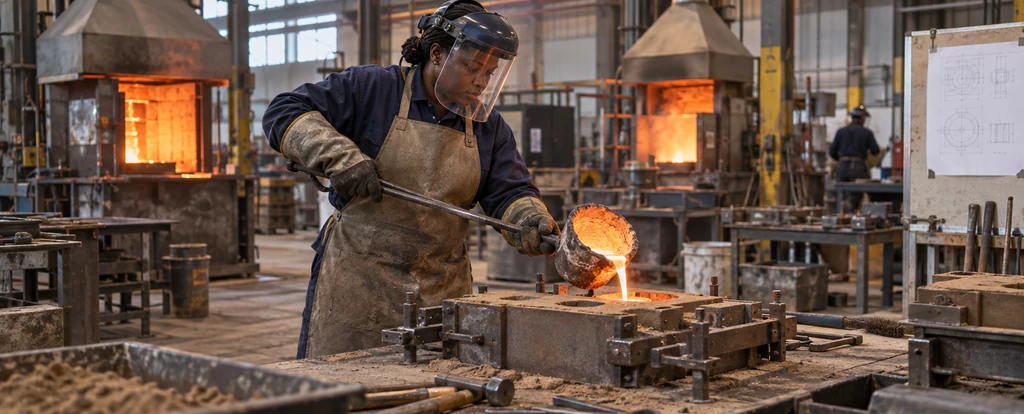
Foundry moulders make sand moulds and pour molten metal into them to cast the metal parts used in mining, transport and construction.
- Median salary*
- $70,200
4.2%vs last year, before tax
- People employed
- 170
15.0%vs last year
- Projected growth
- +4.8%
to 2035
- AI exposure*
- Moderate
- automation risk
- Average hours
- 37/wk
−3h vs all jobs
- Shortage status
- In shortage
national
Foundry moulders work on the foundry floor, preparing sand moulds and cores from patterns, melting and pouring metal, then knocking out, cleaning and inspecting the castings. The patterns they work from are made by patternmakers, while the moulding, pouring and finishing belong to the moulder. Heat, dust and heavy materials are part of the environment, so safety procedures and consistent quality control matter every shift.
How much do foundry moulders earn?
The median full-time salary for a foundry moulder is $70,200 per annum, before tax, up $14,700 since 2018.
Foundry rates are usually set by an enterprise agreement or the manufacturing award, so shift rosters, overtime and hot-work allowances add to the base rate. A completed trade qualification lifts the rate, and foundries casting for mining and heavy industry tend to pay more than those doing general manufacturing work.
What does a foundry moulder do day to day?
The list below is what fills most weeks; the exact mix shifts with seniority and whatever stage the current work is at.
- Ramming sand around a pattern by hand or machine to form the mould cavity
- Setting cores and closing and clamping the mould boxes ready for pouring
- Melting metal in the furnace and pouring it from a ladle at the right temperature
- Knocking out castings, cutting off runners and risers, and grinding the finish
- Checking castings for blowholes, shrinkage and dimensional accuracy against the drawing
What skills do foundry moulders need?
Employers look for hand and power tool work, fabrication and finishing, plant and equipment operation, backed by Moulding boxes and flasks fluency and strong attention to detail.
Specialist skills
- Hand and power tool work
- Fabrication and finishing
- Plant and equipment operation
- Worksite safety management
- Reading plans and specifications
Software and tools
- Moulding boxes and flasks
- Sand mullers and mixers
- Foundry ladles and furnaces
- SOLIDWORKS
- MAGMASOFT
General skills
- Attention to detail
- Problem solving
Is the job growing?
About 170 people work as foundry moulders in Australia, and employment is projected to grow 4.8% over the decade to 2035. That's modest growth: demand is steady rather than booming.
How do you become a foundry moulder?
Here's the path most foundry moulders take, step by step.
- 1Finish Year 10 or Year 12 with maths and a technology subject
Foundry work is learned on the job, but employers look for numeracy and an interest in metalwork. A pre-apprenticeship or school-based trade training is often what gets you an apprenticeship.
- 2Start an apprenticeship in engineering with a casting and moulding focus
The Certificate III covers moulding, melting, casting and finishing, and is delivered through TAFE or a private RTO alongside paid work. It usually takes three to four years.
- 3Learn the trade on the foundry floor
Apprenticeships are paid, and most of the training happens at the moulding bench, the furnace and the finishing area, with block or day release for the theory.
- 4Enter as a foundry labourer or metal trades assistant if no apprenticeship is open
Some people start on knock-out, fettling and material handling, then requalify through an apprenticeship later. Metal trades assistants working on a foundry floor often take this route.
- 5Keep your safety certifications current
Foundries require hot work and confined space training, and a forklift licence or White Card helps with moving moulds and materials. What employers ask for varies by state and by foundry.
Ready to apply as a foundry moulder?
Whether you're working toward becoming a foundry moulder or already are one and want a hand with the next step (sharpening your resume for ATS screening, tightening your cover letter, or knowing what you'll actually be asked at interview), here are examples grounded in this specific role, not generic templates.
What jobs can a foundry moulder move to?
Moving into Metal Machinist typically comes with the biggest pay rise, worth $65,300 a year more on average.
| Move to | Typical pay change | Overlap | Retraining |
|---|---|---|---|
| Metal Machinist Foundry moulders bring metal trade skills and precision, and can retrain to set up and operate machine tools. | +$65,300 | 100% | reskill |
| Fitter and Turner Foundry moulders bring metal fitting and machining awareness, and can retrain to fit, assemble and machine metal components. | +$15,600 | 85% | reskill |
| Engineering Patternmaker Foundry moulders understand pattern and mould design, and can retrain as patternmakers who build the master patterns used in casting. | +$12,000 | 48% | reskill |
| Blacksmith Foundry moulders work with hot metal and can retrain in forging to shape metal by hand and with power hammers. | +$2,600 | 85% | reskill |
| Toolmaker Foundry moulders bring metal casting and finishing knowledge, and can retrain to make precision tools, dies and moulds. | −$5,200 | 61% | reskill |
Moves are chosen from Jobs and Skills Australia's Data on Occupation Mobility, which follows income tax records between 2011-12 and 2020-21, together with entry requirements and skill overlap. A known move is one people were seen making in that data. Pay change compares median full-time pay for the two roles.
Who works as a foundry moulder?
The typical foundry moulder is 52 years old; 97% are men, 89% work full-time, and full-timers average 37 hours a week.
- 52
- Median age
- 3%
- Female share
- 89%
- Full-time
- −3h
- vs all-jobs avg
What's it like being a foundry moulder?
Foundry work runs to production schedules, with heats poured and castings knocked out in batches, so the day has a steady physical rhythm. The pressure sits in getting a pour right the first time, because a mould that fails wastes both the metal and the shift. The work suits someone who likes making something solid and measurable and does not mind heat, noise and shift rosters.
What people like
- You see the finished part. A casting goes from a sand impression to a solid component in a single shift, and you can point to the parts your moulds produced.
- Skills that carry into other metal trades. Reading drawings, working to tolerances and handling hot metal are the same foundations used in patternmaking and machining.
- Variety in what you cast. A foundry might run pump housings one week and wear parts for mining equipment the next, so the moulds and the metal change.
- Hands-on work with clear results. Most of the shift is practical and measurable, and a good casting either passes inspection or it does not.
What people find hard
- Heat and physical load. Mould boxes, sand and finished castings are heavy, and the floor around the furnace and ladle stays hot through the shift.
- Dust, fume and protective equipment. Sand, binders and molten metal mean respirators, face shields and heavy PPE are part of the job rather than optional.
- Location limits your options. Foundries sit in industrial areas rather than city centres, so where you live can decide how far you travel to work.
- Defects that only appear after the pour. A mould that looked sound can still produce shrinkage or blowholes, which means rework and a conversation about what went wrong.
Based on our synthesis of professional-body surveys and public accounts of the role, not first-person verified reviews.
Which industries employ foundry moulders?
Manufacturing employs the largest share of foundry moulders, followed by Mining.
Top employing industries
- 1Manufacturing
- 2Mining
Ranked by employment share; the source doesn't publish an exact percentage per industry.
| Certificate III/IV | 56.8% | |
|---|---|---|
| Year 12 or below | 31.4% | |
| Bachelor degree | 4.1% | |
| Diploma / Advanced Diploma | 3.6% | |
| Postgraduate | 0% |
Will AI replace foundry moulders?
Casting sits at moderate exposure to AI and automation. Design and planning have moved to software, with patterns drawn in CAD and simulation such as MAGMASOFT used to check how metal will fill a mould, which removes some of the trial-and-error pours a foundry used to run. The physical side of the job, ramming sand, pouring from a ladle and fettling castings, is still done by hand on the foundry floor.
Share of typical working time by exposure level
- Mould and core makingRamming sand around a pattern and setting cores depends on feel for sand condition and the pattern in front of you, which software cannot do for you.35%low
- Melting and pouringJudging melt temperature and pouring rate comes from watching the metal and the mould, and the ladle is still handled by a person.25%low
- Fettling and finishingHigh-volume plants use automated knockout and grinding equipment, but cutting off runners and finishing castings by hand is still common in Australian foundries.20%moderate
- Inspection and measurementDimensional checks are shifting towards 3D scanning and other measuring tools, while judging surface defects and shrinkage still relies on an experienced eye.20%moderate
Moves least exposed to AI
These career moves from foundry moulder work are rated low for AI exposure:
- Blacksmith
High skill overlap (85%), reskill to get there, and a low automation-risk profile.
Common questions about becoming a foundry moulder
Straight answers to the questions people ask most.
How much do foundry moulders earn?
Foundry moulders earn a median of $70,200 per annum, before tax. Shift loadings, overtime and a completed trade qualification push individual pay higher, and enterprise agreements in larger foundries set their own rates.
How do you become a foundry moulder?
Most foundry moulders come through an apprenticeship, completing a Certificate III in engineering with a casting and moulding focus over three to four years while working in a foundry. Some start as a foundry labourer or metal trades assistant and take up an apprenticeship later, because the trade is learned on the floor.
Are foundry moulders in demand?
Foundry moulders are currently in shortage nationally, and employment is projected to grow 4.8% over the decade to 2035. It is a small occupation, so it pays to find out which foundries are operating near you and whether they are taking on apprentices.
Will AI or automation replace foundry moulders?
Casting has moderate exposure to automation. Pattern and mould design increasingly happens in CAD and casting simulation software such as MAGMASOFT, which cuts the number of trial pours a foundry needs, but ramming sand, pouring metal and fettling castings are still largely manual work on the floor.
What can foundry moulders move into?
Foundry moulders who know pattern and mould design can move into engineering patternmaking, where pay is $12,000 more, because both roles build the shapes the casting is made from. Another option is toolmaking, at $5,200 less, which uses the same metal casting and finishing knowledge to make precision tools, dies and moulds.
Is foundry moulding hard physical work?
Yes, the work is hot, dusty and physical: mould boxes and castings are heavy, and the floor runs warm near the furnace and ladle. Foundries manage it with mechanical handling, ventilation and protective equipment, and the work is done in a team rather than alone.
Related roles
Not sure this is you? Take the career quiz and get a ranked shortlist of roles that fit how you like to work.