Home Manufacturing & Production
Furniture Finisher
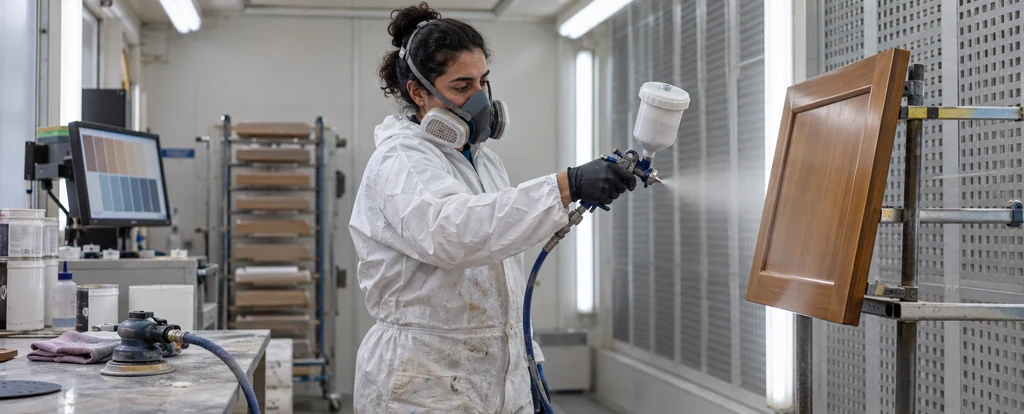
Furniture finishers apply stains, oils, lacquers and polishes to timber furniture, protecting the surface and giving each piece its final appearance.
- Median salary*
- $65,000
4.0%vs last year, before tax
- People employed
- 570
5.0%vs last year
- Projected growth
- +6.1%
to 2035
- AI exposure*
- Moderate
- automation risk
- Average hours
- 42/wk
+2h vs all jobs
- Shortage status
- Not in shortage
national
Furniture finishers work in manufacturing workshops, joinery shops and restoration businesses, preparing and coating timber and composite surfaces. The job sits at the end of the production line, so a piece that leaves the booth looking wrong usually has to be stripped back and redone. Finishing is often confused with cabinet making, but cabinet makers build the piece while finishers decide how it looks and how well it wears.
How much do furniture finishers earn?
The median full-time salary for a furniture finisher is $65,000 per annum, before tax, up $13,500 since 2018.
What you earn depends heavily on the employer and the kind of work: high-end restoration and custom furniture shops generally pay more than volume production lines. Most finishers are covered by a manufacturing award, where shift loadings and overtime add to the base rate, and someone who can run a spray booth or match a difficult colour is worth more to a workshop. Running your own refinishing business is another route, though income then depends on the work you win.
What does a furniture finisher do day to day?
The list below is what fills most weeks; the exact mix shifts with seniority and whatever stage the current work is at.
- Sanding and preparing surfaces by hand and with orbital sanders
- Mixing stains, oils and sealers and matching them to a sample or an existing piece
- Spraying lacquers and topcoats in a booth with an HVLP gun
- Polishing and buffing to the sheen the customer or the specification calls for
- Inspecting finished pieces and touching up runs, sags and dry patches
What skills do furniture finishers need?
Employers look for craft and handmade production, hand and power tool work, plant and equipment operation, backed by HVLP spray gun fluency and strong attention to detail.
Specialist skills
- Craft and handmade production
- Hand and power tool work
- Plant and equipment operation
- Process improvement
Software and tools
- HVLP spray gun
- Orbital sander
- Spray booth
- Moisture meter
- Colour matching system
General skills
- Attention to detail
- Safety and compliance awareness
Is the job growing?
About 570 people work as furniture finishers in Australia, and employment is projected to grow 6.1% over the decade to 2035. That's modest growth: demand is steady rather than booming.
How do you become a furniture finisher?
Here's the path most furniture finishers take, step by step.
- 1Start in a workshop
There is no single entry requirement, and many finishers begin as a trade assistant or general hand, sanding and preparing surfaces before they take on coatings themselves.
- 2Complete a Certificate III in furniture finishing
TAFE and some furniture manufacturers offer the qualification, usually as part of an apprenticeship so you earn while you learn. Around 57% of the people working in the trade hold a certificate III or IV, so it is the credential most workshops recognise.
- 3Learn the spray booth
Spray application is often what separates pay rates: gun setup, film thickness and the way temperature and humidity change a finish take time at the booth to learn.
- 4Settle into a specialty
Finishers tend to specialise in French polishing and restoration, high-end lacquer work or production spraying, and the specialty shapes both the day and the pay.
Ready to apply as a furniture finisher?
Whether you're working toward becoming a furniture finisher or already are one and want a hand with the next step (sharpening your resume for ATS screening, tightening your cover letter, or knowing what you'll actually be asked at interview), here are examples grounded in this specific role, not generic templates.
What jobs can a furniture finisher move to?
Moving into Carpenter typically comes with the biggest pay rise, worth $26,500 a year more on average.
| Move to | Typical pay change | Overlap | Retraining |
|---|---|---|---|
| Carpenter Furniture finishers bring timber knowledge and tool skills, and can move into carpentry after completing a carpentry apprenticeship. | +$26,500 | 14% | requalify |
| Cabinet Maker Furniture finishers bring timber surface knowledge and finishing skills, and can move into cabinet making after completing a cabinet making apprenticeship.Known move | +$7,800 | 29% | requalify |
| Industrial Spray Painter Furniture finishers bring coating and surface preparation skills, moving into industrial spray painting with further training in industrial coatings.Known move | +$6,800 | 35% | reskill |
| Wood Machinist Furniture finishers bring timber knowledge and surface quality awareness, moving into wood machining with reskilling in machine setup and operation. | +$5,200 | 43% | reskill |
| Metal Polisher Furniture finishers bring polishing and surface preparation skills, moving into metal polishing with a short course in metal finishing. | +$0 | 69% | short course |
Moves are chosen from Jobs and Skills Australia's Data on Occupation Mobility, which follows income tax records between 2011-12 and 2020-21, together with entry requirements and skill overlap. A known move is one people were seen making in that data. Pay change compares median full-time pay for the two roles.
Who works as a furniture finisher?
The typical furniture finisher is 45 years old; 89% are men, 74% work full-time, and full-timers average 42 hours a week.
- 45
- Median age
- 11%
- Female share
- 74%
- Full-time
- +2h
- vs all-jobs avg
What's it like being a furniture finisher?
The week runs to the rhythm of drying times rather than meetings: prepare, coat, wait, rub back, coat again. Workshops are usually quiet and focused, but solvents, dust and long stretches at a bench are part of the job, so it suits someone who likes seeing a physical result and does not mind repetition. The pressure comes from deadlines that cannot be hurried, because a coat that is rushed will show.
What people like
- You can see what you have made. A piece leaves the booth transformed, and the difference between raw timber and a finished surface is your work.
- Working with colour and grain. Matching a stain to an existing chair or evening out a blotchy grain takes judgement that a machine cannot supply.
- Variety in restoration and custom work. Repairing a water-damaged table is a different problem from spraying fifty identical chair frames.
- Mostly your own bench. Once a piece is in front of you the work is largely self-directed, with the supervisor checking the finished result rather than every step.
What people find hard
- Fumes and dust. Coatings carry real health risks, so respirators, booth extraction and dust control are part of every shift rather than optional extras.
- Sanding is slow and repetitive. A large share of the week goes into surface preparation, and shortcuts show up later as an uneven finish.
- Rework when a finish fails. A run, a blush or contamination from dust in the air can mean stripping a piece back to bare timber and starting again.
- Drying times set the schedule. Deadlines bunch before a delivery, yet a coat cannot be rushed, so the waiting often runs past the end of a shift.
Based on our synthesis of professional-body surveys and public accounts of the role, not first-person verified reviews.
Which industries employ furniture finishers?
Manufacturing employs the largest share of furniture finishers, followed by Construction.
Top employing industries
- 1Manufacturing
- 2Construction
- 3Other Services
Ranked by employment share; the source doesn't publish an exact percentage per industry.
| Certificate III/IV | 56.7% | |
|---|---|---|
| Year 12 or below | 34.1% | |
| Diploma / Advanced Diploma | 4% | |
| Bachelor degree | 2.8% | |
| Postgraduate | 1.2% |
Will AI replace furniture finishers?
This is a moderately exposed trade. Automated spray lines and robotic coating units handle flat, repetitive parts in larger plants, and colour matching software can suggest a recipe from a sample. Hand preparation, judging how a particular board will take a stain and touching up a flawed finish still rely on a person at the bench, which is what keeps the exposure in the middle.
Share of typical working time by exposure level
- Spraying lacquers and topcoatsAutomated spray lines suit long runs of identical flat parts, while one-off and restoration pieces are still sprayed by hand with an HVLP gun that is set up differently on a humid day.30%moderate
- Sanding and preparing surfacesOrbital sanders speed up flat panels, but contoured edges, veneers and repairs still need hand work and a feel for how much timber is left.25%low
- Inspecting and touching up finished piecesSpotting a run, a dry patch or a blush under workshop lighting and repairing it without stripping the whole surface is judgement built over years.25%low
- Mixing and matching colours and stainsSpectrophotometers and colour matching systems can read a sample and suggest a formula, but two boards of the same species take stain differently and someone still has to adjust the mix.20%moderate
Moves least exposed to AI
These career moves from furniture finisher work are rated low for AI exposure:
- Cabinet Maker
Some skill overlap (29%), requalify to get there, and a low automation-risk profile.
- Carpenter
Some skill overlap (14%), requalify to get there, and a low automation-risk profile.
Common questions about becoming a furniture finisher
Straight answers to the questions people ask most.
How much do furniture finishers earn?
Furniture finishers earn a median of $65,000 per year before tax. That covers full-time workers across production and restoration, so what a particular workshop pays depends on its award, its sector and the skills it needs. Averaged figures hide a wide range, so advertised rates where you are applying are the best check.
How do you become a furniture finisher?
Most people start in a furniture workshop as a trade assistant and pick up sanding, preparation and coating work on the job. A Certificate III in furniture finishing, usually completed as an apprenticeship, is the recognised qualification and the one most workshops look for. Spray booth skills are worth chasing early because they open up better-paid work.
Are furniture finishers in demand?
Furniture finishers are currently not in shortage, and employment is projected to grow 6.1% over the decade to 2035. The occupation is small, with about 570 people in it, so openings tend to come from replacing people who leave rather than from new positions. Local furniture manufacturers and joinery shops are a better gauge of opportunity than the national figure.
Will AI or automation replace furniture finishers?
Automation reaches partway into this work: larger plants already use automated spray lines and robotic finishing for flat, repetitive parts. Hand preparation, colour matching and touch-up still depend on an eye and a feel for the timber, and small workshops are unlikely to automate soon. Expect the equipment around the job to change more than the job itself.
What can furniture finishers move into?
Cabinet making is a common move, since the timber and surface knowledge carries over, and it pays about $7,800 more a year. Metal polishing is the closer skill match at around about the same, with a short course covering the differences in metal finishing. Many experienced finishers instead set up their own restoration or refinishing business, which is often where earnings grow.
Related roles
Not sure this is you? Take the career quiz and get a ranked shortlist of roles that fit how you like to work.