Geology Technician
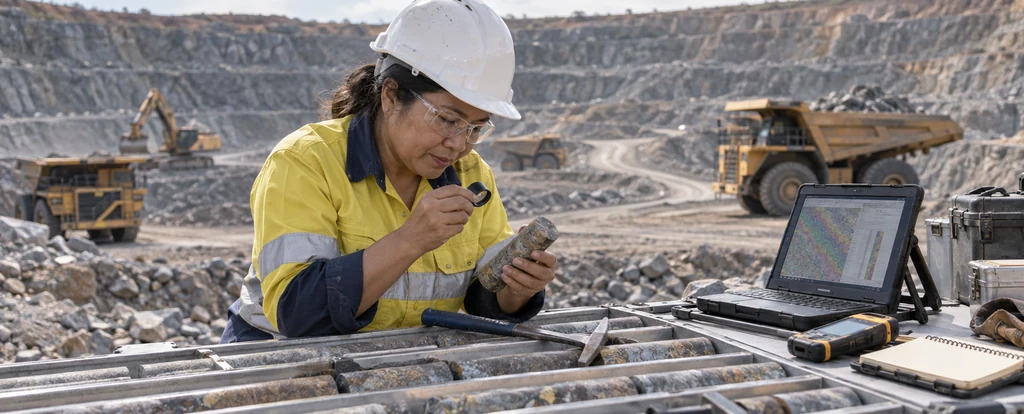
Geology technicians collect and log the rock, soil and drill core samples that tell a mining company what is underground.
- Median salary*
- $96,200
3.7%vs last year, before tax
- People employed
- 1,900
0.0%vs last year
- Projected growth*
- +3%
to 2035
- AI exposure*
- Moderate
- automation risk
- Average hours*
- 42/wk
+2h vs all jobs
- Shortage status*
- In shortage (regional)
national
Geology technicians work on exploration tenements, mine sites and in laboratories, collecting and preparing the samples that geologists interpret. The role sits between the field crew and the geologist: technicians handle the physical sampling and the data behind it, while the geologist interprets it and makes the resource calls. Most work for mining companies, exploration and drilling contractors, and commercial laboratories, and much of it is in remote parts of Western Australia, Queensland and the Northern Territory.
How much do geology technicians earn?
The median full-time salary for a geology technician is $96,200 per annum, before tax, up $19,800 since 2018.
Pay depends heavily on where you work: mine sites and remote rosters pay more than city laboratories, and exploration contractors often add site allowances or project bonuses on top of base rates. Experience matters too, because a technician who can log core unsupervised and run a sampling program without supervision is worth more than one starting out. Enterprise agreements in mining set many of the rates, so the award or agreement covering your employer explains most of the difference.
What does a geology technician do day to day?
The list below is what fills most weeks; the exact mix shifts with seniority and whatever stage the current work is at.
- Collecting rock, soil and drill core samples on exploration programs and mine sites
- Logging drill core and cuttings, recording lithology, alteration and visible mineralisation
- Preparing samples for assay, including crushing, splitting and dispatching them to the laboratory
- Setting up and looking after sampling, survey and field equipment, often in remote camps
- Entering sample and logging data into geological databases and checking it before it reaches the geologist
What skills do geology technicians need?
Employers look for field research and sampling, laboratory analysis, surveying and geospatial work, backed by ArcGIS fluency and strong safety and compliance awareness.
Specialist skills
- Field research and sampling
- Laboratory analysis
- Surveying and geospatial work
- Data analysis
- Plant and equipment operation
Software and tools
- ArcGIS
- QGIS
- Leapfrog Geo
- Microsoft Excel
- ioGAS
General skills
- Safety and compliance awareness
- Attention to detail
Is the job growing?
About 1,900 people work as geology technicians in Australia, and employment is projected to grow 3% over the decade to 2035. That's modest growth: demand is steady rather than booming.
How do you become a geology technician?
Here's the path most geology technicians take, step by step.
- 1Finish Year 12 if you can
Maths and a science subject make the theory in a certificate or diploma easier, though plenty of technicians leave after Year 10 and pick up the geology on the job.
- 2Get a qualification in mining, drilling or geoscience
A certificate III or IV in mining operations, drilling or a related field, or a diploma in geoscience or laboratory technology, covers sampling methods, safety and equipment use. TAFE and private registered training organisations deliver these, and some employers offer traineeships that combine study with paid site work.
- 3Start in a field or laboratory support role
Many people enter as a field assistant, sampler or laboratory assistant and move across once they know the routines. Labour hire and contracting firms are the usual way in for someone with no mining background.
- 4Complete the site and safety requirements
A White Card, a first aid certificate, a manual driver's licence and often a four-wheel drive competency are expected, along with site inductions and a pre-employment medical for remote work.
- 5Decide whether to keep studying
A diploma or degree in geology opens the path to geologist work later, while technicians who stay in the role tend to specialise in core logging, grade control or laboratory analysis.
Ready to apply as a geology technician?
Whether you're working toward becoming a geology technician or already are one and want a hand with the next step (sharpening your resume for ATS screening, tightening your cover letter, or knowing what you'll actually be asked at interview), here are examples grounded in this specific role, not generic templates.
What jobs can a geology technician move to?
Moving into Geologist typically comes with the biggest pay rise, worth $55,300 a year more on average.
| Move to | Typical pay change | Overlap | Retraining |
|---|---|---|---|
| Geologist A geology technician's core logging and sampling experience leads naturally into geologist work, though a geology degree is required. | +$55,300 | 36% | requalify |
| Hydrogeologist Field skills in drilling and groundwater sampling support the move into hydrogeology, but a relevant degree is needed. | +$55,300 | 32% | requalify |
| Geophysicist Geology technicians who read subsurface surveys can move into geophysics, after completing a geophysics degree. | +$55,300 | 32% | requalify |
| Hydrologist Sampling and measurement skills transfer to hydrology, though a degree in hydrology or a related field is required. | +$10,400 | 50% | requalify |
| Hydrographer A geology technician's field measurement and sampling skills suit hydrography, with a diploma providing the needed water measurement training. | +$5,200 | 38% | reskill |
Moves are chosen from Jobs and Skills Australia's Data on Occupation Mobility, which follows income tax records between 2011-12 and 2020-21, together with entry requirements and skill overlap. A known move is one people were seen making in that data. Pay change compares median full-time pay for the two roles.
Who works as a geology technician?
The typical geology technician is 35 years old; 79% are men, 83% work full-time, and full-timers average 42 hours a week.
- 35
- Median age
- 21%
- Female share
- 83%
- Full-time
- +2h
- vs all-jobs avg
What's it like being a geology technician?
The job swings between field campaigns and quieter processing stretches: weeks of early starts, long drives and drilling schedules, then time in a core shed, laboratory or office catching up on data. The pace is set by the drill rig and the exploration program rather than by the technician, which suits people who like a clear routine and don't mind weather. It rewards care over speed, because the value of the work is in samples and records that someone else can trust.
What people like
- Seeing what the drilling found. Core comes up in trays and the mineralisation is either there or it isn't, which is the moment the geologist's model holds or falls over.
- Work that rewards a careful hand. Sample numbers, depths and bag labels have to be right every time, and technicians who are consistently accurate become the people the geologists rely on.
- Blocks of time off with a roster. Site rosters usually run on an even cycle, so weeks in camp are followed by a full week or two at home, which suits some people far better than a standard working week.
- A role you can build a geoscience career from. Technicians see the whole sampling and logging process before they study it, which makes later geology or hydrogeology study easier to connect to the work.
What people find hard
- Remote conditions and long drives. Field campaigns mean heat, dust, rain and hours in a four-wheel drive, and the work carries on whatever the weather because the rig is on a schedule.
- Repetition that cannot be skipped. A large program can run to thousands of samples, and the same careful process applies to each one, because a single mixed-up sample number throws out the assay results.
- Time away from home. Fly-in fly-out rosters mean missing birthdays, sport and ordinary evenings, and the travel days at each end of a swing are long.
- The backlog after the field. When a campaign finishes the data still has to be entered, checked and reported, which often means weeks in an office or laboratory before the next trip.
Based on our synthesis of professional-body surveys and public accounts of the role, not first-person verified reviews.
Which industries employ geology technicians?
Metal Ore Mining employs the largest share of geology technicians, followed by Coal Mining.
Top employing industries
- 1Metal Ore Mining
- 2Coal Mining
- 3Oil and Gas Extraction
- 4Exploration and Mining Support Services
- 5Scientific Research Services
Ranked by employment share; the source doesn't publish an exact percentage per industry.
| Certificate III/IV | 34% | |
|---|---|---|
| Diploma / Advanced Diploma | 26% | |
| Bachelor degree | 20% | |
| Year 12 or below | 20% |
Will AI replace geology technicians?
Geology technician work is moderately exposed: the recording, data entry and reporting side of the job is increasingly handled by logging software and automated validation, while the sampling itself stays physical and site-specific. Tools such as Leapfrog Geo and ioGAS speed up interpretation and quality checks for the geologist, but someone still has to collect the core, split the sample and judge whether it represents the interval. Automated assay systems in commercial laboratories have changed who does the preparation work more than they have removed the need for a technician to monitor it.
Share of typical working time by exposure level
- Field sampling and core loggingChoosing the sample interval, splitting core and logging what you see by hand is physical, ground-level work, and software can record your call but cannot make it for you.35%low
- Sample preparation and laboratory analysisAutomated crushers, splitters and XRF units handle much of the prep and screening, though a technician still loads the runs and watches for contamination between samples.25%moderate
- Data entry and geological databasesField tablets and logging software now populate company databases directly and flag impossible values, cutting the hours once spent retyping sample sheets.25%high
- Surveying, mapping and spatial workDrones, GPS and GIS packages such as ArcGIS and QGIS speed up mapping and volume calculations, but ground control points and checking the output still fall to a technician.15%moderate
Common questions about becoming a geology technician
Straight answers to the questions people ask most.
How much does a geology technician earn?
The median full-time geology technician salary is $96,200 per year before tax. Mine site and remote roster work sits above that figure, while laboratory roles in the cities tend to sit below it, so read it as a midpoint rather than a starting rate.
How do you become a geology technician?
Most people complete a certificate III or IV in mining, drilling or a related field, or a diploma, then start as a field assistant, sampler or laboratory assistant. Site requirements such as a White Card, a first aid certificate and a four-wheel drive competency are usually expected before your first swing, and some employers run traineeships that combine the study with paid work.
Are geology technicians in demand?
Geology technicians are currently in shortage in regional areas, and employment is projected to grow 3% over the decade to 2035. That points to steady work rather than a boom, so it pays to look at which sectors are hiring: mine geology and grade control roles are tied to operating mines, while exploration technician work rises and falls with exploration spending.
Will AI replace geology technicians?
Not the physical side of the job. Logging software, automated assay systems and database validation have taken over much of the recording and checking that used to be manual, but someone still has to collect the core, split the sample and decide whether it is representative, which is why the role is only partly exposed.
What can a geology technician move into?
Geologists earn $55,300 more, but the move needs a geology degree, so most technicians study part-time or take a break to requalify. Hydrography is a shorter step, where field measurement experience transfers and a diploma covers the water-specific training. Laboratory technicians also move the other way, bringing sample preparation skills into geology work through a short course.
Do geology technicians work fly-in fly-out?
Many do, particularly on exploration programs and remote mine sites, where even-time or two-and-one rosters are common. Field technicians typically average 42 hours a week while on roster, and a minority work in city laboratories or corporate offices on standard hours.
Related roles
Not sure this is you? Take the career quiz and get a ranked shortlist of roles that fit how you like to work.