Hydrologist
Hydrologists work out how water moves through catchments, rivers and aquifers, and what that means for floods, water supply and the health of rivers.
- Median salary*
- $106,600
3.9%vs last year, before tax
- People employed
- 990
1.0%vs last year
- Projected growth*
- +6%
to 2035
- AI exposure*
- Moderate
- automation risk
- Average hours*
- 39/wk
−1h vs all jobs
- Shortage status*
- Not in shortage
national
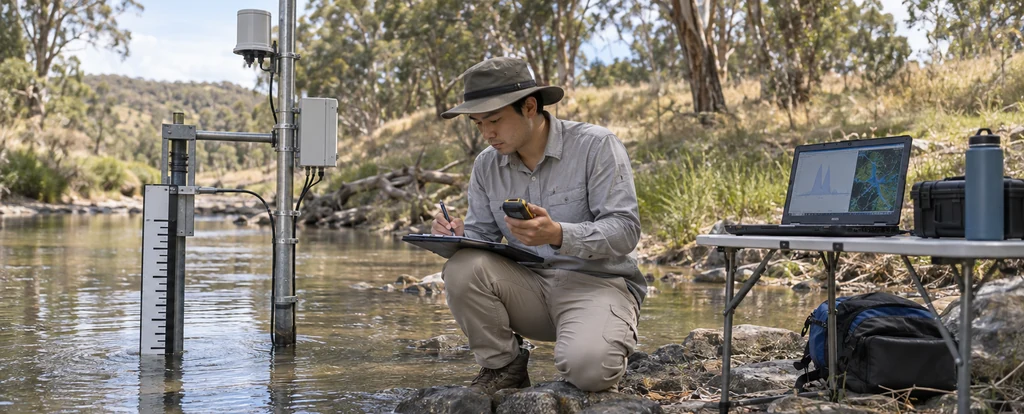
Hydrologists work for government water agencies, utilities, environmental consultancies, mining companies and catchment authorities, and they usually split the week between an office, a model and a gauging station. The job sits beside two easily confused roles: hydrogeologists deal with groundwater, and hydrographers do the hands-on measuring that hydrologists then interpret. Most work in small teams, so a hydrologist is often the water specialist on a project run by engineers or planners.
How much do hydrologists earn?
The median full-time salary for a hydrologist is $106,600 per annum, before tax, up $22,100 since 2018.
Public sector hydrologists are paid on classification scales, with increments tied to experience and sometimes to the scale of projects they lead. Consultancies, utilities and mining companies generally pay more, particularly for flood modelling and dam safety experience, and remote or field-heavy postings often carry allowances on top. Contract and part-time arrangements are common, so pay for the occupation as a whole covers a wide range.
What does a hydrologist do day to day?
The list below is what fills most weeks; the exact mix shifts with seniority and whatever stage the current work is at.
- Collecting and checking streamflow, rainfall and groundwater records
- Building and calibrating hydrological and water resource models
- Assessing flood risk, water availability and environmental flows
- Designing and running field monitoring programs, including gauging stations
- Writing technical reports and advising agencies, utilities and clients on water management
What skills do hydrologists need?
Employers look for data analysis, statistical modelling, environmental assessment, backed by HEC-HMS fluency and strong written communication.
Specialist skills
- Data analysis
- Statistical modelling
- Environmental assessment
- Field research and sampling
- Surveying and geospatial work
- Laboratory analysis
Software and tools
- HEC-HMS
- HEC-RAS
- TUFLOW
- Python
- QGIS
General skills
- Written communication
Is the job growing?
About 990 people work as hydrologists in Australia, and employment is projected to grow 6% over the decade to 2035. That's modest growth: demand is steady rather than booming.
How do you become a hydrologist?
Here's the path most hydrologists take, step by step.
- 1Take a degree in hydrology, environmental science, engineering or earth science
Most hydrologists hold a bachelor degree, usually three or four years full time. Look for a course with water resources, catchment or fluid mechanics subjects rather than a general science degree with one water elective.
- 2Build the maths, statistics and computing side
Modelling is the core of the job, so statistics and a programming language such as Python carry real weight, along with GIS skills that are used almost daily.
- 3Get monitoring or field experience while you study
Casual or cadet work as a hydrographer, or an internship with a water utility, the Bureau of Meteorology or a consultancy, is a common way in and shows you understand how the data is actually collected.
- 4Specialise with honours, a master's or a graduate diploma
About 26% of hydrologists hold a postgraduate qualification. It is often how people move across from engineering, geology or environmental science, or how they add water resource engineering to an existing degree.
- 5Join a professional body and consider chartership
The Australian Water Association and Engineers Australia are the usual professional homes. Hydrologists from an engineering background can work towards chartered status, which some clients expect on flood and dam projects.
Ready to apply as a hydrologist?
Whether you're working toward becoming a hydrologist or already are one and want a hand with the next step (sharpening your resume for ATS screening, tightening your cover letter, or knowing what you'll actually be asked at interview), here are examples grounded in this specific role, not generic templates.
What jobs can a hydrologist move to?
Moving into Hydrogeologist typically comes with the biggest pay rise, worth $44,900 a year more on average.
| Move to | Typical pay change | Overlap | Retraining |
|---|---|---|---|
| Hydrogeologist Hydrologists bring surface water and catchment knowledge to groundwater roles, needing a short course in hydrogeology. | +$44,900 | 50% | short course |
| Geologist Hydrologists apply earth science and water system understanding to geology work, with a short course in geology. | +$44,900 | 57% | short course |
| Agronomist Hydrologists bring water balance and irrigation knowledge to agronomy, though a new qualification in agricultural science is needed. | +$1,200 | 62% | requalify |
| Soil Scientist Hydrologists bring catchment water and land interaction knowledge to soil science, though a new qualification is needed. | −$10,400 | 76% | requalify |
Moves are chosen from Jobs and Skills Australia's Data on Occupation Mobility, which follows income tax records between 2011-12 and 2020-21, together with entry requirements and skill overlap. A known move is one people were seen making in that data. Pay change compares median full-time pay for the two roles.
Who works as a hydrologist?
The typical hydrologist is 42 years old; 70% are men, 81% work full-time, and full-timers average 39 hours a week.
- 42
- Median age
- 30%
- Female share
- 81%
- Full-time
- −1h
- vs all-jobs avg
What's it like being a hydrologist?
The work alternates between field campaigns and long stretches at a desk, and the desk half grows as you gain experience. Flood season and drought both bring surges, because the questions people ask change quickly when a river is rising or a supply is running down. It suits people who like quantitative work but want it tied to something physical, and who are comfortable explaining uncertainty to people who need a decision.
What people like
- You see the water you are modelling. Gauging a stream or walking a floodplain shows you where the numbers come from, which makes a model much easier to trust or challenge.
- The results feed public decisions. Flood maps, water sharing plans and dam releases affect real places, and your analysis is often the evidence behind the choice.
- The problems are genuinely hard. Catchments behave differently at every scale, so calibrating a model against a long record is a puzzle with an answer you can test.
- The work moves across sites and clients. Consultants in particular shift between catchments, industries and states, so the technical problems and the people you deal with keep changing.
What people find hard
- Fieldwork runs on the weather. Gauging a river in flood is when the data matters most and when the work is hardest, and remote sites mean long trips away from home.
- Models are limited by their records. Short or broken gauge records leave genuine uncertainty, and explaining that honestly to a council or a client is part of the job rather than an optional extra.
- Funding comes in cycles. Government water programs and mining investment both drive demand, so consultancies and agencies staff up around funded projects and contract work is common early in a career.
- The advice can be overruled. Water allocation is political, and a well-argued technical recommendation sometimes loses to a decision made somewhere else in the system.
Based on our synthesis of professional-body surveys and public accounts of the role, not first-person verified reviews.
Which industries employ hydrologists?
Professional, scientific and technical services employs the largest share of hydrologists, followed by Water supply, sewerage and drainage services.
Top employing industries
- 1Professional, scientific and technical services
- 2Water supply, sewerage and drainage services
- 3Government administration
- 4Agriculture, forestry and fishing
- 5Mining
Ranked by employment share; the source doesn't publish an exact percentage per industry.
| Bachelor degree | 52% | |
|---|---|---|
| Postgraduate | 26% | |
| Diploma / Advanced Diploma | 13% | |
| Other | 9% |
Will AI replace hydrologists?
Hydrology sits in the middle of the range: the data processing, model runs and report drafting that fill much of the week are increasingly assisted by software, while field measurement and the judgement calls behind a flood study or a water sharing plan are not. Automated quality checks and faster scenario modelling change how quickly a study can be completed, but someone still has to decide what the catchment is doing and defend that reading.
Share of typical working time by exposure level
- Model building and calibrationSoftware such as HEC-RAS and TUFLOW runs scenarios far faster than it used to, but choosing parameters and judging whether the model reflects the real catchment stays with the hydrologist.30%moderate
- Field measurement and gaugingInstalling and maintaining gauging stations, wading in to take a flow reading and checking a site after a flood are physical jobs that depend on being there.25%low
- Data cleaning and quality controlScripts and machine learning now flag suspect readings across years of records, though someone still has to check a suspicious spike against what happened at the site that day.25%high
- Reporting and advice to agencies and clientsDraft text and standard sections can be generated, but the interpretation in a flood study or a water supply assessment is what a council or utility is paying for.20%moderate
Common questions about becoming a hydrologist
Straight answers to the questions people ask most.
How much do hydrologists earn?
Full-time hydrologists earn a median of $106,600 per year before tax. Public sector roles follow classification scales, while consultancies, utilities and mining companies tend to pay more for specialist flood and water resource modelling experience.
How do you become a hydrologist?
Most hydrologists start with a bachelor degree in hydrology, environmental science, engineering or earth science, then build the statistics and programming skills the modelling work needs. Field or hydrography experience while you study is a common way in, and a postgraduate qualification helps if you are moving across from another discipline.
Are hydrologists in demand in Australia?
Hydrologists are currently not in shortage, and employment is projected to grow 6% over the decade to 2035. With about 990 people in the occupation, openings also come from retirements and from people moving into related scientific roles, so new positions are only part of where the work comes from.
Will AI replace hydrologists?
AI is changing the modelling and data work rather than replacing the role. Machine learning now flags suspect gauge readings and speeds up scenario runs, but choosing parameters, judging whether a model reflects the catchment and advising on a water decision still rest with the hydrologist.
What can hydrologists move into?
Hydrologists who retrain into hydrogeology or geology need only a short course, and those roles pay $44,900 more. Hydrographers come the other way with minimal retraining, and geology technicians can follow a degree. Experienced hydrologists also build consulting practices of their own, which is often where earnings grow.
Is hydrology the same as hydrogeology?
They are different subjects. Hydrology covers surface water, meaning rainfall, rivers, catchments and floods, while hydrogeology deals with groundwater and the rocks that hold it. Many hydrologists cross into groundwater work after a short course in hydrogeology.
Related roles
Not sure this is you? Take the career quiz and get a ranked shortlist of roles that fit how you like to work.