Jeweller
Jewellers make and repair rings, pendants, chains and other pieces, working precious metals and setting gemstones by hand at a bench.
- Median salary*
- $59,800
3.8%vs last year, before tax
- People employed
- 4,100
0.0%vs last year
- Projected growth
- +14%
to 2035
- AI exposure*
- Low
- automation risk
- Average hours
- 43/wk
+3h vs all jobs
- Shortage status
- In shortage
national
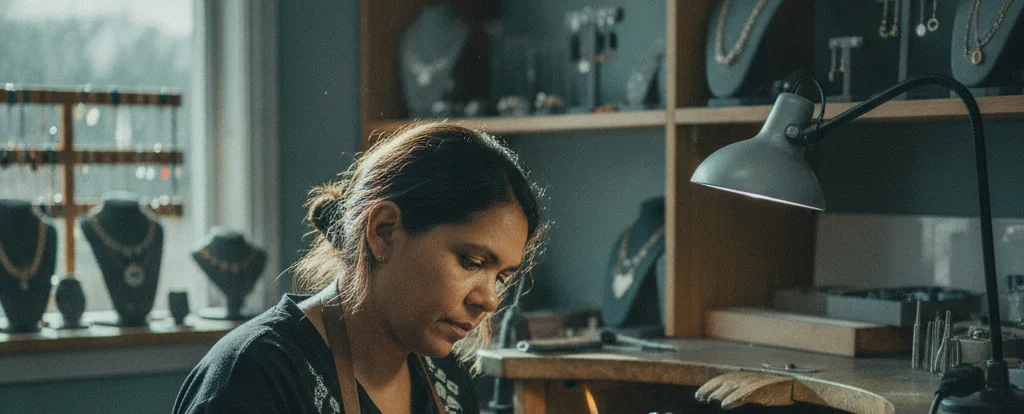
Most jewellers work at a bench in a retail workshop out the back of a shop, in a manufacturing studio, or in a small business they run themselves. The trade covers fabrication, stone setting and restoration, and many jewellers do all three, which is what separates them from a jewellery designer, who may draw a piece that someone else makes. Retail shops keep a jeweller on hand for resizing, repairs and custom work, so the role usually sits close to the customer and their deadlines.
How much do jewellers earn?
The median full-time salary for a jeweller is $59,800 per annum, before tax, up $12,400 since 2018.
What you earn depends on whether you hold a trade qualification and what kind of bench you work at, since manufacturing workshops and jewellers running their own studio tend to pay better than a counter role in a retail shop. Apprentices are paid a training wage set by the award, so the first few years are modest while you build the skills that lift your rate later. Custom commissions can add to your earnings once you price your own work and carry the cost of metal and stones yourself.
What does a jeweller do day to day?
The list below is what fills most weeks; the exact mix shifts with seniority and whatever stage the current work is at.
- Sawing, filing and soldering metal at the bench to take a piece from sketch to solid form
- Setting stones under a loupe, where a slipped burr or a fraction of a millimetre can spoil the piece
- Resizing rings, re-tipping worn prongs and rebuilding clasps on jewellery that is often irreplaceable to its owner
- Polishing and finishing by hand to reach a mirror surface without rounding off sharp design lines
- Quoting repairs and custom commissions, then explaining the trade-offs in metal, stone and cost to the customer
What skills do jewellers need?
Employers look for craft and handmade production, visual design, creative software production, backed by Jeweller's lathe fluency and strong attention to detail.
Specialist skills
- Craft and handmade production
- Visual design
- Creative software production
Software and tools
- Jeweller's lathe
- Soldering torch
- Gemstone setting burrs
- CAD jewellery design software
- Polishing compounds and buffing wheels
General skills
- Attention to detail
- Problem solving
- Client relationships and advisory
- Written communication
Is the job growing?
About 4,100 people work as jewellers in Australia, and employment is projected to grow 14% over the decade to 2035. That's healthy, above-average growth, and the role should stay in solid demand.
How do you become a jeweller?
Here's the path most jewellers take, step by step.
- 1Start a jewellery apprenticeship
The standard route is a Certificate III in Jewellery Manufacture (MEM30619), usually completed over about four years as a paid Australian apprenticeship that combines supervised bench work with TAFE study. You earn while you learn, and the qualification is what most employers mean when they ask for a trade qualified jeweller.
- 2Test the work before you commit
Short courses and night classes in silversmithing or basic jewellery making at a TAFE or community workshop let you find out whether you enjoy the bench before signing up for years of training. They also give you something to show a prospective employer, since apprenticeship places are often filled through contacts rather than advertised.
- 3Add stone and software skills
A gemmology qualification, such as the diploma offered by the Gemmological Association of Australia, helps if you want to buy, sell or assess stones. Learning CAD jewellery design software is worth adding too, because custom commissions are increasingly modelled on screen and grown in wax before casting.
- 4Choose your bench
Once qualified, you can work in a retail workshop doing repairs and resizing, in a manufacturing studio producing ranges, or on your own account. Many jewellers eventually set up their own studio after building a customer base, which is often where earnings grow.
Ready to apply as a jeweller?
Whether you're working toward becoming a jeweller or already are one and want a hand with the next step (sharpening your resume for ATS screening, tightening your cover letter, or knowing what you'll actually be asked at interview), here are examples grounded in this specific role, not generic templates.
What jobs can a jeweller move to?
Moving into Store Manager typically comes with the biggest pay rise, worth $24,400 a year more on average.
| Move to | Typical pay change | Overlap | Retraining |
|---|---|---|---|
| Store Manager Jewellers moving into retail management bring product knowledge and sales experience, though the role requires broader staff and stock management skills.Known move | +$24,400 | 4% | reskill |
| Jewellery Designer Jewellers bring bench skills in metalwork and gem setting, moving naturally into jewellery design with little extra training.Known move | +$10,400 | 75% | minimal |
| Engraver Jewellers already work with fine metal and hand tools, so moving into engraving builds on those skills with additional engraving technique. | +$5,200 | 50% | short course |
Moves are chosen from Jobs and Skills Australia's Data on Occupation Mobility, which follows income tax records between 2011-12 and 2020-21, together with entry requirements and skill overlap. A known move is one people were seen making in that data. Pay change compares median full-time pay for the two roles.
Who works as a jeweller?
The typical jeweller is 55 years old; 61% are men, 60% work full-time, and full-timers average 43 hours a week.
- 55
- Median age
- 39%
- Female share
- 60%
- Full-time
- +3h
- vs all-jobs avg
What's it like being a jeweller?
The work is quiet, precise and hands on, with most of the day spent standing or seated at a bench under good light. Repair work arrives in waves, and the run up to Christmas and Valentine's Day is the busiest stretch of the year, with custom commissions promised for a fixed date. It suits people who like solving problems with their hands and are content to work slowly and accurately rather than quickly.
What people like
- Your work goes out into someone's life. An engagement ring or a repaired heirloom leaves the bench and is worn for decades, and customers often remember the person who made or fixed it.
- The bench rewards concentration. Fabrication, setting and restoration each need a different kind of attention, and a tricky setting or a rebuild of a fragile clasp is satisfying work to get right.
- No two repairs are the same. You might resize a ring in the morning, set a stone after lunch and rebuild a broken chain in the afternoon, so the day rarely settles into one task.
- You can build your own practice. Jewellers who develop a customer base and a recognisable style can move from wage work into their own studio, where custom commissions and repeat clients carry the income.
What people find hard
- Repetition comes with the trade. Ring resizing, chain repairs and prong re-tipping make up a large share of retail bench work, and the same job done many times in a week can wear thin.
- One slip can cost hours. A burr that skates across a stone or a torch that overheats a thin section can undo an afternoon's work, and some pieces cannot be replaced if they are damaged.
- Pay lags the training. Four years of apprenticeship and a skill set that takes years to build do not automatically translate into high earnings, particularly in retail workshop roles.
- Deadlines bunch up before the holidays. Custom work promised for Christmas or Valentine's Day arrives at the same time every year, and late changes from customers land in the busiest weeks.
Based on our synthesis of professional-body surveys and public accounts of the role, not first-person verified reviews.
Which industries employ jewellers?
Manufacturing employs the largest share of jewellers, followed by Retail Trade.
Top employing industries
- 1Manufacturing
- 2Retail Trade
- 3Professional, Scientific and Technical Services
Ranked by employment share; the source doesn't publish an exact percentage per industry.
| Certificate III/IV | 37% | |
|---|---|---|
| Year 12 or below | 26.2% | |
| Bachelor degree | 14.8% | |
| Diploma / Advanced Diploma | 13.5% | |
| Postgraduate | 3.3% |
Will AI replace jewellers?
This is a low-exposure trade, because the value sits in hand skills that machines cannot yet reproduce: sawing and soldering to a fraction of a millimetre, setting a stone without chipping it, and judging how much metal a worn prong can take. CAD jewellery design software and 3D-printed wax patterns have changed how custom pieces are modelled and cast, and they speed up quoting and repeat production, but the finishing, setting and restoration at the bench remain manual.
Share of typical working time by exposure level
- Hand fabrication at the benchSawing, filing and soldering a piece from sheet and wire depends on feel and torch control that no current tool replicates.35%low
- Repairs and restorationResizing a ring or rebuilding a fragile antique clasp means judging how much heat and pressure an old piece will take.30%low
- Stone setting and gemstone workCutting a seat for a stone and tightening a claw without chipping it is done by hand under a loupe.20%low
- Design consults, quoting and CAD modelsCAD software and rendered images make custom design proposals quicker to produce and revise, which is the part of the job AI tools touch most.15%moderate
Common questions about becoming a jeweller
Straight answers to the questions people ask most.
How much does a jeweller earn in Australia?
The median full-time pay is $59,800 per annum, before tax. Where you sit against that depends on your qualification, the type of bench you work at and whether you take custom commissions on your own account, so treat the figure as a broad midpoint rather than a starting rate.
How do you become a jeweller in Australia?
The usual route is a Certificate III in Jewellery Manufacture (MEM30619), completed through a paid apprenticeship of about four years that mixes bench work with TAFE study. Apprenticeship places are often filled through industry contacts, so short courses and a small portfolio help you get a start.
Are jewellers in demand in Australia?
Jewellers are currently in shortage nationally, and employment is projected to grow 14% over the decade to 2035. The trade is small, with about 4,100 people working in it, so openings tend to come from retirements and from employers who cannot find someone with the right bench skills.
Will AI replace jewellers?
AI has limited reach into this trade, because the core work is manual. CAD jewellery design software and 3D-printed wax patterns have changed how custom pieces are modelled and cast, and online tools can help with quoting and stock, but setting a stone, soldering a joint and finishing a surface still depend on a trained hand.
What can a jeweller move into?
Jewellers often move into jewellery design, where bench skills transfer directly and pay is $10,400 more. Others take up engraving, which builds on fine metalwork and hand tool control, or move into retail management, which pays $24,400 more but needs broader staff and stock experience. Running your own studio is the other common path and is often where earnings grow.
Do you need a licence to work as a jeweller?
No licence is required to work at a bench in Australia, but you need a trade qualification to be recognised as a jeweller, and apprenticeships are the way most people get one. If you handle valuations or buy and sell gemstones, specialist gemmology training is worth holding.
Related roles
Not sure this is you? Take the career quiz and get a ranked shortlist of roles that fit how you like to work.