Neurophysiology Scientist
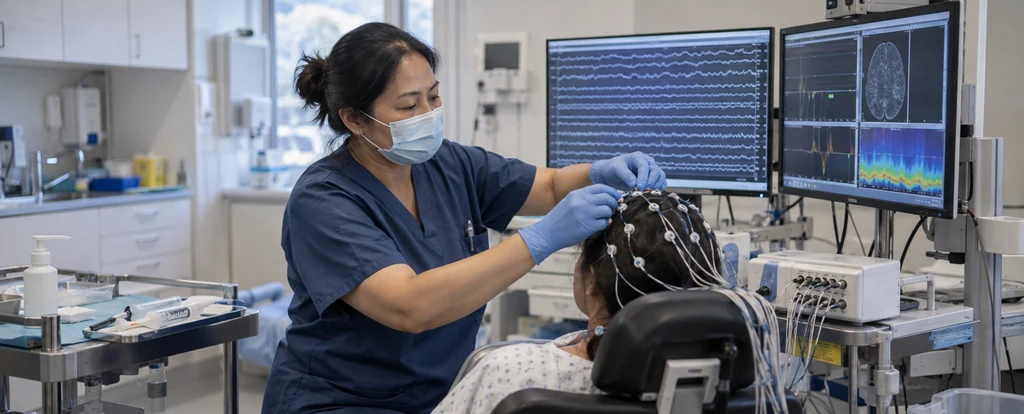
Neurophysiology scientists record the electrical activity of the brain and nerves, and the traces they capture are what neurologists use to diagnose epilepsy, nerve damage and other neurological conditions.
- Median salary*
- $101,400
3.8%vs last year, before tax
- People employed
- 230
15.0%vs last year
- Projected growth*
- +8%
to 2035
- AI exposure*
- Moderate
- automation risk
- Average hours*
- 38/wk
−2h vs all jobs
- Shortage status*
- In shortage
national
Neurophysiology scientists work in hospital neurology and clinical neurophysiology departments, with some in private practices, specialist medical services and research settings. They prepare the patient, run the recording equipment, watch the trace as it comes in and hand the findings to the neurologist who makes the diagnosis. The field is small, with about 230 people working as neurophysiology scientists in Australia, so most teams are a handful of scientists supporting a neurology service.
How much do neurophysiology scientists earn?
The median full-time salary for a neurophysiology scientist is $101,400 per annum, before tax, up $21,000 since 2018.
Most neurophysiology scientists work in public hospitals, so pay follows the state health award that covers medical scientists and rises with your classification level. On-call and after-hours work attracts penalty rates, and intraoperative monitoring or a senior scientist role usually sits higher on the scale. Private practices and research services set their own rates, which can sit above or below the hospital equivalent.
What does a neurophysiology scientist do day to day?
The list below is what fills most weeks; the exact mix shifts with seniority and whatever stage the current work is at.
- Applying electrodes and preparing patients for EEG, nerve conduction studies and evoked potential tests
- Operating EEG, EMG and evoked potential systems to record brain and nerve activity
- Watching recordings as they happen and picking out artefact, seizure activity and other abnormal patterns
- Monitoring nerve function during surgery alongside the neurologist and anaesthetist
- Checking and cleaning equipment, writing up results and following infection control procedures
What skills do neurophysiology scientists need?
Employers look for patient care and support, clinical assessment and treatment, data analysis, backed by Natus NeuroWorks fluency and strong attention to detail.
Specialist skills
- Patient care and support
- Clinical assessment and treatment
- Data analysis
- Plant and equipment operation
Software and tools
- Natus NeuroWorks
- Nihon Kohden EEG systems
- Cadwell EMG systems
- Epic
- Medtronic evoked potential systems
General skills
- Attention to detail
- Written communication
- Problem solving
Is the job growing?
About 230 people work as neurophysiology scientists in Australia, and employment is projected to grow 8% over the decade to 2035. That's modest growth: demand is steady rather than booming.
How do you become a neurophysiology scientist?
Here's the path most neurophysiology scientists take, step by step.
- 1Start with a science or health degree
A bachelor degree in science, biomedical science or a related field, with physiology and anatomy subjects, is the usual starting point. The most common qualification in the workforce is a Bachelor degree, held by 52% of neurophysiology scientists.
- 2Add postgraduate study in clinical neurophysiology
A graduate diploma or masters in clinical neurophysiology covers EEG, nerve conduction studies and evoked potentials, and includes supervised clinical placements. Postgraduate qualifications are held by 26% of the current workforce, and the study is usually done while you are already working in a hospital department.
- 3Complete supervised training in a hospital department
Training positions sit in hospital neurophysiology departments and are accredited through the Australian and New Zealand Association of Neurologists (ANZAN). You build competence across the test types over roughly two years of supervised work, and these places are limited because the occupation itself is small.
- 4Work toward certification and specialise
Certification with the professional body confirms you can work unsupervised across EEG, nerve conduction and evoked potential testing, and competency requirements vary between states and employers. From there, many scientists specialise in intraoperative monitoring, paediatric EEG or long-term epilepsy monitoring.
Ready to apply as a neurophysiology scientist?
Whether you're working toward becoming a neurophysiology scientist or already are one and want a hand with the next step (sharpening your resume for ATS screening, tightening your cover letter, or knowing what you'll actually be asked at interview), here are examples grounded in this specific role, not generic templates.
What jobs can a neurophysiology scientist move to?
Moving into Perfusionist typically comes with the biggest pay rise, worth $36,400 a year more on average.
| Move to | Typical pay change | Overlap | Retraining |
|---|---|---|---|
| Perfusionist Neurophysiology scientists can move into perfusion, applying their understanding of physiology and monitoring, though a specialist qualification is required. | +$36,400 | 38% | reskill |
| Medical Laboratory Scientist The lab science background and analytical skills carry over, but a qualification in medical laboratory science is needed to work across pathology disciplines. | +$5,500 | 43% | reskill |
| Respiratory and Sleep Scientist Neurophysiology scientists bring expertise in diagnostic testing of brain and nerve function, which transfers to sleep and respiratory studies with minimal additional training. | −$6,800 | 52% | short course |
Moves are chosen from Jobs and Skills Australia's Data on Occupation Mobility, which follows income tax records between 2011-12 and 2020-21, together with entry requirements and skill overlap. A known move is one people were seen making in that data. Pay change compares median full-time pay for the two roles.
Who works as a neurophysiology scientist?
The typical neurophysiology scientist is 40 years old; 62% are women, 72% work full-time, and full-timers average 38 hours a week.
- 40
- Median age
- 62%
- Female share
- 72%
- Full-time
- −2h
- vs all-jobs avg
What's it like being a neurophysiology scientist?
The work runs on booked appointments and theatre lists, with long stretches of careful set-up and watching a screen. The pressure arrives when a patient is unwell, when a trace is noisy, or when a surgeon is waiting on your monitoring mid-operation. It suits people who like detail and equipment, and who are comfortable sitting with patients who are often anxious or unwell.
What people like
- Catching the answer on the trace. A routine EEG that captures a seizure discharge can explain months of blackouts, and you are the person who recorded it.
- Getting to know the equipment properly. You work with the same EEG, EMG and evoked potential systems every day, so you learn how to pull a clean signal out of a difficult patient.
- Working next to neurologists. You are in the room for the interpretation as it happens, which builds your understanding of neurology quickly.
- Range across patients and settings. A week can take you from a newborn EEG to nerve conduction studies in an outpatient clinic to monitoring a spinal operation.
What people find hard
- A very small field. About 230 people work in the role nationally, and openings are concentrated in hospital neurophysiology departments, so positions come up when someone leaves or a service expands.
- Fiddly, uncomfortable set-up work. Electrodes have to sit against clean skin, which means gel, paste and light abrasion, and patients with long or styled hair do not always enjoy the process.
- Traces that will not stay clean. Movement, sweat and interference from other equipment all get into the recording, and working out what is real can take patience.
- On-call and theatre standby. Many departments roster scientists for urgent EEGs after hours, and intraoperative monitoring can mean standing in theatre for hours with little conversation.
Based on our synthesis of professional-body surveys and public accounts of the role, not first-person verified reviews.
Which industries employ neurophysiology scientists?
Hospitals employs the largest share of neurophysiology scientists, followed by Specialist medical services.
Top employing industries
- 1Hospitals
- 2Specialist medical services
- 3Medical and diagnostic laboratories
- 4Scientific research services
- 5Health care and social assistance
Ranked by employment share; the source doesn't publish an exact percentage per industry.
| Bachelor degree | 52% | |
|---|---|---|
| Postgraduate | 26% | |
| Diploma / Advanced Diploma | 13% | |
| Other | 9% |
Will AI replace neurophysiology scientists?
This job sits in the middle for AI exposure. Machine learning is already used to flag seizures and other events in long EEG recordings, and reporting software drafts much of the documentation, which speeds up the routine parts of the week. What keeps the exposure from being higher is the hands-on side: getting a usable signal from an unwell or restless patient, and adjusting the recording as it happens, still depends on a scientist at the bedside.
Share of typical working time by exposure level
- Applying electrodes and preparing patientsSkin preparation, paste and electrode placement change with a patient's hair, scalp and tolerance, and a good set-up is what makes the rest of the trace readable.30%low
- Recording routine EEGs and nerve conduction studiesSoftware handles impedance checks and preset montages, but you still watch the trace live and decide whether to repeat a stimulus or ask the patient to hyperventilate.25%moderate
- Writing up results and keeping recordsReport templates and speech-to-text drafting already carry much of the documentation load, though the interpretation and sign-off stay with the scientist and the neurologist.25%high
- Monitoring nerve function during surgeryEvoked potential monitoring in theatre means reading a changing trace in real time and telling the surgeon or anaesthetist immediately if a signal drops.20%low
Moves least exposed to AI
These career moves from neurophysiology scientist work are rated low for AI exposure:
- Perfusionist
Some skill overlap (38%), reskill to get there, and a low automation-risk profile.
Common questions about becoming a neurophysiology scientist
Straight answers to the questions people ask most.
How much do neurophysiology scientists earn?
Neurophysiology scientists earn $101,400 per year before tax. Public hospital scientists are paid under state health awards, so your figure moves with your classification level, on-call and penalty rates, and whether you take on intraoperative monitoring or a senior scientist role.
How do you become a neurophysiology scientist?
Start with a science or health degree, then complete postgraduate study and supervised hospital training in clinical neurophysiology. Most training positions sit in public hospital neurophysiology departments, so entry is competitive and you may need to wait for a place to open.
Are neurophysiology scientists in demand?
Neurophysiology scientists are currently in shortage nationally, and employment is projected to grow 8% over the decade to 2035. The occupation is small, so a few new or vacated hospital positions shift the numbers noticeably, and training places are limited.
Will AI replace neurophysiology scientists?
Not in the near term. Algorithms are already good at flagging candidate seizures and spikes in a long EEG, but a scientist still judges what is artefact, adjusts the recording as it runs and decides what to do next. Documentation and report drafting are where automation does most of the work.
What can neurophysiology scientists move into?
A respiratory and sleep scientist runs similar diagnostic testing on a different body system, and moving across takes a short course; pay is $6,800 less. Moving into perfusion builds on the same physiology but needs a specialist qualification, and pays $36,400 more. Medical laboratory scientist also means reskilling, since pathology disciplines sit outside nerve and brain testing.
What are the hours like?
Full-time neurophysiology scientists average about 38 hours a week, mostly in booked clinics and theatre lists during the day. Many departments also run an on-call roster for urgent EEGs, so some after-hours work is expected.
Related roles
- Respiratory and Sleep Scientist
- Medical Laboratory Scientist
- Perfusionist
- Respiratory and Sleep Scientist
- Medical Laboratory Scientist
- Sonographer
Not sure this is you? Take the career quiz and get a ranked shortlist of roles that fit how you like to work.