Nuclear Medicine Technologist
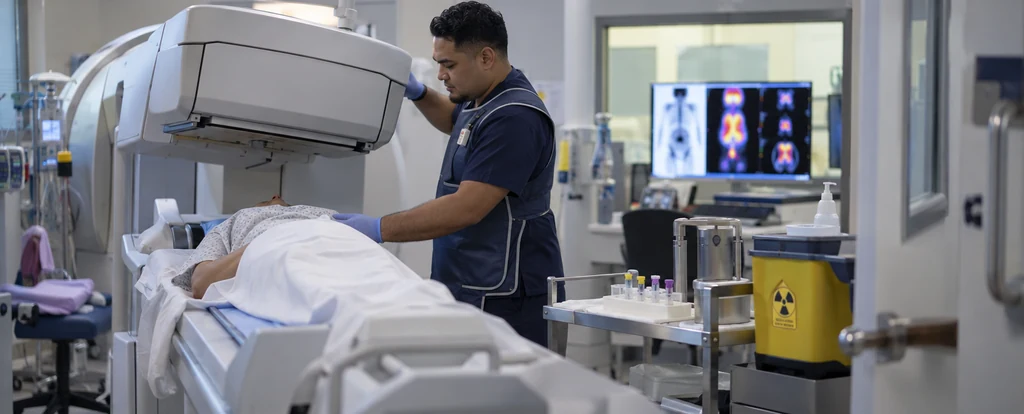
Nuclear medicine technologists prepare radioactive tracers and run the gamma camera and PET scans that show how a patient's organs are working.
- Median salary*
- $106,600
4.1%vs last year, before tax
- People employed
- 830
3.8%vs last year
- Projected growth
- +33.1%
to 2035
- AI exposure*
- Moderate
- automation risk
- Average hours
- 40/wk
matches all-jobs average
- Shortage status
- In shortage
national
Nuclear medicine technologists work in hospital nuclear medicine departments, private imaging practices and a small number of research and radiopharmacy facilities. Their scans show function rather than structure, which is what separates the role from radiography: a radiographer images anatomy, while a nuclear medicine technologist watches how an organ takes up a tracer. Registration with the Medical Radiation Practice Board of Australia through AHPRA is required to practise.
How much do nuclear medicine technologists earn?
The median full-time salary for a nuclear medicine technologist is $106,600 per annum, before tax, up $22,300 since 2018.
In public hospitals, pay follows the state or territory enterprise agreement for medical radiation practitioners, so your classification level and years of experience set the base rate. Shift loadings, on-call allowances and weekend penalties add to it, and private imaging practices set their own rates. Moving into a senior or chief technologist position is the main way the base rate rises.
What does a nuclear medicine technologist do day to day?
The list below is what fills most weeks; the exact mix shifts with seniority and whatever stage the current work is at.
- Preparing and drawing up radiopharmaceutical doses and checking the activity level before each patient
- Positioning patients on the gamma camera or PET scanner and staying with them through a scan that can run for an hour
- Operating hybrid equipment such as SPECT/CT and PET/CT and adjusting the acquisition settings for each study
- Reconstructing and processing images, measuring tracer uptake and passing the results to the nuclear medicine physician
- Handling radioactive materials and waste, monitoring personal dose with a dosimeter and keeping the department's radiation records
What skills do nuclear medicine technologists need?
Employers look for patient care and support, clinical assessment and treatment, infection control and hygiene, backed by Siemens syngo.via fluency and strong attention to detail.
Specialist skills
- Patient care and support
- Clinical assessment and treatment
- Infection control and hygiene
- Health education and advice
Software and tools
- Siemens syngo.via
- GE HealthCare Xeleris
- Hermes Medical Solutions
- MIM Software
- PACS and RIS systems
General skills
- Attention to detail
- Written communication
- Problem solving
- Digital literacy
Is the job growing?
About 830 people work as nuclear medicine technologists in Australia, and employment is projected to grow 33.1% over the decade to 2035. That's very strong growth. Few roles in Australia are expanding this fast, and it points to solid demand for years to come.
How do you become a nuclear medicine technologist?
Here's the path most nuclear medicine technologists take, step by step.
- 1Complete an accredited degree
Most people take a Bachelor of Nuclear Medicine Technology, or a medical imaging degree with a nuclear medicine major, over three to four years. The course includes supervised clinical placements in hospital departments, which is where you first handle tracers and scanners under supervision.
- 2Register with the Medical Radiation Practice Board of Australia
Registration through AHPRA is required before you can practise, and it depends on holding an accredited qualification and meeting the English language standard. Registration is renewed each year with continuing professional development.
- 3Start in a hospital or private imaging department
Many employers expect a structured first year where you build independence across gamma camera, SPECT/CT and PET work. Larger public hospitals are the main training ground because few private practices run the full range of studies.
- 4Specialise or add postgraduate study later
A graduate certificate or masters in PET/CT, hybrid imaging or ultrasound opens up senior technologist, research and, in the case of ultrasound, sonographer roles. Hospital departments often support this study while you keep working.
Ready to apply as a nuclear medicine technologist?
Whether you're working toward becoming a nuclear medicine technologist or already are one and want a hand with the next step (sharpening your resume for ATS screening, tightening your cover letter, or knowing what you'll actually be asked at interview), here are examples grounded in this specific role, not generic templates.
What jobs can a nuclear medicine technologist move to?
Moving into Radiographer typically comes with the biggest pay rise, worth $16,100 a year more on average.
| Move to | Typical pay change | Overlap | Retraining |
|---|---|---|---|
| Radiographer Nuclear medicine technologists bring radiation safety and imaging skills, so moving into general radiography needs little extra training.Known move | +$16,100 | 71% | minimal |
| Sonographer Nuclear medicine technologists can move into ultrasound by building on their imaging and patient care skills with further study.Known move | +$16,100 | 41% | reskill |
| Radiation Therapist Nuclear medicine technologists share radiation safety and treatment planning, allowing a move into radiation therapy with minimal retraining. | −$7,800 | 63% | minimal |
Moves are chosen from Jobs and Skills Australia's Data on Occupation Mobility, which follows income tax records between 2011-12 and 2020-21, together with entry requirements and skill overlap. A known move is one people were seen making in that data. Pay change compares median full-time pay for the two roles.
Who works as a nuclear medicine technologist?
The typical nuclear medicine technologist is 34 years old; 68% are women, 70% work full-time, and full-timers average 40 hours a week.
- 34
- Median age
- 68%
- Female share
- 70%
- Full-time
- +0h
- vs all-jobs avg
What's it like being a nuclear medicine technologist?
The work runs on a schedule of booked scans, each one a set protocol with a tracer, a waiting time and an acquisition window, so the day has a steady rhythm punctuated by urgent studies that arrive without warning. The pressure comes from getting a diagnostically usable image the first time, because a repeat means another dose, another wait and another hour of the patient's day. Technologists who enjoy it tend to like the mix of patient contact and technical problem solving, and the fact that the images they produce feed straight into treatment decisions.
What people like
- Time with each patient. A scan can take 45 minutes to an hour, so you get to know the person on the bed in a way that a radiographer working through a busy list often does not.
- Technology you keep learning. New tracers, PET/CT and theranostic treatments arrive faster than most hospital equipment, so there is nearly always a new protocol or scanner to get your head around.
- Your scans change decisions. Nuclear medicine studies often answer a question that blood tests and structural imaging cannot, and the images you produce feed directly into staging or treatment planning.
- A small, close team. Departments are modest in size and you work alongside physicians, nurses and medical physicists, so you know your colleagues well and follow patients across repeat studies.
What people find hard
- Jobs cluster in bigger hospitals. The profession is small and the equipment is expensive, so most roles sit in large public hospitals and a handful of private imaging groups, and moving to a small town can mean leaving the field.
- Radiation safety never slips. Dosimeters, shielding, waste handling and contamination checks are part of every day, and the records still have to be right when the department is short-staffed.
- Some scans are hard days. Many patients are being investigated for cancer or serious heart and thyroid conditions, so you will scan people who are frightened, in pain or very unwell.
- On-call and rostered weekends. Urgent studies do not wait for business hours, so hospital technologists take their turn on call and cover weekend rosters.
Based on our synthesis of professional-body surveys and public accounts of the role, not first-person verified reviews.
Which industries employ nuclear medicine technologists?
Health Care and Social Assistance employs the largest share of nuclear medicine technologists.
Top employing industries
- 1Health Care and Social Assistance
Ranked by employment share; the source doesn't publish an exact percentage per industry.
| Bachelor degree | 78.4% | |
|---|---|---|
| Postgraduate | 15.1% | |
| Diploma / Advanced Diploma | 4.3% | |
| Certificate III/IV | 0% |
Will AI replace nuclear medicine technologists?
AI and automation already sit inside parts of this work: reconstruction and quantification software does much of the number-crunching that used to be manual, and automated dispensers handle some radiopharmacy preparation. That is why the exposure is moderate rather than high. The rest of the job is physical and clinical, because positioning a patient, getting the tracer in safely and spotting when a scan needs repeating are things the equipment cannot judge for itself.
Share of typical working time by exposure level
- Positioning patients and explaining the scanKeeping someone still and comfortable through a scan that can run 45 minutes is hands-on work, even though camera software now guides some of the alignment.25%low
- Preparing and administering radiopharmaceutical dosesAutomated dispensers and dose calibrators do more of the measuring, but you still confirm the activity level and the correct tracer for the study and give the injection.25%moderate
- Reconstructing and correcting scan dataReconstruction and motion-correction algorithms now produce most of this automatically, and the technologist mainly reviews the output and reruns it when the result looks wrong.25%high
- Measuring uptake and preparing images for the physicianQuantification software returns counts and standardised uptake values in seconds, but deciding which findings are worth flagging in the presentation to the physician stays clinical judgement.25%moderate
Moves least exposed to AI
These career moves from nuclear medicine technologist work are rated low for AI exposure:
- Sonographer
Solid skill overlap (41%), reskill to get there, and a low automation-risk profile.
Common questions about becoming a nuclear medicine technologist
Straight answers to the questions people ask most.
How much does a nuclear medicine technologist earn?
Nuclear medicine technologists earn a median of $106,600 per year before tax. Pay follows the public hospital agreement for your classification level in most states and territories, so experience and grade move it most, with shift, on-call and weekend penalties on top.
How do you become a nuclear medicine technologist?
You complete an accredited degree, usually a Bachelor of Nuclear Medicine Technology or a medical imaging degree with a nuclear medicine major, which takes three to four years and includes supervised clinical placements. You then register with the Medical Radiation Practice Board of Australia through AHPRA, which is required before you can practise.
Are nuclear medicine technologists in demand?
Nuclear medicine technologists are currently in shortage nationally, and employment is projected to grow 33.1% over the decade to 2035. Because the profession is small, most openings sit in larger public hospitals and private imaging groups rather than in every town, so being willing to move helps early on.
Will AI replace nuclear medicine technologists?
Software already handles a good share of image reconstruction, quantification and dose measuring, which is why the exposure here is moderate rather than low. The parts that need a registered technologist, positioning the patient, administering the tracer safely and recognising when a study is not usable, are the parts the software does not reach.
What can nuclear medicine technologists move into?
Radiography is one route, and radiographers earn $16,100 more; the radiation safety and imaging skills carry across with little extra training. Ultrasound is another, at $16,100 more, though it needs further study. Radiation therapy is also open with minimal retraining, at $7,800 less.
Do nuclear medicine technologists work shifts?
Hospital departments run extended hours and urgent studies come in after hours, so on-call and rostered weekend work are common. Private practice is often closer to standard business hours, but the range of studies is narrower.
Related roles
Not sure this is you? Take the career quiz and get a ranked shortlist of roles that fit how you like to work.