Radiographer
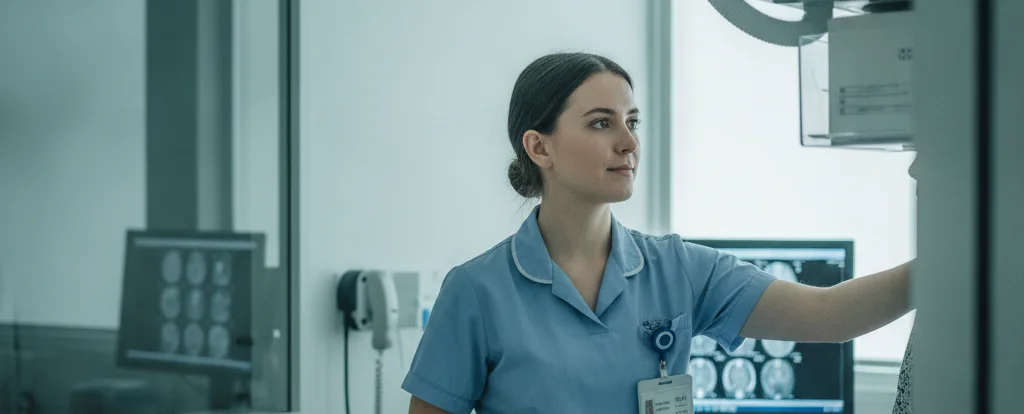
Radiographers use X-ray, CT and other imaging equipment to produce the pictures doctors rely on to diagnose injury and disease.
- Median salary
- $122,700
3.8%vs last year, before tax
- People employed
- 10,200
3.0%vs last year
- Projected growth
- +33.1%
to 2035
- AI exposure*
- Moderate
- automation risk
- Average hours
- 40/wk
matches all-jobs average
- Shortage status
- In shortage
national
Radiographers work in hospital imaging departments, private radiology practices and mobile services, taking scans on a doctor's referral. They are often confused with radiologists, who are the doctors that interpret the images, and with sonographers, who use ultrasound rather than ionising radiation. Because the equipment produces radiation, anyone doing the work must be registered with the Medical Radiation Practice Board of Australia.
How much do radiographers earn?
The median full-time salary for a radiographer is $122,700 per annum, before tax, up $25,400 since 2018.
Public hospital radiographers are usually paid under a state enterprise agreement, so penalty rates for nights, weekends and on-call add a noticeable amount to the base rate. Private practices set their own pay, and what they offer for a speciality or a senior role varies between employers and states. How much overtime and shift work you take on also changes what the same job pays from one person to the next.
What does a radiographer do day to day?
The list below is what fills most weeks; the exact mix shifts with seniority and whatever stage the current work is at.
- Positioning patients and setting exposure for each scan, from a fractured wrist to a chest X-ray, so the image is clear enough to diagnose
- Talking anxious, confused or claustrophobic patients through a scan so they can hold still long enough for a usable image
- Moving between emergency department trauma cases, theatre with a mobile X-ray unit and a booked list of outpatients on the same shift
- Checking image quality before the patient leaves and repeating a view when positioning or exposure has not shown what the referrer needs
- Monitoring radiation dose for patients and staff, and flagging urgent findings to the radiologist or the treating team
What skills do radiographers need?
Employers look for clinical assessment and treatment, patient care and support, infection control and hygiene, backed by X-ray equipment fluency and strong attention to detail.
Specialist skills
- Clinical assessment and treatment
- Patient care and support
- Infection control and hygiene
Software and tools
- X-ray equipment
- CT scanners
- Ultrasound machines
- PACS (Picture Archiving and Communication System)
- Radiation dosimetry monitors
General skills
- Attention to detail
- Problem solving
- Written communication
- Safety and compliance awareness
Is the job growing?
About 10,200 people work as radiographers in Australia, and employment is projected to grow 33.1% over the decade to 2035. That's very strong growth. Few roles in Australia are expanding this fast, and it points to solid demand for years to come.
How do you become a radiographer?
Here's the path most radiographers take, step by step.
- 1Complete an accredited degree in diagnostic radiography
The usual route is a Bachelor of Medical Radiation Science (Diagnostic Radiography), which takes three to four years and must be an approved program of study for registration. Entry is competitive and usually needs a strong ATAR with some science background. If you already hold a health or science degree, graduate-entry master's programs are an alternative route.
- 2Get through the clinical placements
Supervised placements in hospital imaging departments are built into the degree and are the part that shows you what the roster and the patients are actually like. Most students find their first job through a placement or a hospital graduate program.
- 3Register with the Medical Radiation Practice Board of Australia
You cannot work as a radiographer without registration through AHPRA, which you apply for once you have finished an approved program of study. Registration is renewed each year and comes with continuing professional development requirements.
- 4Start in a general role, then specialise
New graduates usually begin in general X-ray across a hospital or private practice before moving into CT, MRI, mammography or interventional work. A postgraduate qualification is normal for sonography, and some services require further study for the more advanced modalities.
- 5Consider assistant or support roles if you want to test the field
Medical imaging assistants and practice reception roles sit alongside radiographers in most departments and give a view of the work, but they do not lead to registration. If radiography is the goal, the degree remains the pathway.
Study routes we have checked
Qualifications that are a recognised way into this role, and what else you need.
- Bachelor of Medical Imaging
A recognised route into this role
Choose an approved diagnostic-radiography programme and obtain registration in that division. Sonography and radiation therapy have different training requirements. This catalogue groups awards: verify the chosen provider, programme and intake; the family-level link is not confirmation that every offering is approved.
Ready to apply as a radiographer?
Whether you're working toward becoming a radiographer or already are one and want a hand with the next step (sharpening your resume for ATS screening, tightening your cover letter, or knowing what you'll actually be asked at interview), here are examples grounded in this specific role, not generic templates.
What jobs can a radiographer move to?
Moving into Radiologist typically comes with the biggest pay rise, worth $95,700 a year more on average.
| Move to | Typical pay change | Overlap | Retraining |
|---|---|---|---|
| Radiologist A radiographer brings imaging knowledge and patient experience, but becoming a radiologist requires a full medical degree and specialist training.Known move | +$95,700 | 53% | requalify |
| Sonographer A radiographer brings diagnostic imaging and patient care skills, and can specialise in ultrasound with further study.Known move | +$0 | 47% | reskill |
| Nuclear Medicine Technologist A radiographer brings imaging physics and patient care, and can move into nuclear medicine with further qualification.Known move | −$16,100 | 71% | requalify |
| Radiation Therapist A radiographer brings radiation physics, imaging and patient positioning skills, and can move into radiation therapy with specialist training.Known move | −$23,900 | 47% | requalify |
Moves are chosen from Jobs and Skills Australia's Data on Occupation Mobility, which follows income tax records between 2011-12 and 2020-21, together with entry requirements and skill overlap. A known move is one people were seen making in that data. Pay change compares median full-time pay for the two roles.
Who works as a radiographer?
The typical radiographer is 35 years old; 68% are women, 67% work full-time, and full-timers average 40 hours a week.
- 35
- Median age
- 68%
- Female share
- 67%
- Full-time
- +0h
- vs all-jobs avg
What's it like being a radiographer?
The job runs on a roster, mixing booked outpatient lists, walk-in emergency cases and theatre calls, with nights, weekends and on-call shared across the team. Most scans take a few minutes, so it is a steady stream of short interactions rather than a long-term caseload, which suits people who like getting a technical task right under time pressure. It is also physical work with trolleys, heavy patients and lead aprons, and the images you take often decide what happens next for that person.
What people like
- You know straight away whether it worked. A clear image with the right anatomy is either on the screen or it isn't, so the feedback on your technique comes within seconds rather than weeks.
- Short contacts with patients. Most people are with you for a few minutes, which suits radiographers who prefer a series of brief encounters to carrying the same patients through a long admission.
- The day changes rooms. A roster can move between emergency, theatre, outpatients and imaging at the bedside, so the work rarely settles into one setting for a whole week.
- There is somewhere to go without leaving. CT, MRI, mammography, interventional work and ultrasound are all reachable with further study, so the profession has room to move inside it.
What people find hard
- Rotating shifts are part of the deal. Nights, weekends, public holidays and on-call come with hospital rosters, and they take a toll on sleep and on the ordinary routines of family life.
- Routine lists can drag. A full day of chest and knee X-rays for a busy clinic is repetitive, and even in varied roles a run of straightforward outpatient scans is normal.
- Patients who are hurt or frightened. Part of the job is positioning someone in pain, confused or distressed and persuading them to hold still while you do it, often with a queue waiting.
- The physical and safety load. Lead aprons in theatre, pushing trolleys and moving heavy patients add up by the end of a shift, and radiation safety steps have to be followed on every scan, not only the difficult ones.
Based on our synthesis of professional-body surveys and public accounts of the role, not first-person verified reviews.
Which industries employ radiographers?
Health Care and Social Assistance employs the largest share of radiographers.
Top employing industries
- 1Health Care and Social Assistance
Ranked by employment share; the source doesn't publish an exact percentage per industry.
| Bachelor degree | 64% | |
|---|---|---|
| Postgraduate | 22.6% | |
| Diploma / Advanced Diploma | 10.5% | |
| Year 12 or below | 1.1% | |
| Certificate III/IV | 0.3% |
Will AI replace radiographers?
AI is already in the work at the image analysis end, where software flags suspected fractures, lung nodules and mammogram abnormalities for the radiologist to review, and exposure settings on newer scanners are increasingly automated. The job itself stays hands-on, because someone has to position the patient, judge whether the images answer the clinical question and manage the person in front of them, which is why the exposure overall is moderate rather than high.
Share of typical working time by exposure level
- Setting up and positioning for each scanProjecting the right view, moving a patient who is in pain and holding a limb still cannot be done from a screen, and it is where most of the week goes.40%low
- Checking images and passing on urgent findingsAI triage tools flag suspicious studies for the radiologist, which speeds up reporting but does not replace the radiographer reviewing each image before the patient leaves.25%moderate
- Adjusting exposure and scan protocolsAutomatic exposure control and protocol software suggest settings, but the radiographer still reads the patient's size, mobility and the clinical question before choosing.20%moderate
- Recording details in the imaging systemEntering referral information, dose records and notes into PACS is increasingly captured automatically by scanning and voice tools rather than typed by hand.15%high
Moves least exposed to AI
These career moves from radiographer work are rated low for AI exposure:
- Sonographer
Solid skill overlap (47%), reskill to get there, and a low automation-risk profile.
Common questions about becoming a radiographer
Straight answers to the questions people ask most.
How much do radiographers earn?
Radiographers earn a median of $122,700 per year before tax, so half earn more than that and half earn less. Specialising in a modality such as MRI or mammography is the most reliable way to move above the median, as is taking on a senior or chief radiographer role. Public hospital rates are set by state enterprise agreements, which differ from one state to the next.
How do you become a radiographer?
You complete an approved degree in diagnostic radiography, usually three to four years full time, and then register with the Medical Radiation Practice Board of Australia through AHPRA before you can work. Clinical placements in hospital imaging departments are part of the degree and are where most students line up their first job. A graduate-entry master's is an option if you already hold a health or science degree.
Are radiographers in demand?
Radiographers are currently in shortage nationally, and employment is projected to grow 33.1% over the decade to 2035. Imaging services run around the clock in hospitals and are busiest during extended hours, so registered graduates generally find work in public hospitals, private practices or mobile services. Which setting and location you end up in depends on where you are willing to work.
Will AI replace radiographers?
Software that flags suspected fractures, lung nodules and breast abnormalities is already used as a second read in some services, and it is changing how quickly a study reaches a radiologist rather than removing the radiographer. The physical parts of the job are much harder to automate: positioning a patient, choosing the views that answer the clinical question and keeping someone calm enough to stay still. The scanning, the patient care and the quality decisions still belong to the person in the room.
What can a radiographer move into?
Other imaging specialities are the common next step. Becoming a sonographer uses the same patient care and scanning skills and the pay is about the same, while nuclear medicine technologists share 71% of the skill set and earn $16,100 less. Moving into radiology as a doctor pays $95,700 more but means a full medical degree and specialist training rather than building on the radiography qualification.
Do radiographers work shift work?
In hospitals, yes: rostered nights, weekends and public holidays are normal, and many departments also run an on-call roster for after-hours trauma and theatre. Full-time radiographers average around 40 hours a week before overtime and on-call are counted. Private practices are often closer to standard weekday hours, which is one reason people move between the two.
Related roles
- Sonographer
- Radiation Therapist
- Nuclear Medicine Technologist
- Radiologist
- Radiation Therapist
- Nuclear Medicine Technologist
Not sure this is you? Take the career quiz and get a ranked shortlist of roles that fit how you like to work.