Rail Engineer
Rail engineers design and maintain the track, structures and systems that keep trains running.
- Median salary*
- $119,600
4.1%vs last year, before tax
- People employed
- 750
7.1%vs last year
- Projected growth*
- +6%
to 2035
- AI exposure*
- Moderate
- automation risk
- Average hours*
- 41/wk
+1h vs all jobs
- Shortage status*
- In shortage
national
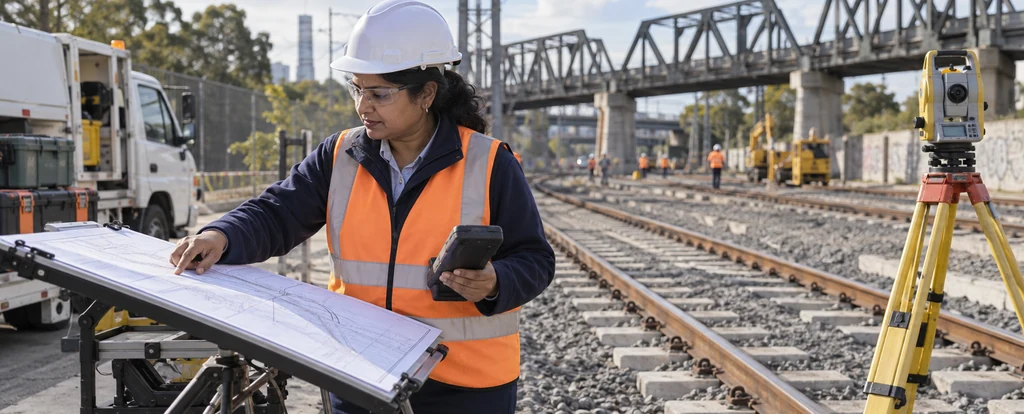
Rail engineers work on the infrastructure a rail network runs on: track, bridges, tunnels, earthworks, drainage, and the overhead and signalling systems alongside them. Most are employed by rail operators, state transport agencies, engineering consultancies and major contractors, and the week is split between the design office and the corridor itself. It is a small, specialised field, with about 750 people working as rail engineers in Australia, so the same names and projects come up often.
How much do rail engineers earn?
The median full-time salary for a rail engineer is $119,600 per annum, before tax, up $25,000 since 2018.
Pay depends heavily on who employs you. State transport agencies pay against enterprise agreement bands with set steps, while contractors and consultancies on major projects often pay more for similar work. Site-based, remote and freight or mining rail roles usually carry allowances on top, as do positions that require chartered status or state registration.
What does a rail engineer do day to day?
The list below is what fills most weeks; the exact mix shifts with seniority and whatever stage the current work is at.
- Designing track alignments, geometry and drainage for new lines and upgrades
- Modelling the corridor and producing drawings in Bentley OpenRail Designer or AutoCAD Civil 3D
- Inspecting track, bridges and drainage during track possessions
- Preparing specifications, safety documentation and estimates for construction
- Coordinating the design with signalling, overhead wiring and civil teams
What skills do rail engineers need?
Employers look for engineering design and analysis, cAD and technical drawing, project engineering and delivery, backed by Bentley OpenRail Designer fluency and strong problem solving.
Specialist skills
- Engineering design and analysis
- CAD and technical drawing
- Project engineering and delivery
- Worksite safety management
- Project management
- Field inspection and testing
Software and tools
- Bentley OpenRail Designer
- AutoCAD Civil 3D
- MicroStation
- Primavera P6
- Trimble surveying equipment
General skills
- Problem solving
- Safety and compliance awareness
Is the job growing?
About 750 people work as rail engineers in Australia, and employment is projected to grow 6% over the decade to 2035. That's modest growth: demand is steady rather than booming.
How do you become a rail engineer?
Here's the path most rail engineers take, step by step.
- 1Complete an accredited engineering degree
A four-year Bachelor of Engineering in civil, electrical or mechanical engineering, accredited by Engineers Australia, covers the structural, geotechnical and electrical fundamentals you will draw on. Rail-specific knowledge is learned on the job rather than at university.
- 2Get rail exposure while you study
Vacation work or an internship with a rail operator, transport agency or contractor is the most direct way into a graduate program, and it shows you whether you prefer design or site work.
- 3Start as a graduate engineer on a rail project
Graduate roles run under supervision for the first few years, with time in the design office and on site during track possessions. This is where rail standards, safety cases and corridor constraints become familiar.
- 4Work towards chartered status
Chartered Professional Engineer recognition through Engineers Australia usually takes four to six years of experience and is increasingly expected in senior design and project roles. Some work also requires state registration, such as RPEQ in Queensland.
- 5Consider the technician pathway instead
A diploma or advanced diploma in engineering can get you into rail as a technician or engineering technologist, supporting design and construction. Further study later can take you into engineering roles, and employers often fund part of it.
Ready to apply as a rail engineer?
Whether you're working toward becoming a rail engineer or already are one and want a hand with the next step (sharpening your resume for ATS screening, tightening your cover letter, or knowing what you'll actually be asked at interview), here are examples grounded in this specific role, not generic templates.
What jobs can a rail engineer move to?
Moving into Electrical Engineer typically comes with the biggest pay rise, worth $13,200 a year more on average.
| Move to | Typical pay change | Overlap | Retraining |
|---|---|---|---|
| Electrical Engineer Electrical engineer draws on rail engineer's traction power and systems knowledge to design electrical networks and equipment. | +$13,200 | 67% | minimal |
| Civil Engineer Civil engineer uses rail engineer's infrastructure design and project skills on roads, bridges and earthworks. | −$4,300 | 67% | minimal |
| Structural Engineer Structural engineer applies rail engineer's understanding of load-bearing rail structures with a short course in building codes and analysis. | −$4,300 | 54% | short course |
| Transport Engineer Transport engineer builds on rail engineer's network planning and operations knowledge, with further study in transport modelling and policy. | −$5,200 | 44% | reskill |
| Rail Signalling Engineer Rail signalling engineer builds on rail engineer's track and systems knowledge, with a short course in signalling principles and safety standards. | −$7,800 | 58% | short course |
Moves are chosen from Jobs and Skills Australia's Data on Occupation Mobility, which follows income tax records between 2011-12 and 2020-21, together with entry requirements and skill overlap. A known move is one people were seen making in that data. Pay change compares median full-time pay for the two roles.
Who works as a rail engineer?
The typical rail engineer is 35 years old; 84% are men, 93% work full-time, and full-timers average 41 hours a week.
- 35
- Median age
- 16%
- Female share
- 93%
- Full-time
- +1h
- vs all-jobs avg
What's it like being a rail engineer?
The job runs on projects rather than a fixed daily routine, so a week can move between the design office, site inspections and meetings with contractors and operators. Rail infrastructure is safety critical, which means decisions are documented and reviewed before anything is built, and much of the site work happens during track closures at night or over a weekend. People who enjoy it tend to like the mix of technical detail and watching a heavy, long-lived asset come together.
What people like
- You see your work carrying passengers and freight. Track and structures have a long life, so a design you worked on can still be in service decades later, and commissioning day is a visible end point after years of drawings.
- Design and site work in the same week. Most rail engineers spend part of their time at a desk on models and calculations and part of it in the corridor checking what is actually there, which suits people who dislike doing either one full time.
- A small field where reputations travel. With a workforce this size, engineers build a known track record across a handful of projects and employers, which makes it easier to find the next role through people you have worked with.
- Genuinely multidisciplinary problems. Fitting track, drainage, signalling and overhead wiring into a constrained corridor means working closely with other disciplines, and the solution is rarely one engineer's alone.
What people find hard
- Documentation and approvals take real time. Safety cases, standards compliance and design reviews are a large part of the job, and they slow everything down. Engineers who want to move quickly find this the hardest part of rail.
- Track access falls on nights and weekends. Possessions, the planned closures when no trains run, are when inspection and commissioning happen, so site work often runs outside standard hours. Projects in the commissioning stage are the heaviest.
- Projects take years to reach the ground. From concept design to an open line can be a decade, and funding or scope decisions can pause work partway through. The satisfaction is delayed compared with many engineering roles.
- The work clusters in a few places. Roles sit around the major city networks, regional freight corridors and mining rail, so moving for work is common and not every location has steady rail projects.
Based on our synthesis of professional-body surveys and public accounts of the role, not first-person verified reviews.
Which industries employ rail engineers?
Rail transport employs the largest share of rail engineers, followed by Heavy and civil engineering construction.
Top employing industries
- 1Rail transport
- 2Heavy and civil engineering construction
- 3Professional, scientific and technical services
- 4Public administration and safety
- 5Mining
Ranked by employment share; the source doesn't publish an exact percentage per industry.
| Bachelor degree | 52% | |
|---|---|---|
| Postgraduate | 26% | |
| Diploma / Advanced Diploma | 13% | |
| Other | 9% |
Will AI replace rail engineers?
Rail engineering has moderate exposure. Design and drafting software already automates alignment optimisation, clash detection and drawing production, which changes how much of the day is spent producing drawings by hand. It does not replace the safety assurance work, the site judgement about what can be built in a live corridor, or the coordination between track, signalling and structures.
Share of typical working time by exposure level
- Track and alignment designTools such as Bentley OpenRail Designer can generate and test alignment options quickly, so engineers spend more time setting constraints and checking outputs than drawing them.30%high
- Site inspection during possessionsWalking the corridor to check track condition, drainage and clearances stays with a person, because the physical site and the trains are not going into a model.25%low
- Coordinating across disciplines and contractorsScheduling tools and shared models reduce the chasing, but resolving a clash between track drainage and signalling cables on a live project still comes down to engineers talking to each other.25%moderate
- Safety assurance and design documentationSoftware can draft standards checks and compile compliance records, but the engineering judgement behind a safety case still has to be made and signed off by a person.20%moderate
Moves least exposed to AI
These career moves from rail engineer work are rated low for AI exposure:
- Civil Engineer
High skill overlap (67%), little retraining to get there, and a low automation-risk profile.
Common questions about becoming a rail engineer
Straight answers to the questions people ask most.
How much do rail engineers earn?
$119,600 per annum, before tax, is the median for full-time rail engineers, so individual pay sits above or below it depending on the employer and the work. Government agencies pay against enterprise agreement bands while contractors and consultancies on major projects often pay more, and site-based or remote roles typically attract allowances on top.
How do you become a rail engineer?
The usual route is a four-year engineering degree accredited by Engineers Australia, in civil, electrical or mechanical engineering, followed by a graduate role on a rail project. Rail-specific knowledge is learned on the job, so internships or vacation work with an operator or contractor while you study makes that first job easier to get. A diploma or advanced diploma can get you in as a technician, with further study later if you want to move into design.
Are rail engineers in demand?
Rail engineers are currently in shortage nationally, and employment is projected to grow 6% over the decade to 2035 over the decade to 2035. Because the workforce is small, each year's openings come down to a handful of projects starting and people leaving the field, so a specific corridor or system can be tight even when the national picture is steady. Signalling and traction power experience is where employers most often have to search.
Will AI replace rail engineers?
Rail engineering has moderate exposure to AI. Design and drafting tools such as Bentley OpenRail Designer and Civil 3D already automate alignment optimisation, clash detection and drawing production, which cuts the time spent on routine design work. What they do not take over is the safety case, the judgement about what is actually buildable in a live corridor, and the coordination of track, signalling and structures across disciplines.
What can rail engineers move into?
Rail engineers often move into a neighbouring discipline rather than leaving rail altogether. Electrical engineering suits those with traction power or systems experience and pays $13,200 more, while civil engineering applies the same design and project skills to roads and bridges and pays $4,300 less. Rail signalling engineering needs a short course in signalling principles and safety standards, and structural or transport engineering are longer moves that require further study.
Do rail engineers work nights and weekends?
Yes, at least some of the time. Inspections, testing and commissioning happen in possessions, the scheduled closures when no trains are running, and those commonly fall at night or over a weekend. Design office weeks are more regular, and some employers offer time off in lieu for possession work.
Related roles
- Rail Signalling Engineer
- Civil Engineer
- Electrical Engineer
- Structural Engineer
- Transport Engineer
- Engineering Technologist
Not sure this is you? Take the career quiz and get a ranked shortlist of roles that fit how you like to work.