Steel Detailer
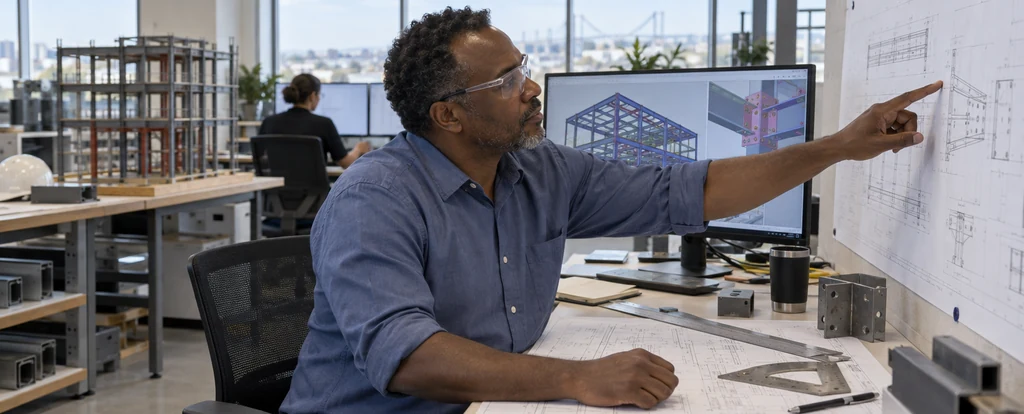
Steel detailers turn a structural engineer's design into the drawings and 3D models a steel fabricator builds from.
- Median salary*
- $88,400
3.9%vs last year, before tax
- People employed
- 440
10.0%vs last year
- Projected growth*
- +4%
to 2035
- AI exposure*
- Moderate
- automation risk
- Average hours*
- 40/wk
matches all-jobs average
- Shortage status*
- In shortage
national
Steel detailers work mostly in the offices of steel fabricators, specialist detailing firms and engineering consultancies, on jobs that range from apartment and warehouse frames to bridges and mine infrastructure. They sit between the engineer's design and the workshop floor, working out how each member and connection will be made, bolted or welded, then setting it out on drawings the fabricator can follow. They are not the engineer who sizes the members, and not the drafter producing general arrangements.
How much do steel detailers earn?
The median full-time salary for a steel detailer is $88,400 per annum, before tax, up $18,300 since 2018.
What you earn depends heavily on where you work, because a steel fabricator, a specialist detailing consultancy and a mining or heavy industrial contractor pay differently for similar work. Experience and software skill matter, and detailers who can run a project or check other people's work usually earn more than those producing drawings under supervision. Overtime during peak project periods is common in some firms, and experienced detailers who contract their services can set their own rates.
What does a steel detailer do day to day?
The list below is what fills most weeks; the exact mix shifts with seniority and whatever stage the current work is at.
- Reading structural and architectural drawings to work out what the steel frame has to do
- Modelling members, connections and bracing in Tekla Structures or Advance Steel
- Setting out shop drawings with member sizes, bolt holes, weld details and piece marks
- Working through clashes and buildability problems with engineers and fabricators
- Checking drawings and models against the engineer's design before they go to the workshop
What skills do steel detailers need?
Employers look for reading plans and specifications, cAD and technical drawing, engineering design and analysis, backed by Tekla Structures fluency and strong attention to detail.
Specialist skills
- Reading plans and specifications
- CAD and technical drawing
- Engineering design and analysis
Software and tools
- Tekla Structures
- AutoCAD
- Revit
- SDS/2
- Advance Steel
General skills
- Attention to detail
- Problem solving
- Written communication
Is the job growing?
About 440 people work as steel detailers in Australia, and employment is projected to grow 4% over the decade to 2035. That's modest growth: demand is steady rather than booming.
How do you become a steel detailer?
Here's the path most steel detailers take, step by step.
- 1Start with a drafting qualification
A Certificate IV in Engineering Drafting (MEM40422) at TAFE is the most common entry point, and a Diploma of Civil Construction Design (RII50520) covers similar ground with more structural content. Either takes about a year full time, longer part time, and both teach the drawing conventions you will use daily.
- 2Learn the detailing software
Most employers expect Tekla Structures, and many also use AutoCAD, Advance Steel or SDS/2. Short courses and training from the software providers are common, and a fabricator will often teach a promising junior on the job.
- 3Come from a fabrication trade
Boilermakers and welders with a Certificate III in Engineering - Fabrication Trade (MEM31925) move into detailing because they already know how steel is cut, welded and erected. Employers often value that practical knowledge highly, though you will still need to learn the modelling software.
- 4Learn the standards behind the details
Detailing follows AS 4100 for steel structures and the shop drawing conventions fabricators work to. The Australian Steel Institute and software providers run courses on connections and fabrication detailing that fill in what a general drafting course leaves out.
- 5Build up through checking and project work
Junior detailers start on simpler members and connections under a checker's eye, then take responsibility for whole projects. Further study, such as an engineering degree, opens the move into structural engineering.
Ready to apply as a steel detailer?
Whether you're working toward becoming a steel detailer or already are one and want a hand with the next step (sharpening your resume for ATS screening, tightening your cover letter, or knowing what you'll actually be asked at interview), here are examples grounded in this specific role, not generic templates.
What jobs can a steel detailer move to?
Moving into Structural Engineer typically comes with the biggest pay rise, worth $26,900 a year more on average.
| Move to | Typical pay change | Overlap | Retraining |
|---|---|---|---|
| Structural Engineer Steel detailer brings practical steel fabrication and detailing knowledge to structural engineering, but a full engineering degree is required. | +$26,900 | 38% | requalify |
| Welding Inspector Steel detailer brings knowledge of steel fabrication, weld details and shop drawings to welding inspection, though a welding inspection certificate is required. | +$15,600 | 32% | reskill |
| Civil Engineering Technician Steel detailer brings steel fabrication drawing and modelling knowledge to civil engineering technical support, with further study needed for civil construction methods. | +$2,600 | 52% | reskill |
| Civil Drafter Steel detailer brings structural steel drawing and modelling skills to civil drafting, though further study is required for broader civil works. | +$0 | 80% | reskill |
Moves are chosen from Jobs and Skills Australia's Data on Occupation Mobility, which follows income tax records between 2011-12 and 2020-21, together with entry requirements and skill overlap. A known move is one people were seen making in that data. Pay change compares median full-time pay for the two roles.
Who works as a steel detailer?
The typical steel detailer is 42 years old; 90% are men, 90% work full-time, and full-timers average 40 hours a week.
- 42
- Median age
- 10%
- Female share
- 90%
- Full-time
- +0h
- vs all-jobs avg
What's it like being a steel detailer?
Steel detailing is office work with a workshop deadline attached. The weeks run around the fabricator's production schedule, so the pressure arrives when drawings have to be released, and much of the day is spent in a model working through connections and clashes. It suits people who like a practical puzzle and enjoy seeing the answer turn up on site as real steel.
What people like
- Your drawings become real steel. A frame you detailed arrives on site as cut, drilled and painted members that fit together, and you can walk past the finished building later.
- The problems have a right answer. Working out a connection that is strong, buildable and cheap to fabricate is a defined problem, and it is satisfying when it resolves cleanly.
- Close to the workshop and the site. You deal with boilermakers, riggers and engineers rather than only with a screen, so the work stays connected to how the steel is actually made and erected.
- Clear scope, steady desk work. Most of the job happens in an office with regular hours, and the deliverable is a set of drawings rather than an open-ended brief.
What people find hard
- Deadlines set by the workshop. Fabrication does not wait. If the drawings are late the shop stops, and that pressure lands on the detailer.
- Design changes arriving late. An engineer's revision can mean reworking connections and reissuing drawings across a whole project, and it often arrives when you are busiest.
- Long days at a screen. The work is almost entirely computer based, so eye strain and desk fatigue come with it.
- Mistakes are expensive. A wrong hole or member length can scrap fabricated steel, so drawings are checked and rechecked, often by a second person, which some people find tedious.
Based on our synthesis of professional-body surveys and public accounts of the role, not first-person verified reviews.
Which industries employ steel detailers?
Construction employs the largest share of steel detailers, followed by Manufacturing.
Top employing industries
- 1Construction
- 2Manufacturing
- 3Professional, Scientific and Technical Services
- 4Mining
Ranked by employment share; the source doesn't publish an exact percentage per industry.
| Certificate III/IV | 34% | |
|---|---|---|
| Diploma / Advanced Diploma | 26% | |
| Bachelor degree | 20% | |
| Year 12 or below | 20% |
Will AI replace steel detailers?
Steel detailing sits in the middle ground. The modelling and drawing production that fills much of the week is increasingly automated, but someone still has to decide how the steel goes together. Software such as Tekla Structures generates shop drawings and clash reports from a model, which removes drafting hours rather than the role, while judgement about connections, tolerances and what a workshop can actually make stays with the detailer.
Share of typical working time by exposure level
- Modelling the steel frame in Tekla or Advance SteelConnection libraries, templates and automated numbering speed up the build, but someone still has to choose the connection and set the levels correctly.30%moderate
- Producing shop drawings and fabrication detailsSheets are generated from the model automatically, so drafting time per drawing keeps falling, but piece marks, dimensions and weld notes still need a detailer to review them.30%high
- Checking drawings against the engineer's designSoftware can flag clashes and missing dimensions, but deciding whether a detail is buildable and complies with AS 4100 relies on experience.25%low
- Coordinating with engineers, fabricators and site staffSorting out a bolt hole or a site tolerance means talking it through with the people who will make and erect the steel, which is not something software does.15%low
Common questions about becoming a steel detailer
Straight answers to the questions people ask most.
How much does a steel detailer earn?
Steel detailers earn a median of $88,400 per year before tax. Pay moves with experience, the software you can run and the sector you work in, and detailers who check or run projects usually earn more than those producing drawings under supervision.
How do you become a steel detailer?
Most people start with a Certificate IV in Engineering Drafting (MEM40422) or a Diploma of Civil Construction Design (RII50520), then learn Tekla Structures or similar software on the job. A background as a boilermaker or fabricator is another common route, because knowledge of how steel is made and erected transfers directly to detailing.
Are steel detailers in demand?
Steel detailers are currently in shortage nationally, and employment is projected to grow 4% over the decade to 2035. The occupation is small and the work follows the construction, mining and infrastructure pipeline, so employers who cannot fill a role locally often look interstate or overseas.
Will AI replace steel detailers?
It will change the job rather than remove it. Detailing software already generates shop drawings from a structural model and flags clashes automatically, which cuts drafting hours; what stays with the detailer is choosing how a connection should be made, whether it can be fabricated and erected, and confirming the model matches the engineer's design.
What can a steel detailer move into?
Civil drafter is a close move, since the drawing and modelling work overlaps and pay is about the same. Structural engineering pays $26,900 more and needs an engineering degree, while a welding inspection certificate opens a route at $15,600 more. Experienced detailers also go out on their own, contracting to fabricators, and that is often where earnings grow.
Do steel detailers need a degree?
No. The most common qualification among people working as steel detailers is Certificate III/IV, held by about 34%, so vocational training is the usual route into the job. A degree matters mainly if you later want to move into structural engineering.
Related roles
Not sure this is you? Take the career quiz and get a ranked shortlist of roles that fit how you like to work.