Survey Assistant
Survey assistants work alongside surveyors in the field, measuring land and recording the data that becomes property boundaries, maps and construction plans.
- Median salary*
- $65,000
4.0%vs last year, before tax
- People employed
- 1,200
0.0%vs last year
- Projected growth
- +1%
to 2035
- AI exposure*
- Low
- automation risk
- Average hours
- 51/wk
+11h vs all jobs
- Shortage status
- Not in shortage
national
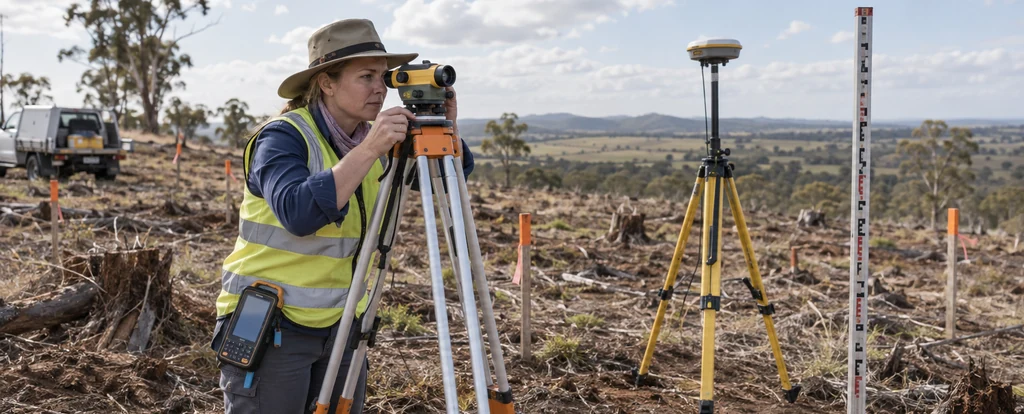
Survey assistants spend most of their time outdoors, setting up instruments, holding staffs and marking points on sites that range from suburban subdivisions to mine pits and new roads. The role is the practical start of surveying: assistants gather and record the measurements, while the surveyor decides what needs measuring and signs off on the result. Most work for surveying firms in professional services, construction or mining, and the job is usually learned on site rather than in a classroom.
How much do survey assistants earn?
The median full-time salary for a survey assistant is $65,000 per annum, before tax, up $13,500 since 2018.
Survey assistants are usually covered by an award or enterprise agreement, and the base rate varies most with the sector: mining and civil construction pay more than a small boundary surveying firm. Site allowances, overtime and living-away-from-home payments can add substantially on remote projects, and labour-hire or casual work often carries a loading. Pay tends to step up as you gain competencies and take on more of the measuring yourself.
What does a survey assistant do day to day?
The list below is what fills most weeks; the exact mix shifts with seniority and whatever stage the current work is at.
- Setting up and levelling a total station or automatic level over each known survey point
- Holding staffs, targets and prisms steady while the surveyor or technician takes readings
- Marking boundaries, pegs and reference points with stakes, paint and star pickets
- Recording measurements and site notes in a data collector running software such as Trimble Access
- Clearing vegetation, digging to uncover old survey marks and carrying equipment between points
What skills do survey assistants need?
Employers look for surveying and geospatial work, field inspection and testing, hand and power tool work, backed by Total station fluency and strong attention to detail.
Specialist skills
- Surveying and geospatial work
- Field inspection and testing
- Hand and power tool work
- Worksite safety management
Software and tools
- Total station
- GNSS receiver
- Automatic level
- Data collector
- Trimble Access
General skills
- Attention to detail
- Physical stamina and dexterity
- Written communication
- Digital literacy
Is the job growing?
About 1,200 people work as survey assistants in Australia, and employment is projected to grow 1% over the decade to 2035. That's modest growth: demand is steady rather than booming.
How do you become a survey assistant?
Here's the path most survey assistants take, step by step.
- 1Get a general construction induction card
Most survey work happens on construction and civil sites, and the induction card (often called a White Card) is the minimum requirement to get through the gate. It takes about a day to complete and can be done before you leave school.
- 2Complete a Certificate II or III in Surveying and Spatial Information Services
These are the standard entry qualifications, offered at TAFE and private registered training organisations. A Certificate II is often enough for a first job, and the Certificate III covers more instrument work, so many people start the certificate while already working.
- 3Find a start with a surveying firm, civil contractor or mining company
Entry roles are rarely advertised widely, so approaching surveying firms directly works well. You learn total stations, GNSS receivers and data collectors on the job, and larger firms usually pair new assistants with an experienced surveyor or technician.
- 4Build your equipment and software skills
Being the person who can set up, check and troubleshoot the gear makes you useful on more jobs. Familiarity with Trimble Access, CAD and plan reading is what separates an assistant who gets sent out on their own from one who stays on the simple jobs.
- 5Study a Diploma of Surveying to move up
A diploma is the usual route into surveying technician work, where you take on more of the measuring and drafting and less of the carrying. It can be studied part time while you keep working, and some employers contribute to the cost.
Ready to apply as a survey assistant?
Whether you're working toward becoming a survey assistant or already are one and want a hand with the next step (sharpening your resume for ATS screening, tightening your cover letter, or knowing what you'll actually be asked at interview), here are examples grounded in this specific role, not generic templates.
What jobs can a survey assistant move to?
Moving into Mine Surveyor typically comes with the biggest pay rise, worth $59,800 a year more on average.
| Move to | Typical pay change | Overlap | Retraining |
|---|---|---|---|
| Mine Surveyor Mine surveying uses the same field measurement and plan reading skills, but requires a degree and registration in mining. | +$59,800 | 38% | requalify |
| Surveyor Field experience with boundaries and measurements supports surveying study, but becoming a surveyor requires a degree and registration.Known move | +$54,600 | 31% | requalify |
| Underground Services Locator Locating buried services builds on survey plan reading and field marking, with a certificate needed to enter the role. | +$28,600 | 31% | reskill |
| Surveying Technician Survey assistants already read plans and take field measurements, skills that transfer directly to surveying technician work after completing a diploma.Known move | +$22,400 | 35% | reskill |
Moves are chosen from Jobs and Skills Australia's Data on Occupation Mobility, which follows income tax records between 2011-12 and 2020-21, together with entry requirements and skill overlap. A known move is one people were seen making in that data. Pay change compares median full-time pay for the two roles.
Who works as a survey assistant?
The typical survey assistant is 34 years old; 88% are men, 56% work full-time, and full-timers average 51 hours a week.
- 34
- Median age
- 12%
- Female share
- 56%
- Full-time
- +11h
- vs all-jobs avg
What's it like being a survey assistant?
The work follows the project rather than the clock: days start early, often well away from the office, and the routine changes from pegging a suburban boundary to setting out a mine haul road. It is physical work in whatever the weather is doing, and it suits someone who likes being outdoors, working with their hands and getting a precise result. The trade-off is long hours and stretches away from home when the job is remote.
What people like
- You are outdoors and moving all day. There is little desk time. Assistants walk the site, carry gear between points and see the ground they are measuring rather than reading about it.
- The results are exact. A boundary closes or it does not. The feedback on your work is immediate and measurable, which appeals to people who like getting the details right.
- Small crews and clear instructions. Most assistants work with one or two other people, so you know what you are doing each day and who to ask when something looks wrong.
- It is a genuine entry point into surveying. You can start with a short qualification and no degree, and the experience counts towards technician and surveyor study if you decide to go further.
What people find hard
- The weather runs the day. Heavy rain, extreme heat and wind can stop measurement work altogether, which means lost hours and rescheduled jobs.
- Long days and time away. Remote and roster work can mean weeks in a camp, and even local jobs often start before sunrise to beat traffic and heat.
- Repetition on big jobs. Setting out hundreds of pegs or holding a staff at the same mark for hours is tedious, and it is a large part of the first year.
- Progress depends on further study. Carrying and holding equipment caps out quickly. Moving into measuring, drafting or supervising means taking on a diploma or degree.
Based on our synthesis of professional-body surveys and public accounts of the role, not first-person verified reviews.
Which industries employ survey assistants?
Professional, Scientific and Technical Services employs the largest share of survey assistants, followed by Mining.
Top employing industries
- 1Professional, Scientific and Technical Services
- 2Mining
- 3Construction
Ranked by employment share; the source doesn't publish an exact percentage per industry.
| Year 12 or below | 45.4% | |
|---|---|---|
| Certificate III/IV | 19.9% | |
| Bachelor degree | 14.7% | |
| Diploma / Advanced Diploma | 10.6% | |
| Postgraduate | 6.3% |
Will AI replace survey assistants?
Survey assistant work is only lightly exposed to AI, because the core of it happens in the field: carrying equipment, setting up instruments, holding a staff steady and hunting for old survey marks. GNSS receivers and robotic total stations have changed how many people a crew needs, and software now handles more of the number crunching, but none of it removes the need for someone on site. Where automation does bite is in the office, transferring readings, checking them against earlier surveys and drafting plans.
Share of typical working time by exposure level
- Setting up and levelling instrumentsGetting a total station over a known point and levelling it still needs hands and eyes on the ground, though self-levelling and robotic instruments have made the job quicker.30%low
- Marking and pegging points on siteDriving pegs, painting marks and digging for buried survey marks is physical work in whatever the ground and weather are doing that day.25%low
- Recording measurements in a data collectorSoftware such as Trimble Access guides the capture and flags entries that do not match the job file, but the assistant still decides what is worth noting.25%moderate
- Checking and processing field data back in the officeReduction and adjustment of raw readings is largely automatic now, so the assistant spends this time reviewing what the software has produced rather than calculating it.20%high
Common questions about becoming a survey assistant
Straight answers to the questions people ask most.
How much do survey assistants earn?
Survey assistants earn a median of $65,000 per annum, before tax, which is about $1,250 a week for full-time work. That is a median rather than a starting rate, so what you are offered depends on the sector, the site and how much overtime is involved.
How do you become a survey assistant?
Most people start with a general construction induction card and a Certificate II or III in Surveying and Spatial Information Services, then learn the instruments on the job. No degree is required, and firms regularly take on school leavers who turn up reliably and are comfortable outdoors. A diploma later opens technician work if you want to keep going.
Are survey assistants in demand?
Survey assistants are currently not in shortage, and employment is projected to grow 1% over the decade to 2035 over the decade to 2035. With about 1,200 people in the role nationally, openings come up where construction, mining and infrastructure projects are active rather than evenly across the country. It pays to look at where the work is, and to approach firms directly rather than waiting for advertised vacancies.
Will AI replace survey assistants?
Field work is among the least exposed parts of surveying, because someone still has to reach the point, set up the instrument and hold the staff steady. GNSS receivers and robotic total stations have reduced how many people a crew needs, but they have changed the tools rather than removed the role. Software does more of the data checking and drafting back in the office, which shifts some of the assistant's work rather than replacing it.
What can a survey assistant move into?
Survey assistants who complete a diploma can move into surveying technician work, where pay is $22,400 more. Becoming a surveyor takes a degree and registration, and pays $54,600 more, while underground services locator is a certificate-level move that builds on reading survey plans to find buried pipes and cables. Some assistants also move into mine surveying, where the same field skills apply with a further qualification.
What are the hours like?
Survey assistants average 51 hours a week in full-time work, which is longer than a standard week. Early starts are normal so measurements can be taken before traffic builds or the heat sets in, and remote or roster jobs mean weeks away from home. Weekend work happens when a project is pushing to finish.
Related roles
- Surveying Technician
- Surveyor
- Underground Services Locator
- Mine Surveyor
- Builder's Labourer
- Building Inspector
Not sure this is you? Take the career quiz and get a ranked shortlist of roles that fit how you like to work.