Tennis Coach
Tennis coaches teach players how to hit, move and compete, and most of the work happens on court, one lesson at a time.
- Median salary*
- $52,000
3.8%vs last year, before tax
- People employed
- 3,100
0.0%vs last year
- Projected growth
- +12.1%
to 2035
- AI exposure*
- Low
- automation risk
- Average hours
- 42/wk
+2h vs all jobs
- Shortage status
- Not in shortage
national
Tennis coaches work on club courts, in school programs and in private lessons, coaching everyone from five-year-olds at their first session to adults coming back to the game. The role overlaps with general sports coaching, but the technical detail of stroke production, footwork and match tactics is specific to tennis. Many coaches are self-employed or contracted to clubs, so the working week is often a patchwork of lessons rather than a single full-time position.
How much do tennis coachs earn?
The median full-time salary for a tennis coach is $52,000 per annum, before tax, up $10,800 since 2018.
Pay depends heavily on how many hours you can fill, because many coaches are paid per lesson rather than on a weekly salary. Private coaching rates are set by the coach, while club, school and council programs usually pay an hourly rate or an annual salary under an award or enterprise agreement. Weather, school holidays and washed-out courts can all cut into a fortnight's income.
What does a tennis coach do day to day?
The list below is what fills most weeks; the exact mix shifts with seniority and whatever stage the current work is at.
- Running individual and group lessons through the after-school and early-evening hours
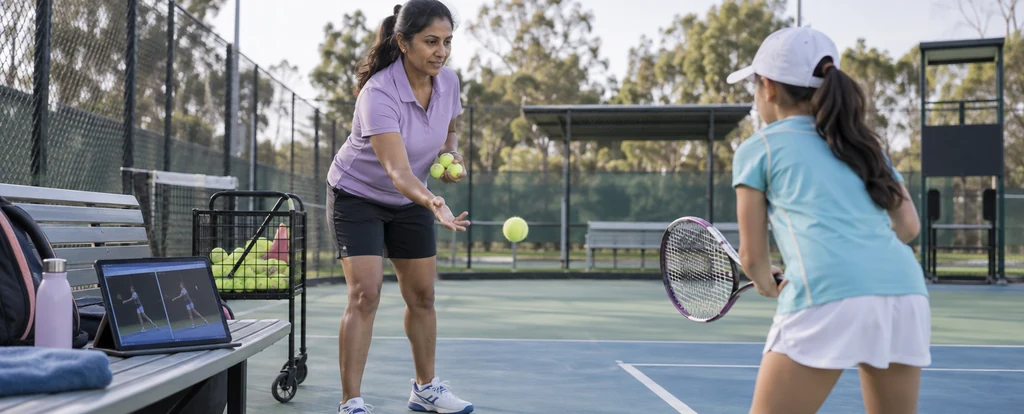
- Feeding balls and breaking a stroke into steps so a player can feel what to change
- Running Hot Shots and junior development programs for primary-aged players
- Planning session progressions and drills that build toward match play
- Managing court bookings, lesson payments and program schedules through booking software
What skills do tennis coachs need?
Employers look for fitness coaching and instruction, teaching and instruction, operations management, backed by Tennis Australia Coach Console fluency and strong written communication.
Specialist skills
- Fitness coaching and instruction
- Teaching and instruction
- Operations management
Software and tools
- Tennis Australia Coach Console
- SwingVision
- Dartfish
- Court Reserve
- PlaySight
General skills
- Written communication
- Customer service
- Empathy and interpersonal care
Is the job growing?
About 3,100 people work as tennis coachs in Australia, and employment is projected to grow 12.1% over the decade to 2035. That's healthy, above-average growth, and the role should stay in solid demand.
How do you become a tennis coach?
Here's the path most tennis coachs take, step by step.
- 1Play regularly and help out at a local club
Most coaches start as players who begin assisting with junior sessions. Clubs and schools often take on casual helpers first, which builds the court time and people skills the paid work depends on.
- 2Complete a Tennis Australia coaching accreditation
Tennis Australia runs an accreditation pathway that starts with a community or junior coaching course and builds through to club professional qualifications. Each level combines online modules with on-court assessment, and higher levels open up squad coaching and competition work.
- 3Get a Working with Children Check and a first aid certificate
Anyone coaching players under 18 needs a working with children clearance, and every state and territory runs its own version under a different name, so check the one that applies where you work. A current first aid certificate is expected by most clubs and schools.
- 4Build paid hours with a club or school program
Running group sessions for a club, school or council program is how most coaches earn their first steady income and learn to manage a class of eight players rather than one.
- 5Specialise or build your own client base
From there, coaches usually choose between high-performance junior squads, adult private lessons, or a mix of both. Private and squad coaching is often set up as your own business, which is where many coaches eventually earn more.
Ready to apply as a tennis coach?
Whether you're working toward becoming a tennis coach or already are one and want a hand with the next step (sharpening your resume for ATS screening, tightening your cover letter, or knowing what you'll actually be asked at interview), here are examples grounded in this specific role, not generic templates.
What jobs can a tennis coach move to?
Moving into Sports Administrator typically comes with the biggest pay rise, worth $95,900 a year more on average.
| Move to | Typical pay change | Overlap | Retraining |
|---|---|---|---|
| Sports Administrator Tennis coaches bring program delivery and athlete knowledge to sports administration, with further study in management. | +$95,900 | 22% | reskill |
| Strength and Conditioning Coach Tennis coaches with sport science study can move into strength and conditioning, though a degree is required.Known move | +$38,000 | 39% | requalify |
| Sports Coach Tennis coaches can broaden into general sports coaching, applying athlete development skills across multiple sports.Known move | +$23,000 | 5% | reskill |
Moves are chosen from Jobs and Skills Australia's Data on Occupation Mobility, which follows income tax records between 2011-12 and 2020-21, together with entry requirements and skill overlap. A known move is one people were seen making in that data. Pay change compares median full-time pay for the two roles.
Who works as a tennis coach?
The typical tennis coach is 28 years old; 78% are men, 20% work full-time, and full-timers average 42 hours a week.
- 28
- Median age
- 22%
- Female share
- 20%
- Full-time
- +2h
- vs all-jobs avg
What's it like being a tennis coach?
The week is shaped by when other people can play, which usually means weekday afternoons, evenings and weekend mornings rather than nine to five. Coaches spend much of the day on their feet, feeding balls and demonstrating, often in heat, wind or cold. It suits someone who likes being active and enjoys the slow, visible progress of a player who could not hit a forehand last month.
What people like
- Watching a stroke click. A player who has been shanking forehands for weeks suddenly finds the contact point, and you were the one feeding the balls. That progress is concrete and shows up within a session or two.
- Different players every hour. A Tuesday might hold a five-year-old's Hot Shots class, a squad of teenagers and a 60-year-old working on their serve, each needing a completely different tone.
- Being outdoors and on your feet. The job is physical and mostly outside, which suits people who would rather not sit at a desk. Fitness is part of the work rather than something squeezed around it.
- Room to build your own thing. Coaches can take on private clients, run holiday clinics or start their own junior program, so the business side can grow with the hours you want to work.
What people find hard
- Income follows the hours you fill. Cancel a day of lessons and that money does not come back later. Coaches who are paid per session feel every gap in the schedule.
- Split shifts and weekends. The busy times are after school and on Saturday mornings, which can mean a break in the middle of the day and very few free weekends during competition season.
- Weather calls the shots. Wet courts, extreme heat and high wind cancel sessions that you cannot easily reschedule, and indoor courts are hard to book at short notice.
- Wear on the body. Hours of feeding balls and standing on hard courts add up in the shoulder, elbow and lower back, which is why many coaches reduce their on-court hours as they get older.
Based on our synthesis of professional-body surveys and public accounts of the role, not first-person verified reviews.
Which industries employ tennis coachs?
Education and Training employs the largest share of tennis coachs, followed by Arts and Recreation Services.
Top employing industries
- 1Education and Training
- 2Arts and Recreation Services
Ranked by employment share; the source doesn't publish an exact percentage per industry.
| Year 12 or below | 51.9% | |
|---|---|---|
| Bachelor degree | 17.4% | |
| Certificate III/IV | 9.5% | |
| Diploma / Advanced Diploma | 8.2% | |
| Postgraduate | 4.2% |
Will AI replace tennis coachs?
Tennis coaching sits at low exposure to AI, because the core of the job is watching a player move and correcting them in the moment, which no tool does on its own. Video and ball-tracking technology such as SwingVision, PlaySight and Dartfish already gives players data on serve speed, spin and ball placement, and coaches use it as another set of eyes. Administrative work, bookings, payments and program scheduling, is where automation has genuinely taken over, and it saves coaches time rather than replaces them.
Share of typical working time by exposure level
- Coaching on court and feeding ballsAdjusting a player's grip or toss in real time depends on seeing the stroke and talking them through it, which stays with the coach.40%low
- Managing bookings, fees and program administrationCourt Reserve and similar systems handle scheduling, payments and reminders, cutting hours of paperwork but still needing a coach to set up programs and deal with families.25%moderate
- Setting session plans and junior program progressionsCoaches draw on drills and lesson templates, and software can suggest progressions, but matching the plan to the player in front of you is the coach's call.20%moderate
- Video and ball-tracking analysis of techniqueSwingVision and PlaySight measure serve speed, spin and placement automatically, so a coach who once filmed and counted now starts from the data and spends the time on what to change.15%high
Common questions about becoming a tennis coach
Straight answers to the questions people ask most.
How much do tennis coaches earn?
Tennis coaches earn $52,000 per year before tax when working full time. The figure moves with how many hours you can fill, what your club or school program pays per session, and whether you run your own coaching business; treat it as a starting reference rather than a rate for your situation.
How do you become a tennis coach?
Start by playing regularly and helping at a club, then complete a Tennis Australia coaching accreditation, beginning with a community or junior course. You will also need a working with children clearance and, in most settings, a current first aid certificate.
Are tennis coaches in demand?
Tennis coaches are currently not in shortage, and employment is projected to grow 12.1% over the decade to 2035 over the decade to 2035. Work is spread across clubs, schools and private lessons, so openings tend to appear as a local club or school program needs someone, rather than through large national hiring rounds.
Will AI replace tennis coaches?
Tennis coaching is lightly exposed to AI, because the job is standing on court reading how a player moves and adjusting them in the moment. Video and ball-tracking tools such as SwingVision and PlaySight already measure serve speed, spin and ball placement, and they work best as extra information for the coach's eye. Administration, bookings and payments, is where automation has changed the most.
Where can tennis coaching lead?
Coaches move into sports administration, where program delivery and athlete knowledge transfer with further study in management, and earn around $95,900 more compared with coaching. Others requalify through sport science study into strength and conditioning, or broaden into general sports coaching, which pays around $23,000 more. Building your own coaching business is also a common direction, and often where earnings grow.
Do you need a degree to be a tennis coach?
No. The most common qualification among people working as tennis coaches is Year 12 or below, held by 52% of them, which reflects a workforce that mostly enters through accreditation and on-court experience. A degree helps if you want to move into high performance sport or sports administration later.
Related roles
- Sports Administrator
- Strength and Conditioning Coach
- Sports Coach
- Surfing Instructor
- Martial Arts Instructor
- Horse Riding Instructor
Not sure this is you? Take the career quiz and get a ranked shortlist of roles that fit how you like to work.