Trolley Collector
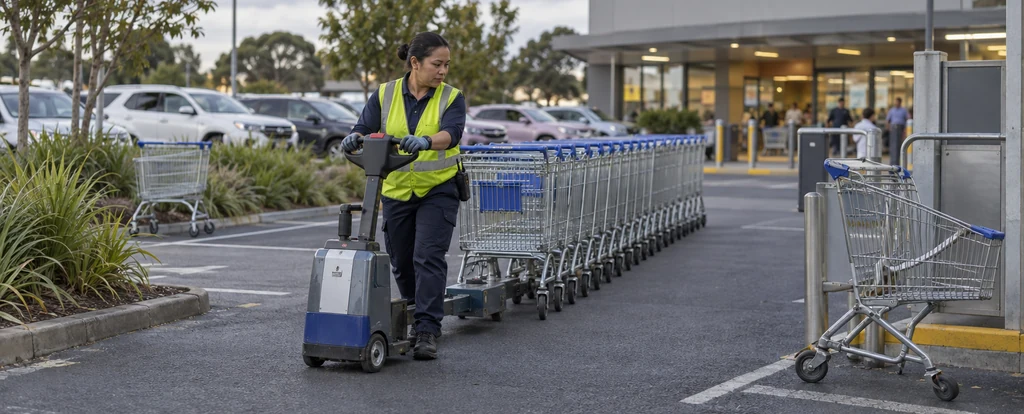
Trolley collectors gather stray shopping trolleys from car parks and return them to the store, keeping bays, walkways and parking spaces clear for customers.
- Median salary*
- $49,400
4.4%vs last year, before tax
- People employed
- 2,800
0.0%vs last year
- Projected growth
- +4.2%
to 2035
- AI exposure*
- Moderate
- automation risk
- Average hours
- 40/wk
matches all-jobs average
- Shortage status*
- Not in shortage
national
Trolley collectors work outdoors in the car parks of supermarkets and shopping centres, rounding up trolleys and pushing or towing them back to the store. The job sits alongside retail assistants and cleaners rather than on the shop floor, and most of a shift is spent walking, pushing and lifting in whatever weather the day brings. Many roles are casual or part-time, with the busiest shifts falling on weekends and public holidays when the car park fills fastest.
How much do trolley collectors earn?
The median full-time salary for a trolley collector is $49,400 per annum, before tax, up $10,400 since 2018.
Casual and part-time work is common in this job, so many people are paid an hourly rate with casual loading plus weekend, evening and public holiday penalty rates on top. Pay also varies with the retail award or enterprise agreement your employer uses and how many of those penalty-rate shifts you take on. Larger shopping centres and contract cleaning or trolley companies often pay a little more than a single supermarket.
What does a trolley collector do day to day?
The list below is what fills most weeks; the exact mix shifts with seniority and whatever stage the current work is at.
- Collecting stray trolleys from bays, kerbs, garden beds and the far corners of the car park
- Pushing or towing rows of trolleys back to the store entrance, using a motorised tug on larger sites
- Checking trolleys for damaged wheels, bent frames and broken child seats, and setting them aside for repair
- Helping customers with a trolley or a heavy load while keeping the traffic lane clear
- Reporting hazards such as broken glass, spills and jammed trolley bay locks to the duty manager
What skills do trolley collectors need?
Employers look for cleaning and grounds maintenance, backed by Motorised trolley tug fluency and strong customer service.
Specialist skills
- Cleaning and grounds maintenance
Software and tools
- Motorised trolley tug
- Two-way radio
- High-visibility vest and gloves
- Trolley bay locking system
General skills
- Customer service
- Physical stamina and dexterity
- Safety and compliance awareness
- Written communication
- Attention to detail
Is the job growing?
About 2,800 people work as trolley collectors in Australia, and employment is projected to grow 4.2% over the decade to 2035. That's modest growth: demand is steady rather than booming.
How do you become a trolley collector?
Here's the path most trolley collectors take, step by step.
- 1Apply directly to stores and centre contractors
There is no course or qualification to complete first. Apply through a supermarket's careers page, a shopping centre's facilities team, or the trolley and cleaning contractors that many centres engage to run the car park.
- 2Expect a short paid induction
Induction covers manual handling, car park traffic and pedestrian safety, hi-vis clothing and radio use. It usually runs a few hours before your first shift and, on larger sites, includes how to operate a motorised trolley tug.
- 3Build a record of reliability and availability
Weekend, evening and public holiday availability is what earns more hours, and casual staff are kept on by turning up on time and finishing a round without being asked.
- 4Move into a related role when you want more pay
The physical stamina and safe manual handling carry across to cleaning, retail and warehousing work. Cleaning is the nearest of those moves in terms of skills, while warehouse storeperson and delivery driving need further training or, for driving, a licence.
Ready to apply as a trolley collector?
Whether you're working toward becoming a trolley collector or already are one and want a hand with the next step (sharpening your resume for ATS screening, tightening your cover letter, or knowing what you'll actually be asked at interview), here are examples grounded in this specific role, not generic templates.
What jobs can a trolley collector move to?
Moving into Cleaner typically comes with the biggest pay rise, worth $20,400 a year more on average.
| Move to | Typical pay change | Overlap | Retraining |
|---|---|---|---|
| Cleaner The trolley collector brings outdoor physical stamina and cleaning routines, with commercial cleaning methods picked up quickly.Known move | +$20,400 | 78% | minimal |
| Warehouse Storeperson The trolley collector brings physical stamina and safe manual handling, with inventory systems and warehouse routines needing further training.Known move | +$19,700 | 17% | reskill |
| Delivery Driver The trolley collector brings outdoor work and vehicle awareness, with licensing and delivery route training required.Known move | +$18,600 | 19% | reskill |
| Retail Assistant The trolley collector brings retail floor awareness and customer service, with sales and till duties needing further training.Known move | +$15,100 | 12% | reskill |
| Shelf Stacker The trolley collector brings manual handling and retail experience, with stock rotation and store systems learned on the job.Known move | +$3,700 | 24% | reskill |
Moves are chosen from Jobs and Skills Australia's Data on Occupation Mobility, which follows income tax records between 2011-12 and 2020-21, together with entry requirements and skill overlap. A known move is one people were seen making in that data. Pay change compares median full-time pay for the two roles.
Who works as a trolley collector?
The typical trolley collector is 26 years old; 95% are men, 19% work full-time, and full-timers average 40 hours a week.
- 26
- Median age
- 5%
- Female share
- 19%
- Full-time
- +0h
- vs all-jobs avg
What's it like being a trolley collector?
The work has a simple rhythm: a round empties the car park, the bays fill again, and you head back out. Peak days stack the rounds on top of each other, so the job rewards people who keep moving without needing to be told what comes next. It suits anyone who would rather be outdoors and on their feet than standing at a till, and who can live with weather, repetition and a heavy row of trolleys.
What people like
- You are outdoors and moving all shift. A full shift is walking, pushing and lifting rather than standing in one spot, and the time passes quickly for people who prefer that kind of work.
- The work has a visible finish. Each round ends with a clear car park and a full trolley bay, which is easier to walk away from than a queue that never stops.
- No qualifications to start. Most employers hire on fitness, reliability and availability, so you can usually start within a week or two of applying and fit shifts around study or another job.
- Team contact without constant customer pressure. Most of the shift is spent with a couple of colleagues on radios, with brief customer contact when someone needs a hand with a trolley or a load.
What people find hard
- The weather shapes the shift. Heat, driving rain, wind and cold are all part of the job, and a wet car park is slippery as well as uncomfortable.
- A full row of trolleys is heavy. Trolleys lock together, and towing forty of them across rough bitumen or up a slope wears on the back, shoulders and wrists.
- Peak days leave no breathing room. Weekends, public holidays and the weeks before Christmas bring the most traffic and the least gap between rounds.
- Limited variety and limited progression. The job is the same round in the same car park, and a step up usually means moving to a different role rather than gaining seniority in this one.
Based on our synthesis of professional-body surveys and public accounts of the role, not first-person verified reviews.
Which industries employ trolley collectors?
Retail Trade employs the largest share of trolley collectors, followed by Administrative and Support Services.
Top employing industries
- 1Retail Trade
- 2Administrative and Support Services
Ranked by employment share; the source doesn't publish an exact percentage per industry.
| Year 12 or below | 65.8% | |
|---|---|---|
| Certificate III/IV | 10.7% | |
| Bachelor degree | 7.1% | |
| Diploma / Advanced Diploma | 6.6% | |
| Postgraduate | 3.8% |
Will AI replace trolley collectors?
This is a moderately exposed job. The collection itself stays with people because it means walking a car park and pushing or towing physical trolleys, while the scheduling, reporting and trolley counting around it is increasingly handled by software. Bay-locking systems and phone apps already record which trolleys are out and where, but someone still has to go and get them.
Share of typical working time by exposure level
- Gathering trolleys from bays and car park edgesThis means walking the length of the car park in all weather and pulling trolleys out of kerbs and garden beds, which no current system does.45%low
- Towing rows of trolleys back to the storeA train of forty locked trolleys on a slope or rough bitumen still needs a person on the end of it, and a motorised tug only helps on the flattest, largest sites.30%low
- Working to a zone roster set by a supervisorRostering and task-allocation software decides which parts of the car park you cover and when, though you still change the order once you see where the trolleys actually are.13%moderate
- Logging trolley counts and faultsPhone apps and wheel-locking bay systems already count and time trolleys, so this part of the job is mostly confirming what the system has recorded.12%high
Moves least exposed to AI
These career moves from trolley collector work are rated low for AI exposure:
- Cleaner
High skill overlap (78%), little retraining to get there, and a low automation-risk profile.
Common questions about becoming a trolley collector
Straight answers to the questions people ask most.
How much do trolley collectors earn?
Full-time trolley collectors earn a median of $49,400 per year before tax. Casual and part-time roles are common, so many people are paid hourly with casual loading and weekend or public holiday penalty rates added, which changes what a week's work comes to.
How do you become a trolley collector?
You apply directly to a supermarket or the contractor that runs the shopping centre car park, since there is no qualification or course to complete first. Employers look for physical fitness, reliability and weekend availability, and a short paid induction covering manual handling and car park safety comes after you are hired.
Are trolley collectors in demand?
Trolley collectors are currently not in shortage, and employment is projected to grow 4.2% over the decade to 2035. New positions depend on stores and shopping centres opening or expanding, so most openings come from staff moving on, and applying directly remains the practical way in.
Will AI replace trolley collectors?
Not the collection itself, because walking a car park and pushing a row of locked trolleys is beyond what automated systems can currently do. What is changing is the organisation around the work, such as rostering software, zone allocation and wheel-locking bay systems that already count and time trolleys automatically.
What can trolley collectors move into?
Cleaning is a recorded move from this job, with 78% skill overlap and minimal retraining, and it pays $20,400 more. Retail assistant and warehouse storeperson are also recorded moves, paying $15,100 more and $19,700 more, though both need training on sales or stock systems.
Do trolley collectors work full time?
Many positions are part-time or casual, with full-time roles more common at larger centres and with contractors covering several sites. Shifts generally follow trading hours, and the most hours are available on weekends, public holidays and in the weeks before Christmas.
Related roles
Not sure this is you? Take the career quiz and get a ranked shortlist of roles that fit how you like to work.